


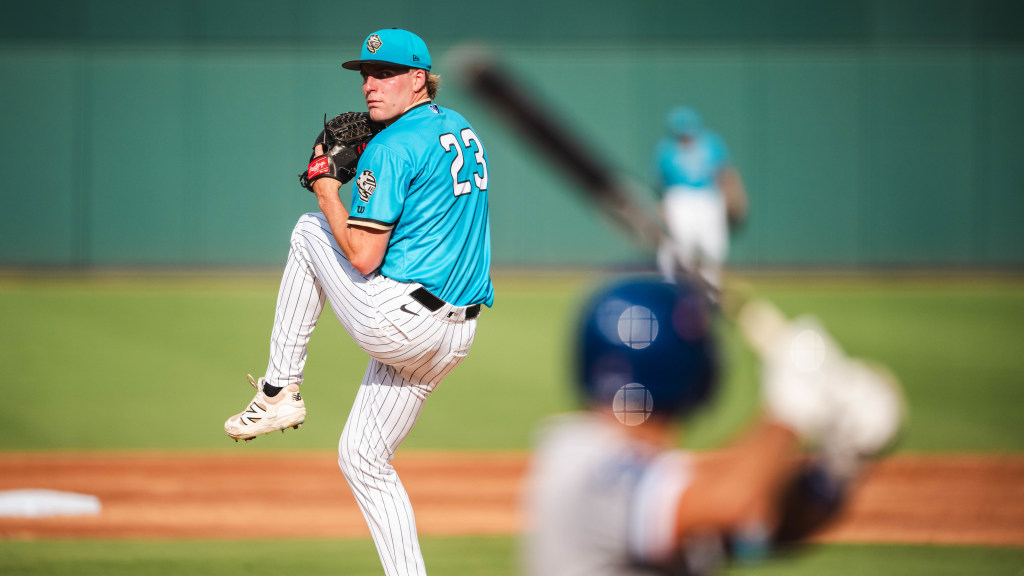
There is a particular period of waiting in Minor League Baseball (MiLB) that does not appear as waiting to those on the outside at all.
It looks like a bullpen session. A lift. A scouting report. A 5-inning start on a Friday night. Waiting 5 days for another start. Another bus ride, another flight, another hotel, another morning walking into the clubhouse at call time with the stability that comes from recognized faces and conversations.
Jonathan Cannon’s journey has been defined by anything but stability.
Charlotte. Chicago. Charlotte, again.
And somewhere along the way, the right-handed pitcher learned it may be harder to be where his feet are when he does not know where they will end up, come the start of the next day.
“I feel like I handle it by not thinking about it at all,” Cannon said. “If you get caught up in that, you'll just kind of put your mind in a blender, and that's all you'll be thinking about. So just kind of out of sight, out of mind.”
Because in baseball, the trajectory of a career can change in a split second, all by a simple phone call.
Someone gets hurt. Someone gets healthy. A roster spot opens. Another closes. A pitcher is recalled, optioned, activated or sent out. The difference between Triple-A and the Major Leagues can be a transaction decided any moment, followed by a booked flight a second later.
Cannon knows both sides of it.
He also knows what it feels like when everything seems to happen so quickly that it becomes hard to wrap your head around.
The Chicago White Sox selected Cannon in the third round of the 2022 Major League Baseball (MLB) Draft out of the University of Georgia (UGA). Less than two years later, he opened the 2024 season with Triple-A Charlotte Knights. He made only two successful starts for the Knights before Chicago selected his contract on April 16.
The next day, at 23-years-old, Cannon stood on a Major League mound for the first time at Guaranteed Rate Field.
“I feel like I got called up pretty quick,” he said. “I was only here [Charlotte] for a couple weeks before I was called up in ‘24, and then kind of just thrown right into the fire.”
His first three Major League starts were imperfect.
Cannon posted a 7.24 Earned Run Average (ERA) across 13 ⅔ innings before Chicago optioned him back to Charlotte on April 28.
The first taste of the Major Leagues had lasted less than two weeks. Then came the waiting.
For more than a month, he was back in Triple-A, pitching every fifth day and trying to become the pitcher Chicago would call again.
On June 7, they did.
The White Sox recalled Cannon from Charlotte, and that night he delivered three scoreless innings against Boston. Five days later in Seattle, Washington, against the Seattle Mariners, he struck out seven over seven innings while allowing only one run.
Then came June 18.
The Houston Astros.
He worked through the first inning without allowing a run. Then the second. Then the third. The Astros kept coming back to the plate, and Cannon kept sending them back to the dugout.
By the time he walked off the mound in the ninth inning, he had thrown 8 ⅔ scoreless frames. Seven hits had been scattered across the night. He had allowed one walk and struck out four.
One out separated him from a complete-game shutout. Instead, he walked away with another core memory.
His first Major League win.
He became the first White Sox rookie since 2011 to pitch at least 8 ⅔ scoreless innings. A record that took 13 years to break, Cannon accomplished while being in the minors three weeks prior.
Those were the starts he remembers as the ones that fundamentally changed his early career.
“I came back up and had three of the better outings of my career,” Cannon said. “And that kind of catapulted me forward and gave me a lot of confidence for the rest of the year in ‘24.”
He stayed in Chicago.
Cannon eventually accumulated 124 ⅓ Major League innings during his rookie season, the most by a White Sox rookie since Carlos Rodón in 2015. He made 21 starts, recorded seven quality starts and allowed three earned runs or fewer in 12 of them.
It was the kind of rookie season that could make the future appear increasingly certain.
Baseball rarely allows certainty to last.
By the beginning of 2025, he was no longer simply aiming to prove he could pitch in the Major Leagues. He had already done that.
After establishing himself as one of Chicago’s most dependable starters behind Garrett Crochet in 2024, Cannon entered the following season firmly in the White Sox rotation conversation. He was even among the candidates considered for the Opening Day start.
That brings a different pressure.
The pressure of arriving becomes the pressure of staying. None of which is ever shown to the public.
“There’s pressure everywhere,” Cannon said. “There’s pressure here [Charlotte], there’s pressure up there. It’s just kind of the nature of the business.”
His objective was not to eliminate it. It was to learn how to perform through it.
“Just kind of learning how to play with it and accept it,” he said, “and be able to perform at your best, no matter what the circumstances are.”
For a while, that is exactly what Cannon did.
He carried a 3.76 ERA before being scratched from his scheduled May 24 start with tightness in his lower back. Three days later, he returned to the mound against the New York Mets at Citi Field, wearing a therapeutic wrap around his back between innings.
The discomfort persisted.
On June 3, Chicago placed Cannon on the 15-day injured list with a lower back strain.
For a starting pitcher accustomed to the rhythm of every fifth day, the rhythm disappeared.
Cannon eventually returned on June 29.
The pitcher who came back, however, could not immediately find the consistency of the one who had left.
Over his first stretch following the injury, the results began to unravel. By August, Chicago decided Cannon needed something different —a mandatory recommendation that every player dreads: a reset.
On August 8, 2025, the White Sox optioned him to Charlotte.
The organization described a pitcher who had once been among its most consistent starters searching for a version of himself that had made a career so promising.
Cannon remembers the feeling more simply, yet more complex. Sometimes, nothing seemed to make sense.
“There were a lot of lessons that I’ll take with me for the rest of my career that I learned at the end of last year and kind of the beginning of this year,” he said. “It just feels like you can’t do anything right, and you’re like, ‘I have no idea what’s going on.’”
When the problems in baseball are measured simply as velocity, release point, walk rate and pitch shape, they can be adjusted. There are others much deeper that cannot.
What happens when the confidence built through 124 Major League innings begins to shake?
And what happens when the destination he wants is somewhere other than where he currently stands?
For Cannon, the answer eventually became less about finding his way back to Chicago and learning the skills to foster in Charlotte.
“I think it was tough at first,” he said. “No one obviously wants to get sent down.”
But disappointment and understanding can coexist.
“You can recognize there are things you need to work on, things you can do to improve.”
That became the true testament of the work.
Not figuring out when the phone would ring. Figuring out who he was while he waited.
The shadow of uncertainty followed Cannon into 2026. He began the season with Charlotte before Chicago recalled him on April 12. Another opportunity. Another round of a Major League clubhouse. Another chance.
It lasted three batters.
Cannon walked all three hitters he faced against the Kansas City Royals before leaving the game with right hip irritation. Two days later, Chicago placed him back on the injured list. An experience he was no stranger to the second time around.
He returned to Charlotte on a rehab assignment April 28.
On May 6, the White Sox activated him from the injured list. And then, on the same day, he was optioned to Charlotte.
Healthy enough to pitch, but not enough to return to Chicago.
There may be few transactions that better capture the strange middle ground of professional baseball.
Cannon could spend his days wondering when another move would come. He could calculate the rotation. Watch Chicago’s injury report. Study the roster. Wonder which performance might be enough. Wonder who might be getting the golden opportunity when Manager Chad Pinder’s phone rings. Wonder who might be sent down to Double-A Birmingham Barons. Wonder whether tomorrow would change everything.
Instead, Cannon learned how quickly those thoughts could consume him.
“You have no idea what moves they’re gonna make or who they’re gonna call up, who they’re gonna send down or DFA or whoever,” Cannon said. “If you get caught up in that, you’ll just kind of put your mind in a blender, and that’s all you’ll be thinking about.”
So he stopped trying to predict it.
“Out of sight, out of mind,” he said.
Then came the phrase that perhaps explains his season better than any transaction ever could.
“Just kind of be where your feet are, and do the best you can wherever you’re at.”
For now, his feet were in Charlotte, at Truist Field.
So Cannon pitched.
On June 5, in Durham, North Carolina, he repeatedly worked himself out of trouble while keeping the Durham Bulls off the scoreboard early.
On July 2, in Memphis, Tennessee, the Knights waited through a two-hour rain delay before finally beginning the game after 10 p.m. Cannon waited too. He threw six scoreless innings, allowing only two hits.
A week later at Truist Field, he worked five innings against the Nashville Sounds, holding them to two runs in a final score of a 9-2 Charlotte victory.
The numbers have not always told a clean story. Through his first 17 appearances for Charlotte in 2026, Cannon carried a 5.31 ERA across 78 innings.
But numbers are only part of what this season has been.
Because the pitcher with endless potential who arrived in Charlotte already knew he could dominate a Major League lineup.
The challenge was learning what to do when he was not.
Cannon titles this chapter of his career as a “self-identifying journey.”
Not a comeback, not a failure, not a detour. But simply a process of identification.
“I feel like I’ve kind of figured out some of the things on the field and off the field, routine-wise,” Cannon said.
The difference is that now, when something goes wrong, there is somewhere for his mind to go. A checkpoint. Then another.
“Like okay, where are the checkpoints?” he said. “What are we looking at to try and improve?”
An imperfect performance no longer has to mean everything went wrong. One piece can be wrong, then worked on to be corrected. He can finish an outing, reflect on the checkpoints and find the piece that slipped.
“Was this good? Was this good? Nope, that’s it,” he said. “Okay, let’s go fix that.”
There is a quiet difference between a player searching for answers and one who knows where to look for them. Cannon spent portions of the previous year feeling as though he could do nothing right. Now he knows what to explore when something goes wrong.
“That’s been very helpful for me this year.”
Maybe that captures the essence of what development looks like for players with Major League experience. Not a straight line upward.
Sometimes it is being good enough to reach Chicago your rookie season, struggling enough to return to Charlotte and becoming experienced enough to understand that neither place completely defines the pitcher on the mound. The game offers another chance in five days.
So Cannon searches for what worked. Then what did not. Then he goes back to work. Because ultimately, tomorrow is always a new day.
There is entirely another reason why the pressure becomes manageable for athletes. They are not standing there alone. Starting pitchers spend an incomprehensible amount of time together.
They throw together. Watch games together. Study many of the same hitters. On the four days when one is not starting, he watches someone else do the job and has profound comprehension of what is at play on and off the mound.
“You see us in the dugout on days we’re not pitching; we’re together,” Cannon said. “We’re throwing together every day.”
They talk about lineups or pitching. And sometimes, they talk about everything that has nothing to do with either.
“We all have lives outside the field,” he said. “There can be a lot of stress coming from off the field that maybe you don’t see.”
It is one of the invisible realities behind a professional athlete's statistics.
The box score knows nothing about what happened before a player arrives at the stadium. It does not know what phone call a player received that morning. It does not know what is happening at home. It does not know whether a pitcher spent the afternoon prior pondering his career.
It simply records what happens after the first pitch is thrown.
The people inside the clubhouse know there is more.
“That’s a good place to kind of talk to guys and figure out what’s going on or something that might be affecting what you’re doing at the field,” Cannon said.
Maybe that is why the clubhouse matters so much to the team.
Because ask Cannon what he remembers about baseball, and eventually the conversation moves away from baseball.
It navigates toward the people he met along the ride.
The first thing that stands out when observing Cannon around the Charlotte clubhouse long enough is his personality—the jokes, conversations, the lightness that comes coupled with his presence.
That might seem like a temperament, but for him, it is also a philosophy.
“At the end of the day, this is supposed to be fun,” Cannon said.
He has talked with players whose careers are already completed. And when they tell stories, the content is not always about ERAs, strikeouts, or the accomplishments on the stats sheet. They remember the clubhouse, the dugout, the jokes shared with the people sitting beside them throughout it all.
“You remember some of the on-field success,” Cannon said, “but you remember the guys in the clubhouse and the conversations in the dugout and before the game most.”
There is practicality behind that optimism. He has decided how he wants to experience baseball, however long it lasts. Baseball provides enough emotional volatility on its own. A great outing can convince a pitcher he has solved everything. A bad one can convince him he has solved nothing. A call-up can make the future appear open. An option can make it feel closed.
“If you ride the emotional roller coaster of this game, it’ll wear on you emotionally,” he said.
So, after the difficult outings, he asks different questions about improvement rather than ruminating on what he wishes he could have done differently.
“It makes the game way easier when you can stay positive throughout.”
Not because every result is positive, but because there has to be something with permanence beyond the result.
Some children come to Truist Field and see Cannon in a Knights uniform.
Others have watched him pitch on television in a White Sox uniform.
To the outside, perhaps the distance between the two looks enormous. Cannon has lived long enough inside professional baseball to know how small it can actually be.
A phone call. A roster move. A plane ticket. One day you are here. The next, somewhere else.
And when baseball becomes consumed by those destinations, it can become easy to forget why anyone started moving toward them in the first place.
Cannon had been thinking about that recently.
“Sometimes you just get so caught up in the game and where you are,” he said, “you kind of forget, like, why? What am I doing here? Why am I doing this?”
The answer takes him farther back than Chicago.
Farther back than Charlotte.
Farther back than Atlanta.
Back to when baseball was nothing more than the game he loved.
“I really feel like I’ve been tremendously blessed with the talent to play this game and play it at the highest level,” Cannon said.
From the beginning, his goal was to discover how far that talent, and his love for the game, could take him.
“To use my talent to the best of my ability and try to become the best that I can be.”
There is no transaction attached to that goal. No level. No timetable. No guarantee. Just distance.
“When I fell in love with the game when I was young,” he said. “I was gonna take it to the end of the road and as far as this game will take me.”
For a child hoping to follow him someday, Cannon’s advice is considerably simpler.
Have fun.
His favorite memories are still stories from fields he played on when he was 12 or 13 years old. Friends he met through sports. Moments they still talk about years later.
“Go out, have fun with it, enjoy it,” Cannon said, “because it’s going to end eventually, and the stories that you’re left with and your experiences are what you’re gonna remember.”
There is no conclusive answer to where the road ends. That is the uncomfortable truth of baseball.
It is also, perhaps, the lesson the last three seasons have been trying to teach him.
In 2024, Charlotte became Chicago, then Chicago became Charlotte, before Charlotte became Chicago again. Somewhere within all of that movement came a Major League breakthrough, 8 ⅔ scoreless innings, 124 ⅓ rookie innings and the confidence that followed.
Then baseball moved again.
A back injury interrupted the following season. Struggles followed. So did Charlotte. By 2026, Cannon had worked his way back to Chicago, only for three batters and a hip injury to send him through another rehab assignment and, eventually, back to the place that became so familiar.
Charlotte again.
There could be another phone call tomorrow. It could come next week or next month. Cannon cannot know, and after three seasons spent moving between levels, clubhouses, injuries and opportunities, he has learned there is little value in trying to.
Because uncertainty has never stopped the game in front of him.
There is still a baseball in his hand. Another start to prepare for. Teammates beside him. Checkpoints to return to. And the same game he once promised himself he would follow for as long as it allowed him.
Where that game takes him next is not his to know yet.
For now, Jonathan Cannon does not know where the road ends. He only knows where his feet are.