


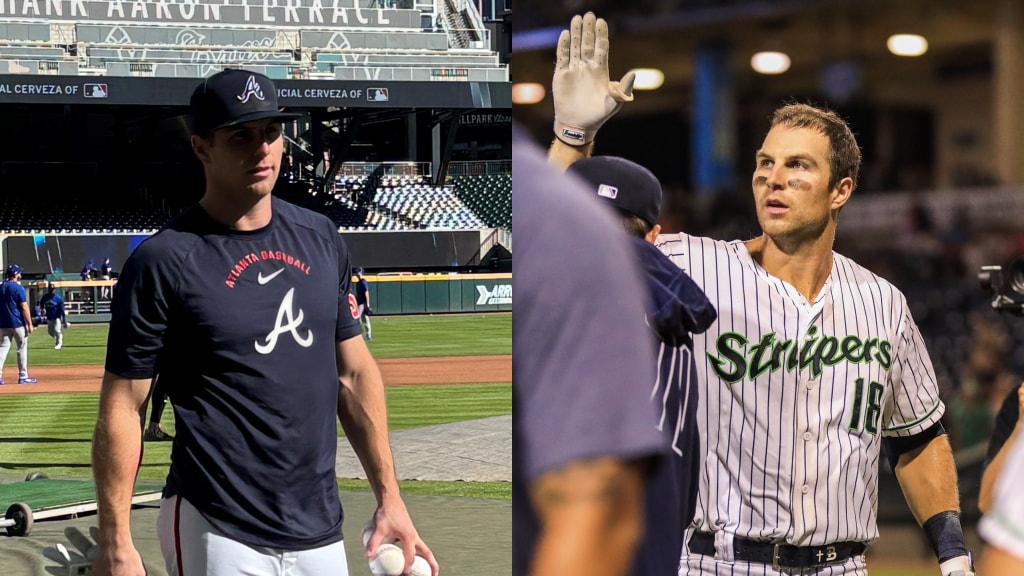
On a day in late September, at the tail end of what had been the biggest season of his life, Brewer Hicklen awaited word of his Postseason fate.
Even though he had finished the year with the Atlanta Braves and been a part of the club’s champagne celebration for a 19th National League East Division title a week earlier, it was not guaranteed that he would make the 26-man roster for the National League Wild Card Series.
He reported to the Truist Park weight room and went through his typical stretching routine until Braves’ bench coach Tony Mansolino summoned him to a fateful meeting.
“Hey man, not so fast, it’s not always good news,” Hicklen recalls Mansolino warning him as they turned the hallway corner to manager Walt Weiss’s office.
“My stomach dropped, my heart went from, you know, zero to 1,000,” said Hicklen. “But I got in there, and Alex (Anthopoulos) and Walt said congratulations on making my first Postseason.”
Hicklen, a 30-year-old outfielder who dreamed of playing for the Braves while growing up in Huntsville, Alabama and had idolized Chipper Jones, Greg Maddux, Andruw Jones and other legends of Braves’ playoff past, was now set to play his own part in Atlanta’s October history.
“To be just a small part of this is pretty special,” said Hicklen. “Obviously my role is small, and I don't know what my role will be on any given day. But I'm ready for whatever, and it's just been cool to really just fit in with the guys.”
It’s an opportunity that he acknowledges seemed unlikely when he was optioned back to Triple-A Gwinnett in late July following an eight-game Major League stint. Though Hicklen had hit an impressive .368 with four doubles, three RBIs, and a 1.057 OPS during his first eight-game stint in a Braves uniform, there was reason to doubt another call-up. Ronald Acuña Jr. was back from a month-long stint on the Injured List, and a trade-deadline deal for veteran Lane Thomas further crowded the Atlanta outfield.
“Any time you get (sent) back down to the Minors, there’s no guarantee that you’re getting back because now you start the clock over and you have to prove yourself once again,” reflected Hicklen. “That’s honestly been my career, and so it’s just something I’m used to and something that doesn’t surprise me at this point.”
Molded by a nine-year professional career that includes over 500 Triple-A games with the Kansas City Royals, Philadelphia Phillies, Milwaukee Brewers, Detroit Tigers, and Braves organizations, Hicklen’s path has been anything but easy.
“I do have a lot of perseverance in my story in the sense that there's been so many times that I've wanted to quit, and so many times that I've just been hit in the face and just, you know, don't see the light at the end of the tunnel,” admitted Hicklen. “But my faith is something that I've always leaned really strong on. It's something that has gotten me to where I am today. I truly believe that. Truly believe that God has opened doors.”
Powered by that steadfast faith, Hicklen went back to work with the Stripers and continued to showcase his combination of power and speed. Over 19 games following the option, Hicklen hit .313 with five doubles, two triples, two homers, nine RBIs, five steals, and a .937 OPS.
As of his final game with Gwinnett on August 21, he was leading the team in batting (.302), homers (18), RBIs (64), slugging percentage (.520), and OPS (.893), while his 30 steals were fourth-most on the club.
Though playing in Triple-A, Hicklen was still on Atlanta’s 40-man roster, one call away from another chance. It came on August 23, as the Braves made him their 27th player for the MLB Little League Classic vs. Detroit.
Hicklen didn’t play in that showcase game in Williamsport, Pennsylvania but was retained a day later as young shortstop Jim Jarvis was optioned back to Gwinnett for more seasoning.
The second call-up wasn’t quite as productive as the first, as Hicklen hit .150 with one double, no RBIs, and a .492 OPS over his final 12 games. But his full body of work between Triple-A and the big leagues was enough to convince Braves’ brass that he was worthy of a coveted spot on the NLWCS roster.
His story of rising from Gwinnett to the MLB Postseason was hardly unique, as 13 different players who spent time in a Stripers uniform in 2026 joined him as active for the best-of-three series vs. Philadelphia. That group included first baseman Rowdy Tellez and outfielders DaShawn Keirsey Jr. and Luke Williams, all of whom had spent more than 100 games with Gwinnett.
“Familiar faces always make it a little bit more sweet,” said Hicklen about being surrounded by Stripers teammates. “Just having guys that you're comfortable with, guys that you've gone through the grind with. But the guys that have been here (with Atlanta) for years, and even just this year, I really can't say how incredible it is and the way that they welcome people and make people feel like they're part of the team, so that's something that's been really eye-opening to me.”
Hicklen made his MLB Postseason debut in Game 1 of the NLWCS vs. the Phillies, entering the game as a defensive replacement in the eighth inning. Though he didn’t see a plate appearance, he did catch both of the fly balls hit his way in Atlanta’s 5-3 come-from-behind victory.
He wouldn’t play again in the series as the Braves ousted the Phillies in a three-game nail-biter but was Atlanta’s choice for a bench spot over Keirsey Jr. and Williams for the NL Division Series vs. the Los Angeles Dodgers.
Through three games of the NLDS, Hicklen has appeared twice, pinch-running for Tellez in Game 2 at Dodger Stadium and going 0-for-1 as a defensive replacement in Game 3 at Truist Park. The reserve role is not one he’s used to, but one he embraces.
“It takes a different level of focus, different mindset,” said Hicklen about adjusting his preparation. “When you're playing every day, you get feedback instantly and figure out things that you may need to work on, or things that they're doing to you to find trends. But when you go out there, you've got one opportunity and one moment to make the most of it.”
Whether utilized for his defensive range, his natural speed on the bases, or his right-handed power, Hicklen knows any action he’ll see is likely to be in more late-game, do-or-die situations. And though it’s only human to feel anxious in those spots, above all else he is grateful for the opportunity to play for his childhood team on a national stage.
“If the nerves aren't there, then it's time for you to be done,” said Hicklen. “So, the nerves are there, but with such limited time in the big leagues, like I felt the same nerves for those games as I do these nerves. But it's all controlled for me. I'm super thankful to be in the position that I'm in and opportunities that God has given me.”