


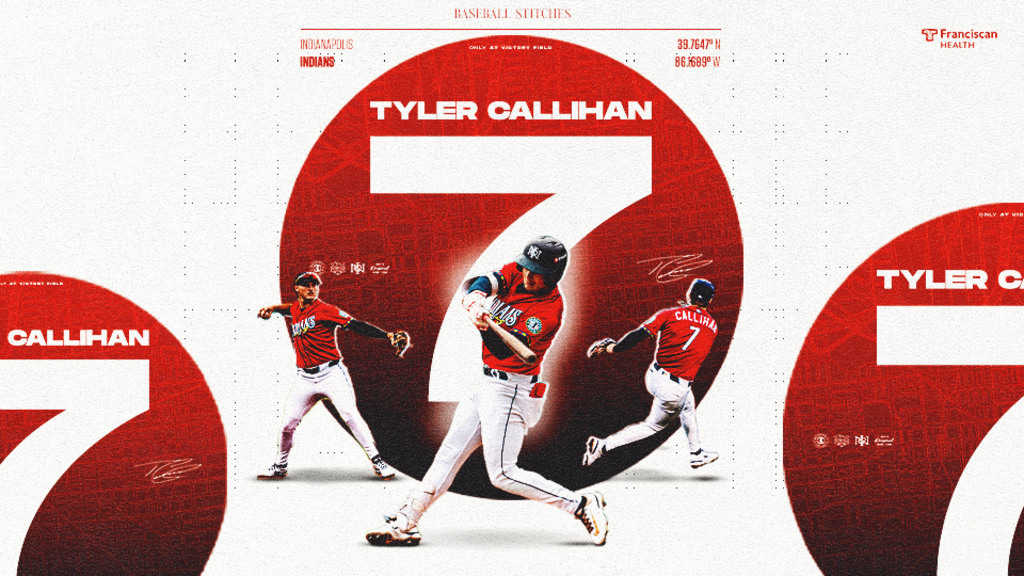
On May 5, 2025, Tyler Callihan hit a wall.
The young Reds prospect took his position in Truist Park’s left field, surrounded by 30,175 fans in his fourth-ever MLB game. In the bottom of the third inning, the Atlanta Braves held a 2-0 lead against the Cincinnati Reds. With two outs and a runner on first base, Braves first baseman Matt Olson unloaded on a sinker in the zone, shooting it toward the left-field line.
The ball was in the air for 3.9 seconds.
Sprinting at full speed toward the left-field foul line, Callihan reached his left arm up and across his body for the falling baseball. He saw the approaching wall; he knew how fast he was going. If he could just snatch the ball and tuck his glove into his body before running out of room, he could prevent Olson from extending the Braves’ lead and end the inning.
Callihan grabbed the ball, but his arm slammed into the wall before he could pull it back. He hit the ground and rolled over.
The noise came first.
“I can still hear the sound of it. Feel it. All of it,” Callihan said. “It sounded like two wooden bats breaking at the same time.”
Lying on his back, Callihan looked up at the sky and a pair of eyes peered back at him. A young fan stared at him over the railing. “I broke my arm,” Callihan blurted out. “I broke my arm.” He sat up, looked down at his arm and immediately rolled over again, his face contorted with pain.
“[My arm] was, like, zigzagged,” Callihan said. “It was up and down. I remember taking my arm off the wall and seeing it. It was bad.”
His mind went numb. It was no longer on the play, or the game. It took 20 excruciating seconds for the athletic trainer to reach Callihan, who had by then gotten up on his feet. He was hunched over and hobbling around, as if to distract himself from his left arm hanging limp at his side, or maybe because he could not quite register what had just happened.
By the time Callihan made it to the dugout and into the tunnel, everything hit him at once. He was ready to pass out, to throw up. He started yelling for medicine; the pain was unbearable at that point. Medical staff carted Callihan over to Atlanta’s clubhouse for X-rays, and the findings revealed that both the ulna and radius bones in his arm had completely split in half. Finally, they gave him shots to numb the pain. The first one didn’t work. By the third or fourth, the pain had subsided; he could only feel the loose bones hitting one another in his arm.
A TV in the corner of the room playing the game caught his eye. Looking closer, the score bug at the bottom of the screen read 4-0.
4-0? There’s no way.
“Did they score? Did they score on that play?” Callihan asked the room. The medical staff looked at him; no one said a word. This is so weird. He caught that ball. It was in his glove. The inning had ended. Right? He slowly began to piece everything together. “Did they give that a home run?” Callihan asked. Everyone shrugged their shoulders. “Yeah, they did,” one of them offered. It was not ruled a catch, but instead an inside-the-park home run. The cherry on top.
As Callihan lay leaning over the side of the medical table, he saw a pair of bright white baseball pants walk up to his eye level. Callihan looked up. And up some more. Hovering above the 24-year-old rookie was 6’6” 10-time All-Star Chris Sale.
“Hey, man,” Sale said. The tall southpaw lifted his throwing arm. “I’ve had a dozen arm surgeries. You’re going to be just fine. I appreciate your effort. Keep grinding, you’re going to be okay.”
More than 400 miles away in Louisville, Ky., Catherine Callihan was certainly not okay. She was 34 weeks pregnant — too pregnant to travel — panicking and helpless as the TV replayed her husband crashing into the left-field wall over and over and over and… over. It felt as if it was replayed 100 times.
“I was watching him run toward the wall, and it was the craziest experience ever because I saw what was going to happen before it happened,” Catherine Callihan recalled. She still gets chills thinking about it. Catherine Callihan yelled at the TV, begging Tyler Callihan to stop sprinting. As soon as he hit the wall, she immediately began sobbing. “I just knew it was really, really bad.”
Catherine Callihan was flooded with emotions. Tyler Callihan had endured far more than his fair share of injuries: Tommy John surgery in 2021, a car accident in 2022 and a broken finger in 2023 amounted to just one full season of professional baseball since he was drafted in 2019. He overcame it all and made it to the big leagues, only to be shut down after his fourth MLB game.
Emergency surgery was scheduled for the next morning. Twelve screws and two metal plates later, two four-inch scars run down both sides of Callihan’s left forearm. The operation did more than secure his bones back together — it brought his family closer than ever. On June 5, 2025, Crew Callihan was born, exactly one month after that horrific crash into the wall in Atlanta. The three of them moved to Arizona together as Tyler Callihan rehabbed at the Reds’ training facility.
“We were able to slow down and live our own little life for a few months. They brought a lot of light into a time that could have been really dark for me,” Tyler Callihan said. “I hung out with little man every day, went to the field for a few hours, and then came back and made dinner and hung out with them, and it was sweet. It was time I wouldn’t trade for the world.”
The experience changed his outlook on everything.
“All the stuff that’s important in life hit me really quickly,” Tyler Callihan said. “Being a husband and being a dad, so much cooler to me than being a baseball player, and it sounds so cliché, but it’s 100 percent the truth.”
The circumstances were devastating, but the silver lining outweighed everything. The Callihans were gifted peace and time — something that is almost impossible to come by in the baseball world, where paternity leave is typically just three days.
“It just brought so much joy into our lives,” Catherine Callihan said. “I will never have that much time with him again [when] having a baby; even [in comparison to] normal jobs, we got months together. It was so much help for me and just being able to be together every day, it was the best time together. We still talk about it.
“We go with the flow, everything works out,” Catherine Callihan continued, reflecting on what she had learned from the past year. “If it doesn’t, we’ll figure it out. As long as us three are together, that’s when we do our best and we’ll figure it out together.”
A few weeks post-surgery, Callihan’s left wrist was still bothering him. An MRI soon revealed that the collision with the left-field wall had also torn the triangular fibrocartilage complex (TFCC), the structure of ligaments and cartilage in his wrist. A second surgery was underway, and Callihan was shut down for the remainder of the season. Frustratingly, many of his challenges were unfamiliar to his surgeons and athletic trainers, who had never seen an injury like this in baseball.
“There were several times throughout, especially the day of [the injury], where I thought there was no chance I was going to step back on a baseball field,” Callihan said.
With a new scar stamped on his left wrist, Callihan was cleared to start taking swings again in October. It wasn’t perfect, as his arm didn’t feel great and he was struggling in the weight room. One day, it was terrible: sharp pains all throughout his arm. Callihan couldn’t swing. In November, the decision was made to remove one of the plates in his left arm — surgery number three. He started swinging, again, in January. This time the wall he hit was not just physical, but mental too.
“It was just constant tweaking, trying to figure out what worked… how I could swing true to myself and just keep my swing,” Callihan said. “That was definitely the hardest part. I found myself not swinging as hard with my top hand to try to avoid it. There was a lot of stuff I had to work through with that.”
And work through it, he did. In his return to baseball, Callihan sent his first hit of 2026 Spring Training almost 400 feet, clearing the right-center field wall. In that moment, Callihan found himself and his confidence.
Alright, I can do this again. I am capable of doing this and competing.
As if three surgeries in seven months weren’t enough curveballs, life threw him another. On March 4, 2026, seven games into Spring Training, Callihan was traded to the Pittsburgh Pirates.
“No part of me thought I was going to be traded,” Callihan said. “I believed in myself, but I didn’t know a lot of other teams believed in me as well. That was very bittersweet [and] super sad to leave everybody that [I’d] built friendships and relationships with. I feel like I’ve grown up with them. I was a teenager, I was young, I just came out of high school.
“[I was traded] at the end of the day, so a lot of people weren’t there,” Callihan continued. “I didn’t get to say bye to a lot of the people that helped me throughout my rehab process, so that upset me. But on the other hand, [the trade] gave me so many opportunities, and I’ve met so many great people over here [with the Pirates] that I’m so thankful for. And I got the opportunity to be with the big league club this year.”
Callihan began the 2026 season here with the Indianapolis Indians. On May 28, Callihan woke up to his phone ringing. It was Indians manager Eric Patterson.
“Hey, what are you doing?” Patterson asked. Well, he was sleeping. “Do you want to go to Pittsburgh? Because you got to go to Pittsburgh,” Patterson said. “It’s not 100 percent sure you’re going to be activated or not, so just see what happens and they’ll keep you updated from there.”
In typical Tyler-Callihan-life-is-crazy fashion, his flight to Pittsburgh was delayed. He made it to PNC Park in the second inning, around 7:00 PM. Kristopher Negrón, the Pirates’ bench coach, found Callihan on the ground in the batting cages, rolling his back out.
“Calli, you’re in the game,” Callihan heard Negrón say. “Like, as soon as you can be in the game.”
Before he knew it, Callihan was standing at third base.
“I remember stepping out and the stadium felt packed,” Callihan said. “Paul Skenes was on the mound, and Dansby Swanson’s up to bat right now, and I’m playing 3rd base, and it was all very quick. It was a crazy day, but I’m very grateful for it.”
In his Pirates debut that night, Callihan launched an RBI double to the center-field wall. As he stood on second base, Callihan took in the Bucs’ faithful and his cheering teammates in the dugout. That first pitch he hit back in his return to the majors was a sinker — the same pitch that was rocketed at him off the bat of Olson 388 days ago.
Callihan returned to Truist Park on June 5 — his son’s first birthday. He started two games at third base, but made sure to walk over to the left-field wall before the series started. The very spot where he once thought his career was over. Callihan punched the wall with a grin on his face.
The scars running down Callihan’s forearm and curving around his wrist are reminders of the person he has become in the last 16 months: a father, a Pirate, a batter with a metal plate in his left arm. Callihan was broken in more ways than one, but stitched up by everyone who supported him along the way. He stands head and shoulders above the helpless Tyler Callihan lying in the dirt of the left-field corner on May 5, 2025, staring up into the sky with a fractured arm and uncertain future. 108 stitches bind a baseball; 12 screws fastened the player and his dream back together. Everyone’s road is different, and Callihan’s journey is a testament to that. And when baseball is no longer there, Catherine and Crew always will be.