

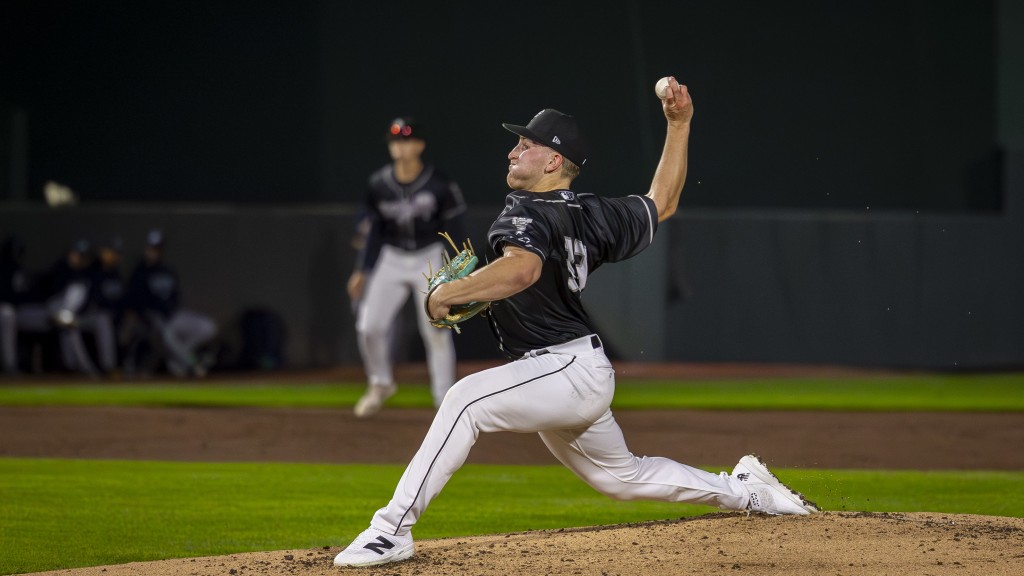
Playing in Major League Baseball wasn’t something Zane Taylor dreamed about. But, he said, the better he's become, the realer that possibility has become.
“I always knew that whatever I did, I wanted to be the best at, and baseball has always been in my life and the most consistent thing in my life that I've done,” Taylor said. “And so my goal is to reach the highest level of that and have the most fun and compete as much as I can.”
That goal goes one step further for Taylor. He doesn’t just want to reach the big leagues, he wants to stay. And he’s well on his way to making it happen.

Baseball Beginnings
After a stellar senior year of college ball, the ultra-competitive pitcher is playing his first full professional season at the High-A level of Minor League Baseball with the Lansing Lugnuts. Through the first half of the season, Taylor has found success, ranking at or near the top of several Midwest League statistical categories: 1st in ERA, 1st in innings, 2nd in WHIP, 4th in batting average allowed.
Taylor didn’t grow up solely playing baseball. Basketball didn’t stick, and an eighth grade not-so-great football memory of being barked at by an opposing player after getting tackled was enough to steer him away from the pigskin.
So baseball it was, and Taylor said he’s been playing the sport since he was five or six, with an early memory coming to mind.
“I definitely played T-ball,” Taylor said. “I knew I went up there, I think swinging left-handed with a right-hander's grip. I think before I knew I was gonna be a PO (pitcher only), God knew I was gonna be a PO, and he didn't need me hitting baseballs 'cause it's not my [strength].”
In his senior year at PRO5 Baseball Academy, Zane Taylor made the switch to pitcher only.
Taylor spent his four years of college etching his name in the record books at the University of North Carolina Wilmington. Taylor is tied for first in games started in program history (57), tied for second in wins (27), tied for seventh in strikeouts (263) 10th in innings pitched (301 2/3) and 12th in opponent batting average (.223).
In his final year as a Seahawk in 2025, Taylor was a standout, finishing the year with the lowest WHIP in Division I (0.76) and the third-lowest ERA (1.98). Taylor also had the best strikeout-to-walk ratio in the country (9.55) and was second in walks allowed per nine innings (1.03).
After college, Taylor was drafted by the Athletics in the fifth round of the 2025 MLB draft with the 141st overall pick.
“Getting that feeling of seeing my name and my face on the TV and seeing my parents just start crying, it was a lot to take in and there's not many words for that,” Taylor said. “It's everything I could dream of now.”
When it comes to the support he’s had along the way, Taylor thinks first of his family and how they’ve been with him while he’s adjusted to his new professional career. He credits Jay Stott, a coach for him at PRO5, and Drew Blakely, the team chaplain at UNCW, who helped him in his faith as a Christian.
“I know that Jesus has done so much for me, dying on the cross and everything else. … There's so much in this world that we could take for granted,” Taylor said. “Just having two legs, two arms to come out here, run, jump, and play baseball. There's not much I can really say, but I have to give a lot of glory to Him for everything and anything I can do.”
Taylor said that his faith helps him handle the failures that come with playing baseball by helping him stay humble and level-headed. Taylor uses Jesus as a “perfect representative” of “everything perfect”.
“So (if) you just keep that thought in your head and aspire to be like Him, the world's endless,” Taylor said. “You can conquer many things.”
Competitive fire
Tied at one run apiece in the second inning with the Cedar Rapids Kernels on June 11, Taylor got the chance to be part of a big play at home plate.
With one out and runners on second and third, Kernels’ Danny De Andrade hit a ground ball that was fielded by Lansing shortstop Ali Camarillo who threw the ball to catcher Carlos Franco to commence a run down of the Cedar Rapids baserunner on the third base line. Franco threw the ball to third baseman Jared Sprague-Lott for the tag and the first out.
But the play didn’t end there, as Sprague-Lott then fired the ball to second baseman Gunner Gouldsmith in an attempt to get the out of De Andrade at second. Instead, Gouldsmith threw the ball to Taylor who was covering home plate, and the pitcher applied the tag of Cedar Rapids’ Yasser Mercedes to end the inning with the double play.
Walking back to the dugout, Taylor flexed and tossed the ball back to the pitcher's mound, clearly excited about the play he had just helped turn.
“ I was surprised I got to be part of that play, and getting the ball and making the play, I couldn't ask for anything more,” Taylor said after the game.
When Taylor is on the mound for the Lugnuts, it’s not uncommon to see the emotion he plays with, whether he’s part of making a play or not. Lansing’s pitching coach Levi Kelly said that the thing that stuck out the most about Taylor when they first met was that Taylor was a “fierce competitor.”
“You can tell he loves to compete, and sometimes he says some words I don't even understand when he's coming off the mound, but it just speaks to how wound up and kind of competitive [he is] and how much he loves the competitive atmosphere,” Kelly said.
Competition is what Taylor said he likes most about playing the sport.
“Being on the mound alone I think is its own game within baseball, and I have the most fun pitching more than anything,” Taylor said. “I do miss playing the outfield and getting to hit every now and then, but pitching you're controlling the whole game, and I think I have the most fun doing that than anything else.”
Taylor said that one of the places his competitiveness comes from is a desire to be the best and to win in whatever he is doing.
“Who wants to be a loser?” Taylor said. “It's not that fun. Things are 10 times better when you're winning.”
But for him, it’s also about staying upbeat.
“Overall, when you're happy, I think you're winning, too,” Taylor said. “So I think just having a smile on your face will set you up for success in the long run.”
Taylor said he hopes his competitiveness has an impact on his teammates.
“ I just hope… that if I'm representing myself well and trying to show that I'm competing and doing everything I can, that the people behind me would also see that and be like, ‘All right, if he's gonna try his hardest for me, then I'm gonna try my hardest for him as well.’”
Taylor is getting his wish. Kelly said that Taylor’s competitiveness is infectious to the rest of the clubhouse and that the starters “feed off of” it.
“You have a guy that's out there giving it his all every time he's out there, from pitch one to pitch 90, and you can see how wound up he gets,” Kelly said. “And the guys play hard behind him because they know how much he cares about the game he's pitching. But not only that game, but how this team's doing throughout the year.”
“ When you see Zane on the mound and you see him getting outs and competing, it just fires you up,” fellow starting pitcher Nathan Dettmer said. “And it fires up the hitters, and they want to go get some runs. And for me as a pitcher… it is kind of a fun competition between us, see who can have a better stat line and see who does better. We push each other, and the greatest teammates I think do that.”

Motivation and Success
Taylor said one of the places he finds his motivation to be the best is from the understanding that his opportunity to pitch is one a lot of other people would love to have. But he also finds motivation from his family.
“My dad's in the military, and so my mom was the one driving me around a lot, taking me to and from practices, this, that, and the other,” Taylor said. “She sacrificed so much of her time and her life for me that if I don't put in work, then I feel like I'm also failing my parents for as much money and time as they've put into me when I was younger.”
Taylor attributed some of his success to getting batters to swing, something he said comes from throwing strikes. His pitching coach also mentioned the strike zone.
“He's not afraid of anyone,” Kelly said. “He attacks the strike zone, and sometimes guys put balls in play, but he just bounces right back and continues to just attack hitters and not fall behind.”
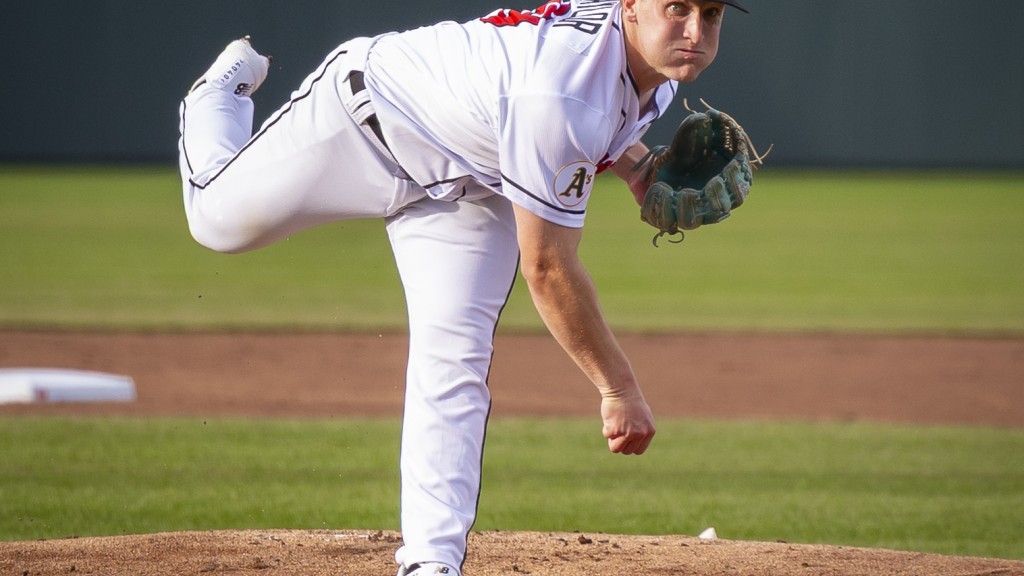
Kelly also said that the way Taylor releases the ball makes his pitches deceptive.
“He's kind of a lower slot guy but has good ride on his fastball, so the fastball plays up,” Kelly said. “I know he's 93, 95 [miles-per-hour], but I think it plays to hitters even a tick harder. And then he also has the breaking balls to go with it.”
Taylor also credited his defense with his success.
“Granted, I do get strikeouts, but I also walk people and let up doubles. And once… people are on base, it's up to the fielders then when the ball's put in play again. So I can only give myself as much credit as I need to give everyone else.”
“He keeps the game so simple in his head, and sometimes it's funny,” Dettmer said. “There's guys out there yelling at themselves and making the game way harder than it needs to be, but Zane just, whatever the sign is, he's gonna throw it.”
Dettmer also said it appears Taylor’s success is coming from his ability to keep the game from speeding up on him.
“It doesn't matter the situation, he is the same guy, and he doesn't let the game speed up on him,” Dettmer said. “He doesn't let it change. Every single pitch that he throws, he has the same intent. He's just trying to throw a strike.”
Even though Kelly said Taylor came into Lansing “pretty polished," the pitching coach said he has seen his starter grow by learning how to expand his pitches when he’s ahead in counts.
“He's had to adjust a little bit, 0-2, 1-2 (counts), just going to pitches a ball, a ball and a half out of the zone instead of just throwing breaking balls down the middle and getting whiff, where he probably did that in college and dominated because his stuff is so elite,” Kelly said.
What’s Next?
Heading into the future, Taylor noted a few things he would like to accomplish on the diamond.
“I would definitely love to cut down the walks,” Taylor said. “That’s my big thing. … A big goal of mine now… is nine innings, so just throw a complete game, regardless of how many runs I let up. But if I could throw a complete game and get the win, that would definitely be a major one up there. And then I don't think I've had double-digit strikeouts, so maybe 10 strikeouts. Other than that, just win, and win as a team.”
Moving forward, Kelly said he thinks there is “a little bit more life” in Taylor’s pitching to still be unlocked, both in terms of velocity and knowledge of how to use the pitches he has.
“He's a strong, super powerful kid, and I think you'll see his stuff tick up even throughout the rest of this year. … I think there's definitely more in there, and the more he starts to learn his stuff and how to use it, I think you'll just see the success continue.”