


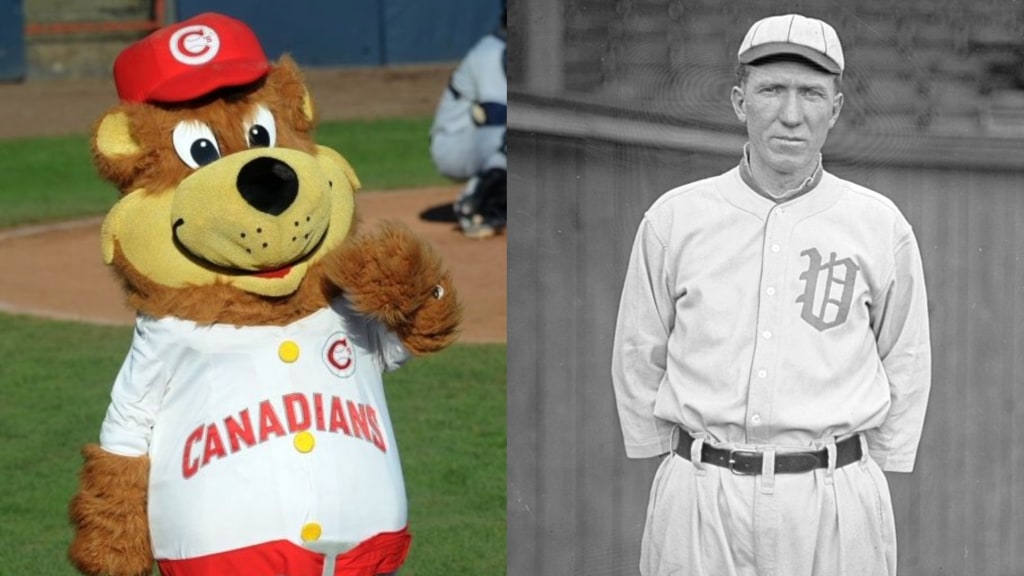
How did the Vancouver Canadians end up with a mascot named in honor of a Spokane Indians player? To find the answer to that, we’ve got to go back to the beginning.
Robert Paul Brown was born on July 5, 1876, in Scranton, PA. The ninth of 10 children in a Roman Catholic family, Brown’s parents were both immigrants from County Mayo, Ireland, an area hit particularly hard by the Great Famine (nearly 90 percent of the population in the area relied on potatoes as a staple food). Brown’s father worked as a laborer in the anthracite coal mines, but declining wages and labor unrest forced the family to leave Scranton shortly after Brown’s first birthday. They moved to Dunmore, PA, and Sherman, IA, before eventually settled in Blencoe, IA.
A talented athlete, Brown spent his childhood playing baseball and racing horses across the Hawkeye State. He spent two years at St. Joseph’s College in Dubuque before enrolling at Notre Dame, where he played both baseball and football. Despite his slender frame (5-foot-9, 150 pounds), he earned a reputation as a fearsome competitor on the gridiron.
Brown left Notre Dame to serve in the Spanish-American War, spending most of his time away from the action as a private in Georgia. After returning to Indiana to finish his schooling, Brown began his professional baseball career with the Helena Senators in 1900, where he was teammates with future Hall of Famer Joe Tinker (of Tinker to Evers to Chance fame). Brown continued to play and manage throughout the Northwest over the next decade, with stops in Pendleton, Aberdeen and Grays Harbor, before landing with the Spokane Indians in 1909.
Brown signed a two-year contract to manage the Indians while also purchasing a stake in the club. In his first season at the helm, he led the team to 100 wins as a player-manager, though he hit just .198 in 344 at-bats. Brown focused solely on managing in 1910, guiding the team to a 96-64 record and the Northwestern League title – the first in franchise history.
Following the 1910 season in Spokane, Brown sold his stake in the Indians and moved to Canada to become the owner and player-manager of the Vancouver Beavers, purchasing a 60 percent stake in the club for the low price of $500. In his first season with the team, the Beavers won 103 games en route to the NWL title, and Vancouver went on to capture back-to-back championships in 1913 and 1914.
Desperate for a new ballpark, Brown spearheaded the construction of Athletic Park, even helping to clear the site himself with a pickaxe and dynamite. His new ballpark helped put Vancouver baseball on the map, attracting big-league stars like Babe Ruth and Lou Gehrig on barnstorming tours. Athletic Park burned to the ground twice over the following decades, in 1927 and 1946, and both times the indefatigable Brown helped rebuild it.
Brown organized the first game played under lights in Canada and later served as president of the Western International League, where he was responsible for hiring Emmett Ashford (who would become MLB’s first Black umpire in 1966). He lobbied to bring a Pacific Coast League franchise to Vancouver, and in 1956 the Oakland Oaks moved to BC and became the Vancouver Mounties. Brown served as the team’s public relations director during their inaugural season while also running a youth baseball program.
In total, Brown spent more than 60 years as a player, manager and owner in the Pacific Northwest, operating teams in Vancouver continuously from 1910 to 1953. He passed away peacefully on June 21, 1962, at the age of 85, leaving behind a legacy as one of the game’s great pioneers, who managed to keep baseball alive in Vancouver through two world wars and the Great Depression.
For his countless contributions to the game, Brown earned the nickname “Mr. Baseball”, and was inducted into the BC Sports Hall of Fame in 1966 and the Canadian Baseball Hall of Fame in 1989. The ultimate recognition for Brown came in 2008, when the Vancouver Canadians honored him with his own mascot: the lovable, furry Bob Brown Bear.
More than a century later, Brown’s story is a reminder that baseball is not just America’s pastime—it’s a global game with the power to connect us across country borders, across generations, and across time.
ABOUT THE SPOKANE INDIANS
The Spokane Indians are the High-A affiliate of the Colorado Rockies located in Spokane Valley, Wash. The Indians have played at Avista Stadium, home to the MultiCare Kids Bench Seat, since 1958 and have been a proud member of the Spokane community since 1903. Parking at all Spokane Indians games is FREE. The Spokane Indians Office and Team Store are open 9:00 a.m. - 5:00 p.m. Monday to Thursday and 9:00 a.m. - 1:00 p.m. on Fridays.