


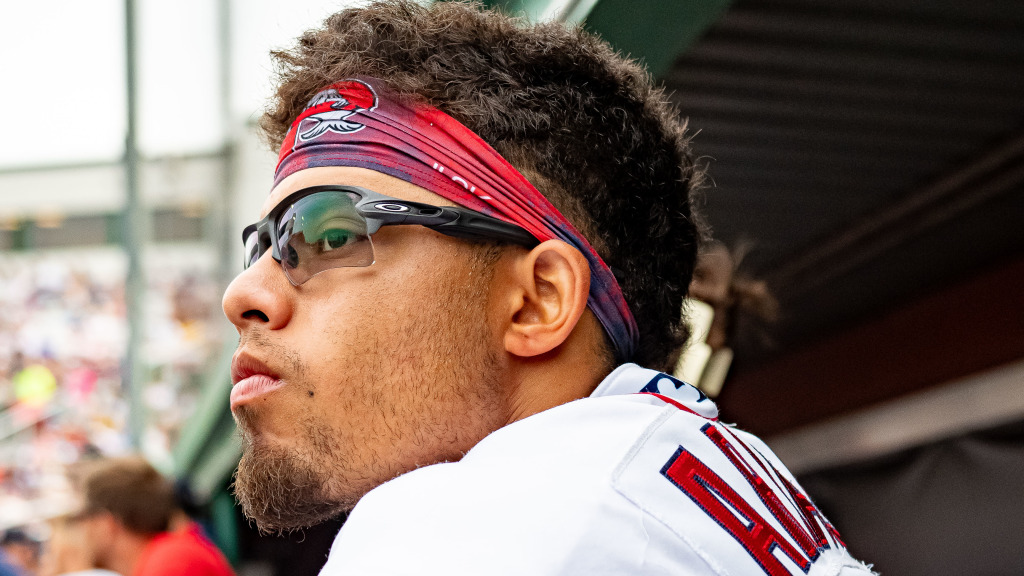
As a young athlete in the minor leagues, it can be easy to get swept away in the maelstrom of pressure, speculation, and exaggeration constantly swirling around high-profile prospects.
Franklin Arias, 20, is the No. 1 prospect in the Boston Red Sox organization, and current shortstop for their Double-A affiliate, the Portland Sea Dogs. He shoulders that pressure with a smile, bolstered by a lifetime of encouragement and support from his family that has prepared him to weather the storm.
Stellar defense has always been a part of Arias’ player profile. Entering 2026, Baseball America also named Arias the best hitter in the Red Sox system, and he has more than lived up to expectations. Arias earned Eastern League Player of the month in April, and currently leads qualified players in the Eastern League in batting average (.329), slugging percentage (.606), and on-base plus slugging percentage (1.020). He has the second best on-base percentage (.414), the fourth most hits (81), and the fifth most home runs (17) in the league.
Arias hails from Charallave, Venezuela, a city of approximately 150,000 residents about an hour south of Venezuela’s capital, Caracas, at the northern tip of South America. In Charallave, baseball is not just a game but a way of life.
“Eso es algo bien, bien, bien grande,” said Arias. “O sea, yo siento que todas las personas que salimos de ese pueblo somos beisboleros. Las personas mayores tú ves que sigan acompañando a sus niños, pero yo siento que es algo que desde pequeño a todos nos gusta el béisbol en ese pueblo.”
“It’s a really, really big deal,” said Arias. “I mean, I feel like everyone who comes from that town is a baseball person. You see older folks still playing with their kids, but I feel like loving baseball is something that starts when we’re all just little kids in that town.”
For Arias, it was a foregone conclusion that he would follow in the footsteps of his father, Franklin, and his older brother, also named Franklin, 29, who both played baseball. Arias’ younger brother, 9, is the fourth Franklin in the family, so their mother, Rosalba, calls them by their middle names to differentiate. Arias goes by Alexander, his older brother is called Alberto, and his younger brother, Andrés.
The apartment Arias grew up in overlooked a baseball stadium next door, proximity that helped spark a lifetime of passion for the sport. By the time he was three years old, he was already learning how to throw and catch, usually with his older brother, anywhere from the field to the streets. His brother was both a role model and an inspiration for Franklin, who wanted nothing more than to follow in his footsteps.
But if you ask Franklin how his family impacted his life in baseball, it’s not the physical experiences they shared that come to mind. Instead, it is the values his parents imparted on him from an early age.
“Yo siento que uno muy grande que ellos me han dicho bastante, es ser humilde siempre,” said Arias. “No importa lo que tengas, siempre recordarte donde tú sales y ser agradecido con todo lo que tú logres en la vida.”
“I feel like a really big one—something they’ve told me a lot—is to always be humble,” said Arias. “No matter what you have, always remember where you come from and be grateful for everything you achieve in life.”
Arias’ humility augments his everpresent positive attitude, also instilled by his parents. His mother Rosalba’s constant message since his childhood is that his number one objective when he steps on the field should be to have fun and enjoy the moment. Along the same vein, his father, the elder Franklin, imparted crucial wisdom about the power of positivity in staying steady through the unpredictable journey of baseball.
“Él siempre me ha dicho, que el béisbol no es fácil, que siempre tiene altas y bajas,” said Arias. “Pero siempre me ha dicho que me mantenga firme en los momentos malos, porque no son momentos que que es para siempre. Son los que uno tiene que tener buena cara y seguir pensando positivo, que las cosas buenas siempre van a salir.”
“He’s always told me that baseball isn’t easy—that there are always ups and downs,” said Arias. “But he’s always told me to stay strong during the tough times, because they don’t last forever. Those are the moments when you have to keep your head up, and keep thinking positively, knowing that good things will always come.”
Rosalba and Franklin have always been realists, who helped Arias understand from a young age that no one is perfect. It is not his mistakes that define him, but how he acknowledges and responds to those mistakes, taking action to prevent future missteps.
“Yo siento que eso ya viene desde pequeño, cuando yo hacía algo malo,” said Arias. “Es algo que mi papá me decía que eso ya siempre iba a pasar, tanto en el campo como fuera en la vida. Entonces no tenía que tratar de como que salir adelante, ver qué hiciste mal, y tratando de hacer lo mejor para la próxima.”
“I feel like that goes back to when I was little—whenever I did something wrong,” Arias said. “It’s something my dad used to tell me: that it was always going to happen, both on the field and in life. So, I had to try to move forward, look at what I did wrong, and try to do my best the next time.”
Nearly every day, Arias speaks to his parents over the phone. Their temperament has always been the same. They ask him how he’s feeling, physically and mentally. If things are not going Arias’ way in a game, he thinks of his mother to calm his mind. He thinks of Venezuela, and playing with his brothers.
When Arias was navigating the world of international free agency at just 17 years old, he was searching for a future home that shared the same values, who would help remind him how lucky he is to play a kids game as a professional. He found that home in the Boston Red Sox.
“Cuando yo estaba con cuando traté y todos esos momentos con las personas allá de Boston,” said Arias*. “Este era algo como que, muy lindo. Y yo sentía eso y mi familia también. Yo lo veía cuando ellos hablaban con las personas de Boston. Serán momentos muy lindos.”*
“Back when I was interacting with the people from Boston—all those moments—it was really special,” said Arias. “I felt it, and my family did too. I could see it when they spoke with the people from Boston; Those were truly beautiful moments.”
As Arias has moved through the Red Sox system, that feeling of closeness and community has only grown, especially with five fellow Venezuelans in the Sea Dogs clubhouse, making reminders of home constant. Arias feels an immense amount of gratitude for the effort the Red Sox have put into his development, and said those initial feelings from the scouting process in Venezuela have not changed.
“Me sentía como una familia el primer momento y ahorita lo sigo,” said Arias. “Más este las intenciones, todo lo que han hecho por mí de la preparación física, el apoyo, bateando, corriendo, haciendo todo. Siento que me han ayudado bastante.”
“I felt like part of the family from the very first moment, and I still do,” said Arias. “Especially considering their intentions and everything they’ve done for me—physical conditioning, support, hitting, running, doing it all. I feel they’ve really helped me a lot.”
Arias was recently selected to participate in the 2026 All-Star Futures Game, just the latest in a string of accomplishments for the shortstop. His parents tell him often how proud they are of not just those accomplishments but how he carries himself through them. Rosalba and Franklin have not yet been able to travel to the United States to watch their son play in person, but Arias hopes it will happen soon.
Siento que eso con el favor de Dios no va a ser un futuro tan lejano, said Arias. “Yo siento que puede que pase en algún momento. No, no tan lejos.”
"I feel that, God willing, that won't be such a distant future," said Arias. "I feel like it could happen at some point. No, not too far off."
For now, his Red Sox family will continue to fill the void, and propel Arias towards that future.