

It is bold for someone to sue the Commissioner of Major League Baseball, let alone win.
Award-winning journalist Melissa Ludtke did just that in 1977—and, she won.
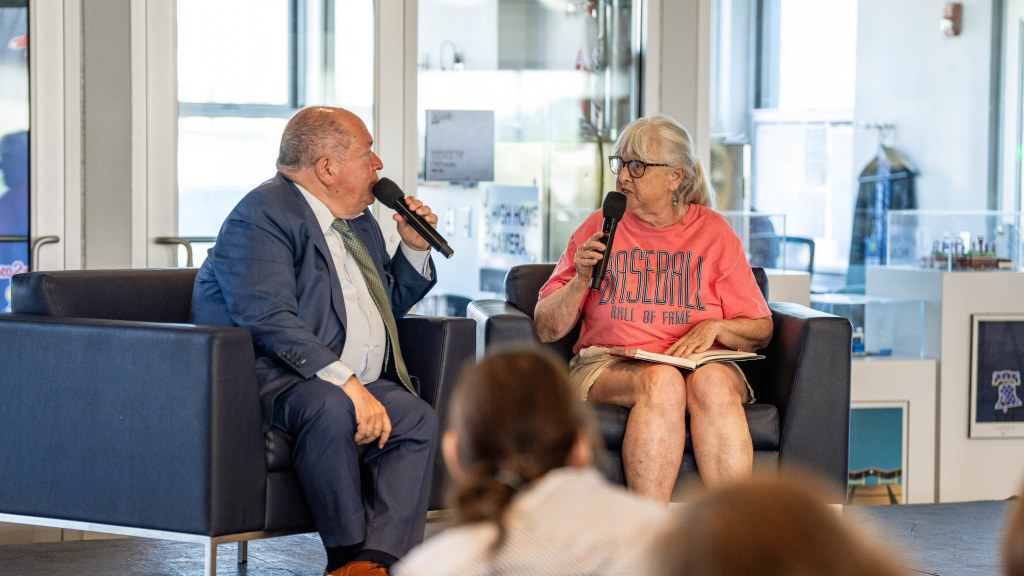
On Saturday, July 25, 2026, Ludtke headlined the day’s edition of the Larry Lucchino Writers Series at Polar Park. In a conversation moderated by WooSox President Dr. Charles Steinberg, Ludtke shared passages from her 2024 book, “Locker Room Talk,” which traces her 1977 lawsuit.
As a female writer for Sports Illustrated covering baseball, Ludtke was not allowed into clubhouses before or after games because team officials feared her seeing naked players—or so they claimed. To make a change, Ludtke began with a gradualist approach, first speaking privately with players, managers, and club officials in hopes of gaining equal access.
Enter Mickey Morabito, who in 1976 and ’77 was a rookie member of the New York Yankees’ PR team. Ludtke built a rapport with Morabito, and he would frequently direct Ludtke through a side corridor of the clubhouse to Yankees Manager Billy Martin’s office.
“I was the gradualist, because when you are the first, and you are making a change, you make that change in a way that is going to work not only for you, but the people who are going to face the ramifications of that change,” Ludtke said. “That is every single one of those players in the clubhouse who’ve never experienced this.”
Ludtke followed this pattern every time she visited Yankee Stadium for the rest of the 1977 season. While sitting on the couch across from Martin’s desk, Ludtke would hear questions from male reporters, giving her a clearer perspective of what players were saying in the Yankees clubhouse. At the same time, the male reporters got used to Ludtke asking questions in Martin’s office, a gradual step in making a change.
For the two final 1977 regular season games, Morabito, to Ludtke’s surprise, left her clubhouse passes to interview players. Ludtke made the conscious choice to only go in the clubhouse before the games, when players would be in their uniforms.
Fast forward to the 1977 World Series between the Yankees and Dodgers, with the first game at Yankee Stadium. The Yankees were fine with Ludtke’s presence in the clubhouse, and she sought to obtain similar approval from the Dodgers. Ludtke first spoke with Manager Tommy Lasorda, who passed her off to Tommy John, the Dodgers’ player rep. John took her request to the Dodger players, and a majority of them voted to allow Ludtke into the Dodgers clubhouse.
And, so, it was settled. Or, so Ludtke thought.
Later that night, due to Ludtke’s presence in the Dodgers clubhouse being moved up the baseball PR chain, Bob Wirz, who worked directly for then-Commissioner Bowie Kuhn, caught wind. Wirz took the issue directly to Kuhn, who said, according to Ludtke, “Bob, you know what to do.”
At that moment, Commissioner Kuhn unilaterally revoked Ludtke’s access to the clubhouse for the rest of the 1977 World Series. It turns out that in 1975, Kuhn wrote a policy that stated, “Baseball will never give women equal access,” according to Ludtke. That policy remained in a drawer in Kuhn’s office—until Kuhn directed Wirz to bar Ludtke from the clubhouses two years later. To add salt to the wound, Wirz forced Morabito to deliver the news to Ludtke.
“I understood very well [the] notion that you couldn’t go up against the authority of baseball and the authority of [Commissioner] Bowie Kuhn, who actually had the authority of a king,” Ludtke said. “He was given it as a commissioner, because when they brought in the first commissioner, Kennesaw Mountain Landis, he refused to come in unless they gave him absolute authority. No team owner could go against him, and he worked in what was called the ‘best interests of baseball.’”
That was the tide Ludtke was going up against. Ludtke chose to go up against baseball.
By November 1977, after Ludtke’s male Sports Illustrated colleagues failed to negotiate “separate accommodations” for her, Peter Carry, her editor, and Gary Johnson, the magazine’s lawyer, asked, “Would you be willing to put your name on a lawsuit if we take it to federal court and be the plaintiff in the case?”
Lutdke agreed, but she had no idea how she would be treated in the court of public opinion.
“I only saw it through the prism of wanting to do my job,” Ludtke said. “That was my tunnel vision.”
On December 29, 1977, Ludtke v. Kuhn was officially filed in the Southern District of New York. That day, Ludtke’s life changed forever.
“The Associated Press sent out a story … I was suddenly a woman who only wanted to see men naked. It was all framed the way the commissioner wanted it framed,” Ludtke said.
The 1978 season opened with Ludtke being branded as a villain at a time when baseball’s popularity was nationally soaring. On April 14, 1978, Ludtke’s lawyer, F.A.O. “Fritz” Schwarz Jr., of the famed toy store family, argued the case in front of Judge Constance Baker Motley.
Motley was the first Black woman in U.S. history appointed to the federal bench, and prosecuted Jim Crow Laws in the South based on the Equal Protection Clause of the 14th Amendment.
Schwarz bases his argument in Ludtke v. Kuhn on the 1961 Burton v. Wilmington Parking Authority case, which argued that businesses considered part of a state-owned facility could not discriminate against protected groups under the 14th Amendment. Such discrimination, according to the ruling, would be described as state action, due to the business being located inside a public building. Burton was argued in front of the U.S. Supreme Court by then-lawyer Constance Baker Motley.
Schwarz argued in Ludtke v. Kuhn that the New York Yankees were a private business operating in a state-owned facility, Yankee Stadium, and that discriminating against Ludtke went against the Equal Protection Clause, like in the Burton case.
When the two-and-a-half-hour hearing ended, Motley ordered the parties in the case to privately negotiate rather than her issuing a public ruling. The parties could not come to a mutual solution. So, on September 27, 1978, Judge Motley rendered her opinion that Ludtke’s ban from the locker rooms violated the 14th Amendment’s Equal Protection and Due Process Clauses, and that Yankee Stadium was required to give Ludtke equal access.
The night of the ruling, Ludtke stayed home.
“The real reason that I didn't go to the game … [was] because I knew it would be a screwed-up media circus where every single TV station and radio station would send a woman who’d never been to a baseball game and would never go to another baseball game,” Ludtke said. “I wanted no part of that. That wasn’t my story. That was their story.”
The 1978 World Series came around—once again Yankees vs. Dodgers. This time, Ludtke had equal access to clubhouses due to the court ruling in her favor.
An official MLB policy change, however, would not come until 1985 when Kuhn’s successor, Commissioner Peter Ueberroth, wrote such a memo in one of his first acts as commissioner.
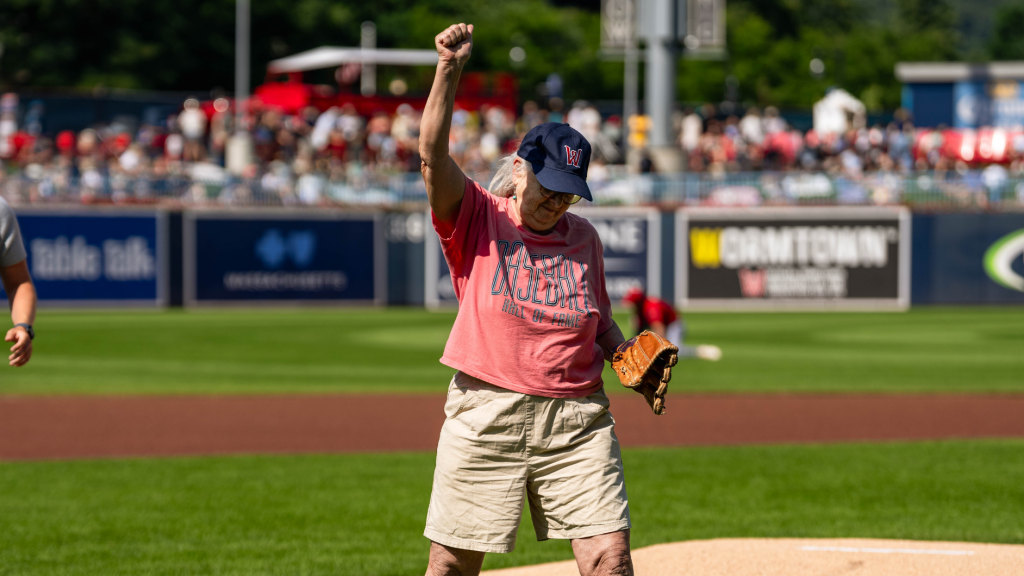
Before Saturday’s 4:05 p.m. WooSox game against the Jacksonville Jumbo Shrimp, Ludtke delivered a Ceremonial First Pitch—a strike down the middle.
“This was never about nakedness. This was about exclusion,” Ludtke said.