

The Dodgers are back in the World Series for the second straight year and the third time in six years. The Blue Jays haven’t been here since finishing off back-to-back titles in 1993.
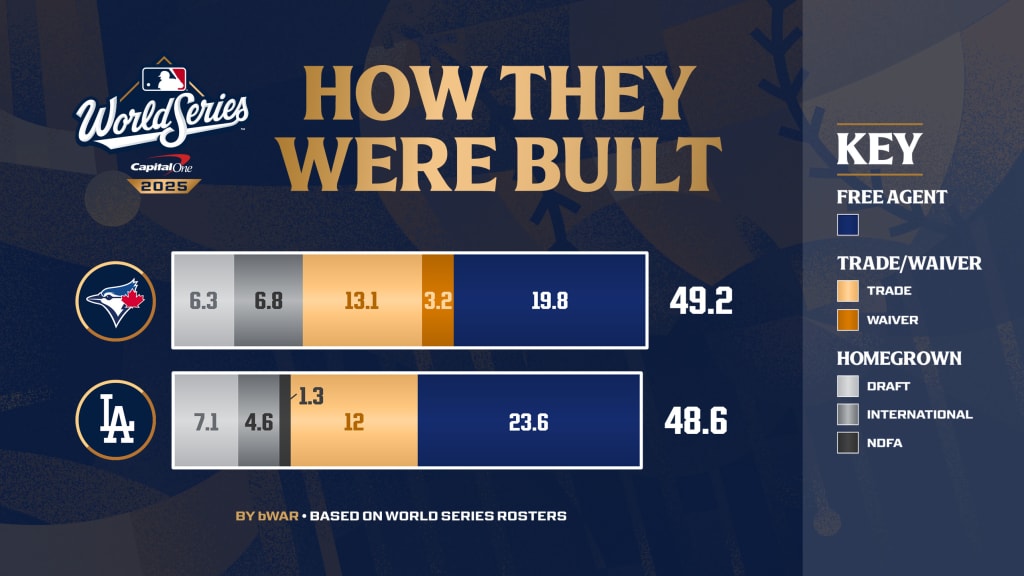
When the postseason began, the Blue Jays were tied for fourth among the 12 playoff teams based on Wins Above Replacement. The Dodgers were seventh, based on Division Series rosters. Now, based on World Series rosters, the two teams are very evenly matched, with Toronto holding a slim 49.2 to 48.6 bWAR lead over Los Angeles.
While every organization constructs its roster differently, these two squads have a lot of similarities, from smaller amounts of homegrown players (and production from those players) to almost equally relying on free agent signings and trade acquisitions to help them get to this stage.
Let’s dig in to what each team has done in each area of player procurement.
Draft
Dodgers: 7.1 WAR
Blue Jays: 6.3 WAR
With Bo Bichette likely returning to the Jays’ lineup, that gives them a 5-4 edge in the homegrown draftee category. Bichette's 3.4 WAR from the regular season -- which leads all of Toronto’s drafted guys -- also gives them the lead in overall homegrown WAR. Trey Yesavage, the team’s first-round pick from 2024, has just six Major League starts on his resume, but three of them have come in the playoffs, including a crucial Game 6 win in the ALCS.
But the Dodgers’ four draftees were a touch more productive in 2025, with 7.1 WAR vs. 6.3 for the Blue Jays. The bulk of that comes from Will Smith, who was the No. 32 overall pick in the 2016 Draft and accumulated 4.5 WAR in '25. And, of course, there is lifetime Dodger Clayton Kershaw, who is one of two players drafted back in 2006 in the World Series (Max Scherzer is the other.)
International Amateurs
Blue Jays: 6.8 WAR
Dodgers: 4.6 WAR
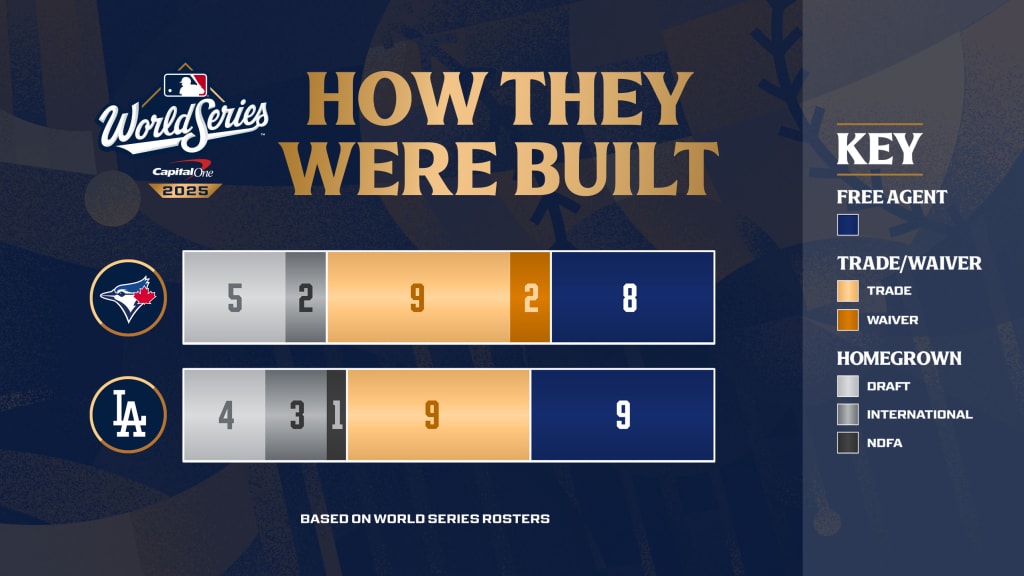
Neither team has been impacted from a volume perspective much from the international market. The Blue Jays have just two international signees, but one of them is about as big as it gets: Vladimir Guerrero Jr., who signed for $3.9 million back in July of 2015. He accounts for 4.5 of the team’s 6.8 WAR in this category, with Alejandro Kirk providing the other 2.3.
The Dodgers’ also only have two entrants here. Andy Pages, who signed for $300,000 in October 2017, accrued 3.8 WAR during the season. Roki Sasaki created all kinds of buzz last offseason and the Dodgers scrounged up as much international bonus pool money as possible to sign the Japanese right-hander for $6.5 million. His rookie season was up-and-down and included a stint on the 60-day injured list. But he’s become the team’s closer this postseason, allowing just one run over seven appearances to solidify what had been a shaky bullpen.
Free Agents
Dodgers: 23.6 WAR
Blue Jays: 19.8 WAR
This is where things heat up. The Dodgers hold the advantage, both in numbers of players (9 vs. 8) and in WAR. The leader is someone fans might not be all that familiar with … Shohei Ohtani. He, of course, joined the Dodgers ahead of the 2024 season with a 10-year, $700 million contract ($680 million deferred). But he isn’t alone. His 7.7 WAR was joined by that of Yoshinobu Yamamoto (5.0), who signed a $325 million contract in December 2023; Max Muncy (3.6) joined the Dodgers back in 2017; and Freddie Freeman (3.5), a key signing in March 2022. Blake Snell wasn’t as productive, WAR-wise, during the regular season, but the lefty who signed a five-year, $182 million contract last November has been huge in the postseason.
Not be outdone, the Blue Jays have gotten huge contributions from free agent signings like George Springer, who signed a six-year, $151 million contract with the team ahead of the 2021 season. Springer led the team in WAR this season (4.8), and hit the biggest home run in franchise history since Joe Carter. It might surprise some to find out that Ernie Clement, who signed with Toronto in March of 2023 after the A’s released him, is next with 4.3 WAR. Kevin Gausman is the top arm acquired on this market (3.8).
Trades
Blue Jays: 13.1 WAR
Dodgers: 12 WAR
Both teams used the trade market at almost exactly the same rate, with both having nine such players. The Blue Jays had a slight advantage during the regular season: 13.1 WAR for Toronto, 12 for Los Angeles.
Mookie Betts is the headliner, coming from the Red Sox to the Dodgers back in February 2020. On the mound, Tyler Glasnow was acquired from the Rays in December 2023 and has bounced back from shoulder inflammation that landed him on the 60-day IL to be a part of LA’s lights-out rotation this postseason.
The Blue Jays’ trade acquisition production was a bit more spread out, with Miles Straw (2.9 WAR), who came from the Guardians in January of this year, and Daulton Varsho (2.8), who arrived from the D-backs in December of 2022, leading the way.