

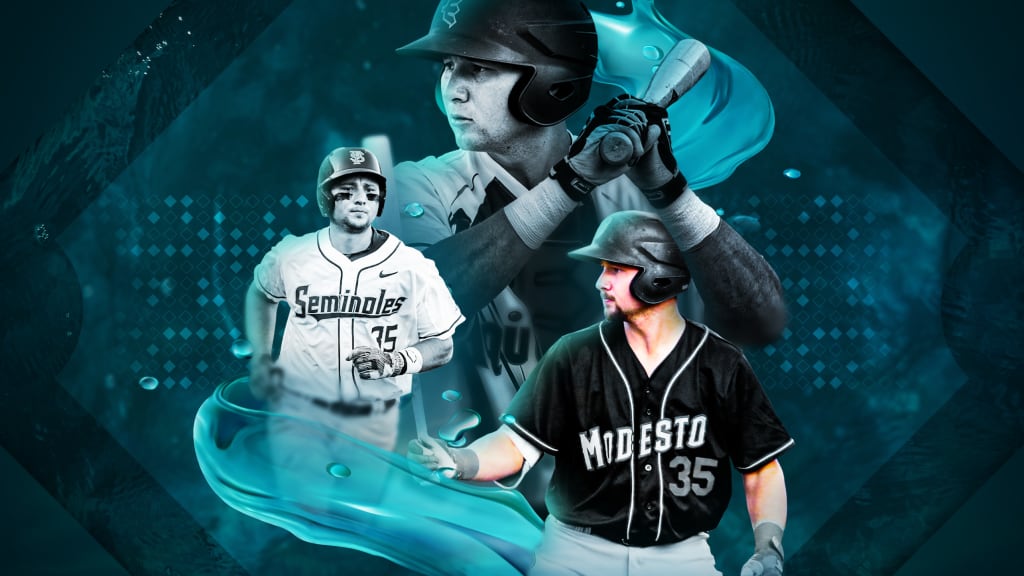
How does a player who wins a Platinum Glove in 2024 and encores by becoming the first catcher to launch 60 homers in a season last 90 picks in the 2018 Draft? There were a lot of questions about Cal Raleigh coming out of Florida State. Fortunately for the Mariners, they had an area scout who could answer them.
Raleigh's raw power from both sides of the plate stood out, though he hadn't performed well with wood bats in the Cape Cod League two summers earlier and struggled at the plate as a Florida State sophomore. He bounced back as a junior, slashing .326/.447/.583 with 13 homers, but still received mixed reviews for his defense. MLB Pipeline ranked him as just the 150th-best prospect available and there were some signability concerns as well.
While area scouts don't decide whom their teams select, they play a huge role in the process. Rob Mummau, who began evaluating players for the Mariners after his playing career ended in 2001, was invaluable to his club in 2018.
Stetson right-hander Logan Gilbert entered the year as a consensus top-five-overall pick following a big summer in the Cape Cod League, but his fastball velocity dipped that spring while he dealt with an undiagnosed case of mononucleosis. Mummau's work assuaged those concerns and Seattle selected Gilbert at No. 14 in the first round, landing the second-best pitcher in the entire Draft behind Tigers ninth-round steal Tarik Skubal.
The Mariners were using data more than ever in the 2018 Draft, still relying on traditional scouting but for the first time also employing a model that considered a variety of quantifiable factors. And that model didn't like Raleigh. Then-vice president of scouting Tom Allison remembers that it ranked him 379th in the Draft pool.
But Mummau knew that Raleigh had played hurt for most of his sophomore season, batting .227/.330/.398 but not missing any time while dealing with a left thumb injury after he got jammed on a pitch early in the year. Seattle's Draft was a collaborative effort and Mummau's explanation made everyone, including team director of baseball analytics Jesse Smith and his group, more comfortable.
The first day of the '18 Draft ended after two rounds, and the Mariners planned on taking Raleigh in the middle of the third round. There was talk that the Braves, who didn't have a third-round pick, had promised Raleigh a seven-figure bonus in the fourth round, and Seattle couldn't afford that much with their bonus pool. The Mariners trusted Mummau's rapport with players and his gut feeling that Raleigh wanted to play pro ball and would sign in the end.
"The key was that Rob was able to fill in the blanks, just like he did with Logan Gilbert in the first round," said Allison, who's now a special assistant with the Dodgers. "Cal's sophomore year was terrible, but Rob was really tight with the coaches at Florida State and knew he was banged up even if it wasn't obvious. Rob was able to fill in the blanks and that's what great scouts do."
Scott Hunter, who has been the Mariners' scouting director since September 2016, remembers that his team had strong reports on Raleigh but none stronger than Mummau's.
"Our first scouting report was from the fall of 2017 and Rob put a big grade on his raw power, a 70 [on the 20-80 scale where 50 connotes big league average], coming off a terrible sophomore year. Everyone else thought it was a 55 or 60," said Hunter, who played with Raleigh's uncle, Matt, at Double-A. "He had raw power but the defensive grades were all 45-50ish. The arm grades were all 45-50ish and the pure hit tool, some guys were light. But Rob graded him higher and Cal has turned a lot of those grades into 60s and 70s."
Mummau played collegiately at James Madison a few years before Raleigh's father, Todd, was an assistant coach there, and he got to know the family well. He first watched Cal during fall practice in 2015 before his freshman year and saw a lot to like.
"Cal stood out pretty quickly," Mummau said. "He was a big, physical guy who hit the ball hard from both sides of the plate. He has really good hands, a strong arm. One of the interesting things I noticed about him is that he could throw from different angles. I was like, man, this guy's more athletic than most catchers."
The consensus among Seattle's evaluators was that Raleigh had a high probability of becoming a big league backup with a chance to become a regular. Mummau envisioned him as more of a starter, though he's quick to point out he didn't project him to become the best defensive catcher in the Majors or the seventh player ever with a 60-homer season.
Raleigh's negotiations went down to the wire before he signed for $854,000 ($221,300 over slot value) minutes before the July 6 deadline. When he hit 29 homers and reached Double-A in his first full pro season, the Mariners began to realize that he might be better than they expected. He made his big league debut in 2021 and delivered a pinch-hit walk-off homer the following season to end Seattle's 21-year playoff drought. He has totaled 151 home runs in four seasons as a regular while also standing out with his ability to frame pitches and erase baserunners.
"None of us knew he was going to have the power he has now," Allison said. "Once you met Cal and got to know him and how his mind worked, his desire to get his body in shape and work on his throwing and game-planning, you're like, oh my gosh, he has a chance to be really special. His makeup was so good."
More from MLB Pipeline:
• Top 100 prospects | Stats | Video | Podcast | Complete coverage
Raleigh's makeup may be the biggest part of the equation. He has the toughness and desire to play virtually every day, as well as the desire and work ethic to constantly improve.
While Raleigh was in the Minors, he had a machine that fed him tennis balls so he could work on blocking in his apartment. Coaches consistently noted his work with weighted balls and a throwing program to improve his release and arm strength, and how he'd arrive at the park hours before everyone else so he could get his work in early to give him more time to plan with pitchers.
"We were all wrong about Cal Raleigh," Hunter said. "We got him into the system and let him take over. He made two to three jumps in grades compared to college. We got the right person and the right player for the right reasons and it was a collaborative effort to get there."