

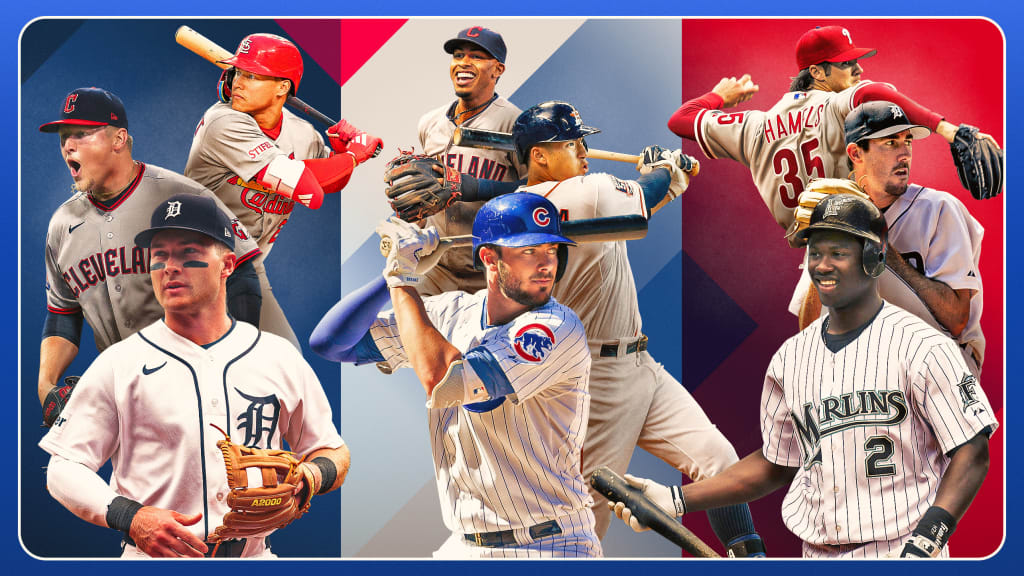
Was 2026 an all-time great season for rookie production? Yes -- by at least one measure.
Of course, it depends how you look at it. But this isn't about long-term outcomes, and it isn't about only the big names at the top of the leaderboard. It's about the depth of the overall rookie class and how it compares to the rest of the league.
To be specific: MLB.com's research went back to 1947, when the American and National Leagues began to integrate and the Rookie of the Year Award became an official national award handed out by the Baseball Writers' Association of America (BBWAA). For each season, we totaled up batting and pitching Wins Above Replacement (WAR) accrued by all AL and NL rookie-eligible players, according to FanGraphs' version of the metric. We then divided that figure by the total WAR of all players, to remove the effect of expansion over time. (Obviously there are a lot more rookies in 2026 than 1956, just as there are a lot more players in total.)
Going by that specific measure of productivity, the 2026 rookie class reigns supreme, a status that's more about quality up and down the list than a few superstars shouldering the load. It also fits in with a larger trend of rookies gaining prominence in MLB, as teams increasingly lean on young talent.
Using that same methodology, here are the top 10 rookie classes since 1947:
1) Class of 2026
Rookie of the Year Award winners: Kevin McGonigle (AL), Sal Stewart (NL)
Rookies with at least 2 WAR: 31 (18 hitters, 13 pitchers)
Total rookie WAR: 128.6 (12.9% of total)
While there wasn't an Aaron Judge or Shohei Ohtani in this class, Tigers infielder and AL Rookie of the Year Kevin McGonigle hit the ground running as a top-20 overall player by WAR despite playing the majority of the season as a 21-year-old. Guardians left-hander Parker Messick was a finalist not only for AL Rookie of the Year, but also AL Cy Young. Like Messick, a number of pitchers played key roles on postseason teams, including Payton Tolle (Red Sox), Didier Fuentes (Braves) and Logan Henderson (World Series champion Brewers). This rookie class also was bolstered by imports from Japan's NPB, most notably a pair of sluggers (Munetaka Murakami of the White Sox and Kazuma Okamoto of the Blue Jays), as well as left-hander Foster Griffin (Nationals/Guardians), who returned to the States after three seasons overseas.
2) Class of 2015
Rookie of the Year Award winners: Carlos Correa (AL), Kris Bryant (NL)
Rookies with at least 2 WAR: 19 (13 hitters, six pitchers)
Total rookie WAR: 124.8 (12.5% of total)
Bryant (6.1 WAR) became an immediate star, helping the Cubs return to the postseason for the first time since 2008 before following that up with a World Series title and NL MVP Award a year later. A pair of dynamic young shortstops, Houston's Correa and Cleveland's Lindor, announced their presence as well. On the pitching side, the Mets' Noah Syndergaard brought his triple-digit heat to MLB, and the Astros' Lance McCullers Jr. introduced big league hitters to his nasty curveball. The list of 2-WAR players doesn't even include talented rookie hitters such as Kyle Schwarber (Cubs), Ketel Marte (Mariners) and Corey Seager (Dodgers).
3) Class of 2006
Rookie of the Year Award winners: Justin Verlander (AL), Hanley Ramirez (NL)
Rookies with at least 2 WAR: 22 (11 hitters, 11 pitchers)
Total rookie WAR: 115.0 (11.5% of total)
The Marlins had three of the top four NL vote-getters, in five-tool shortstop Ramirez, slugging second baseman Dan Uggla and hard-throwing righty Josh Johnson. Ryan Zimmerman (Nationals), Mike Napoli (Angels), Russell Martin (Dodgers), Andre Ethier (Dodgers) and Nick Markakis (Orioles) were among the other hitters to post at least 2 WAR and launch stellar careers. Verlander (Tigers) was hardly the only notable rookie starting pitcher who excelled in 2006, joining the likes of Matt Cain (Giants), Cole Hamels (Phillies) and Jered Weaver (Angels). Jonathan Papelbon (Red Sox) was dominant from the back of Boston's bullpen to lead the group of young relief talent.
4) Class of 2023
Rookie of the Year Award winners: Gunnar Henderson (AL), Corbin Carroll (NL)
Rookies with at least 2 WAR: 21 (17 hitters, four pitchers)
Total rookie WAR: 113.9 (11.4% of total)
It was quite a dynamic Rookie of the Year pairing in 2023, as Carroll hit 25 home runs, stole 54 bases and scored 116 runs for Arizona, while Henderson hit 28 homers, drove in 82 runs and scored 100 times for Baltimore. Those two combined for 10.1 WAR, and while nobody else in the class rose to quite that level as a rookie, there were other impressive performances in the class as well. The Rangers, who triumphed over Carroll's D-backs in the World Series, did so with Josh Jung and Evan Carter in the starting lineup. Elly De La Cruz debuted his all-around skillset with the Reds, and Kodai Senga made a splash on the mound for the Mets after coming over from Japan.
5) Class of 2024
Rookie of the Year Award winners: Luis Gil (AL), Paul Skenes (NL)
Rookies with at least 2 WAR: 24 (14 hitters, 10 pitchers)
Total rookie WAR: 109.3 (10.9% of total)
If the 2024 rookie class is remembered for a single thing, it will probably be the arrival of Skenes, who had been the No. 1 overall pick in the 2023 Draft by the Pirates, as one of the most hyped pitching prospects in history. Skenes was as good as advertised from the beginning, going 11-3 with a 1.96 ERA in 23 starts and finishing third in the NL Cy Young race. But this wasn't just about Skenes. The 2024 rookie class also included a long list of burgeoning stars, including the Cubs' Pete Crow-Armstrong, the Brewers' Jackson Chourio, the Padres' Jackson Merrill, the Nationals' James Wood, the Rays' Junior Caminero and the Athletics' Mason Miller. Shota Imanaga (Cubs) and Yoshinobu Yamamoto (Dodgers) arrived from Japan as two of the top rookie starting pitchers.
6) Class of 2016
Rookie of the Year Award winners: Michael Fulmer (AL), Corey Seager (NL)
Rookies with at least 2 WAR: 24 (12 hitters, 12 pitchers)
Total rookie WAR: 101.5 (10.2% of total)
The National League rookie class in particular was stacked in 2016. Seager was a unanimous NL ROY winner for the Dodgers, posting an .877 OPS and 26 homers as a 22-year-old shortstop. But receiving votes behind him were the likes of Trea Turner (Nationals) and Trevor Story (Rockies), as well as Seager's teammate, Kenta Maeda, who went 16-11 with a 3.48 ERA after making the leap from NPB. Other prominent rookies from 2016 include the Twins' Byron Buxton, the Astros' Alex Bregman, the Braves' Dansby Swanson, the Mariners' Edwin Díaz and the Rays' Blake Snell.
7) Class of 2012
Rookie of the Year Award winners: Mike Trout (AL), Bryce Harper (NL)
Rookies with at least 2 WAR: 17 (eight hitters, nine pitchers)
Total rookie WAR: 97.9 (9.8% of total)
It's difficult to find two bigger rookie stars than Trout and Harper. The former immediately became the best player in the game, easily leading the Majors with a rookie-record 10.1 WAR. The latter posted a 4.4 WAR and helped spur the Nationals to a division title despite playing the entire season as a teenager. Trout and Harper weren't alone, though. There was an influx of international talent, thanks to the A's Yoenis Cespedes (Cuba), the Rangers' Yu Darvish and the Brewers' Norichika Aoki (Japan), and the Orioles' Wei-Yin Chen (Taiwan). Other notable rookie contributors included the Orioles' Manny Machado, the Cubs' Anthony Rizzo, the Mets' Matt Harvey and the Braves' Andrelton Simmons.
8) Class of 1947
Rookie of the Year Award winner: Jackie Robinson (MLB)
Rookies with at least 2 WAR: 10 (five hitters, five pitchers)
Total rookie WAR: 49.2 (9.7% of total)
The Rookie of the Year Awards now bear Jackie Robinson's name, honoring the first winner. (In 1947-48, there was just one total winner each year, before it expanded to an AL/NL format in '49.) And of course, Robinson was brilliant on the field for the Brooklyn Dodgers in 1947, in addition to breaking the color barrier and dealing with everything that came with that. He hit .297, stole 29 bases, scored 125 runs and played nearly every game for the NL pennant winners. Fellow trailblazer Larry Doby (Cleveland) also was part of this rookie class, as were the likes of Yogi Berra (Yankees), Bobby Thomson (Giants) and Ferris Fain (Athletics), who actually led all rookies with 4.1 WAR (albeit, many decades before WAR was developed).
9) Class of 2014
Rookie of the Year Award winners: José Abreu (AL), Jacob deGrom (NL)
Rookies with at least 2 WAR: 15 (seven hitters, eight pitchers)
Total rookie WAR: 92.8 (9.3% of total)
Abreu signed with the White Sox out of Cuba and was immediately one of the best hitters in baseball as a 27-year-old rookie, leading the Majors in SLG (.581) and smacking 36 home runs. Yankees pitcher Masahiro Tanaka was an international arrival, out of Japan, going 13-5 with a 2.77 ERA. Mets right-hander Jacob deGrom foreshadowed the even greater dominance to come by posting a 2.69 ERA in 22 starts, and Reds speedster Billy Hamilton electrified with 56 stolen bases. Mookie Betts (Dodgers), George Springer (Astros), José Ramírez (Cleveland), Kevin Gausman (Orioles) and Kyle Hendricks (Cubs) were a bit further down the WAR list as rookies but went on to big things in the years to come.
10) Class of 2013
Rookie of the Year Award winners: Wil Myers (AL), José Fernández (NL)
Rookies with at least 2 WAR: 15 (nine hitters, six pitchers)
Total rookie WAR: 90.9 (9.1% of total)
Fernández, whom the Marlins selected 14th overall in the 2011 Draft, was an immediate sensation, producing a 2.19 ERA and 4.2 WAR in 28 starts and finishing third in the NL Cy Young race despite debuting at the age of just 20. The same could be said of Dodgers outfielder and fellow Cuba native Yasiel Puig, who produced 3.9 WAR in just 104 games after debuting in the Majors in June and proceeding to bat .436 that first month. Puig's teammate, Hyun Jin Ryu, made an immediate impact while making the transition from the KBO. This was a strong rookie pitching class, which also included Gerrit Cole (Pirates), Sonny Gray (A's), Zack Wheeler (Mets), Julio Teheran (Braves) and Michael Wacha (Royals), among others. While neither made a huge splash as rookies, Nolan Arenado (Rockies) and Christian Yelich (Marlins) both got close to the 2-WAR mark on the position player side.