
The No. 1 overall pick in the Draft is supposed to be the no-brainer, the slam dunk, the no-doubt-about-it type of pick. Those taken with the first selection are the ones slated not just for a big league career, but for superstardom.
As history has shown, it hasn't always worked out that way. And sometimes it's a later pick who becomes that Draft's biggest gem.
In fact, a review of the first 60 years of the event (1965-2024) -- 2025 is too recent to include -- reveals the challenge that the team with the top selection faces. With the tremendous benefit of hindsight, and acknowledging that much can still change, only nine of those No. 1 picks stand the test of time as the optimal choice based on the information available today, even giving the drafting team some benefit of the doubt.
The challenge of nailing No. 1 this year goes to the White Sox, who will kick off the 2026 Draft on Saturday.
2026 MLB DRAFT PRESENTED BY NIPPON EXPRESS
Day 1: Saturday, July 11 (Rounds 1-4)
• 1:00-2:30 p.m. ET - Preview show + Picks 1-10 (NBC/Peacock)
• 2:30-4:30 p.m. ET - Picks 11-40 (MLB Network, MLB.com, MLB.TV, MLB+)
• 4:30-7:45 p.m. ET - Picks 41-135 (MLB.com, MLB.TV, MLB+)
Day 2: Sunday, July 12 (Rounds 5-20)
• 11:30 a.m.-7:30 p.m. ET (MLB.com, MLB.TV, MLB+)
Coverage
Below is a look at each top selection so far -- again, excluding 2025 as too recent -- and the player who now appears to be most deserving, among all the picks who signed that year. Each player is listed with his career Baseball-Reference WAR as of July 10, 2026. (Active players yet to reach the Majors are listed as “N/A,” while retired players who never got there are listed as “DNP.”)
2024 (Guardians): Travis Bazzana (1.0 WAR)
Should've picked: Nick Kurtz, 4th overall, A's (8.7)
Bazzana just reached the Majors on April 28 and has been a contributor right away. With that said, Kurtz is the reigning AL Rookie of the Year, with a .958 OPS over his first 209 MLB games. In what's proven to be a stacked 2024 class, he looks like the cream of the crop.
2023 (Pirates): Paul Skenes (15.7)
Should've picked: Skenes
Skenes almost immediately became one of the best pitchers in the Majors. He's now an All-Star for the third time in three seasons.
2022 (Orioles): Jackson Holliday (1.2)
Should've picked: Cam Schlittler, 7th round, Yankees (5.9)
Holliday is still just 22, but big league success has been elusive for him over his first three seasons. Zach Neto (Angels, 13th overall) has a big lead in WAR from this class, but Schlitter has emerged as a serious Cy Young candidate.
2021 (Pirates): Henry Davis (-1.1)
Should've picked: James Wood, 2nd round, Padres (8.3)
Davis has a .559 career OPS in the Majors, while Wood has become an elite slugger with the Nationals, who acquired him in the Juan Soto trade.
2020 (Tigers): Spencer Torkelson (2.0)
Should've picked: Pete Crow-Armstrong, 19th overall, Mets (13.9)
Torkelson has gone through a lot of ups and downs in Detroit, while Crow-Armstrong (since traded to the Cubs) has established himself as the best defensive player in the Majors and looks to be on his way to garnering MVP votes for the second year in a row in 2026.
2019 (Orioles): Adley Rutschman (16.5)
Should’ve picked: Bobby Witt Jr., 2nd overall, Royals (26.9)
This has the potential to go down as a ridiculously stacked Draft class, featuring not just Rutschman and Witt but also Corbin Carroll (16th), Gunnar Henderson (second round) and a number of other All-Stars. Rutschman hardly looks like a bad pick, even given some recent stumbles, but Witt is the type of five-tool star shortstop that every franchise dreams of landing.
2018 (Tigers): Casey Mize (7.4)
Should’ve picked: Tarik Skubal, 9th round, Tigers (20.0)
Mize was an All-Star in 2025 and is off to a strong start in 2026. But coincidentally, the best player in this Draft looks to be his rotation-mate, Skubal, who was the much less heralded pitcher coming out of Seattle University.
2017 (Twins): Royce Lewis (4.6)
Should’ve picked: Hunter Greene, 2nd overall, Reds (12.8)
Daulton Varsho (second round) actually leads what's been an underwhelming class in WAR, but we'll go with Greene, who had a 2.76 ERA in 2024-25 before running into an elbow injury that kept him out until this month. Lewis has flashed huge potential at times, but constant injuries stalled his progress.
2016 (Phillies): Mickey Moniak (1.2)
Should’ve picked: Will Smith, 32nd overall, Dodgers (23.8)
Moniak finally found some success with the Angels and now the Rockies but isn't close to the top of an odd class in which most of the best players were not first-round picks. That list includes second-rounders Pete Alonso, Bo Bichette and Bryan Reynolds, third-rounders Zac Gallen and Jesús Luzardo and fourth-rounders Corbin Burnes and Shane Bieber. We'll go with Smith, who's been one of baseball's best catchers for several years now.
2015 (D-backs): Dansby Swanson (31.1)
Should’ve picked: Alex Bregman, 2nd overall, Astros (45.3)
Not only did the D-backs select Swanson over his fellow SEC shortstop, they shipped him to Atlanta just six months later in a disastrous trade for pitcher Shelby Miller. While Swanson has enjoyed a fine career since then, his current teammate, Bregman, has a huge lead in career WAR.
2014 (Astros): Brady Aiken (DNP)
Should’ve picked: Trea Turner, 13th overall, Padres (41.6)
Injury concerns led to Houston not reaching a deal with Aiken, who went 17th to Cleveland a year later and never reached Double-A. Meanwhile, San Diego traded Turner to Washington as a prospect, only to watch him emerge as one of the game's most dynamic talents.
2013 (Astros): Mark Appel (0.3)
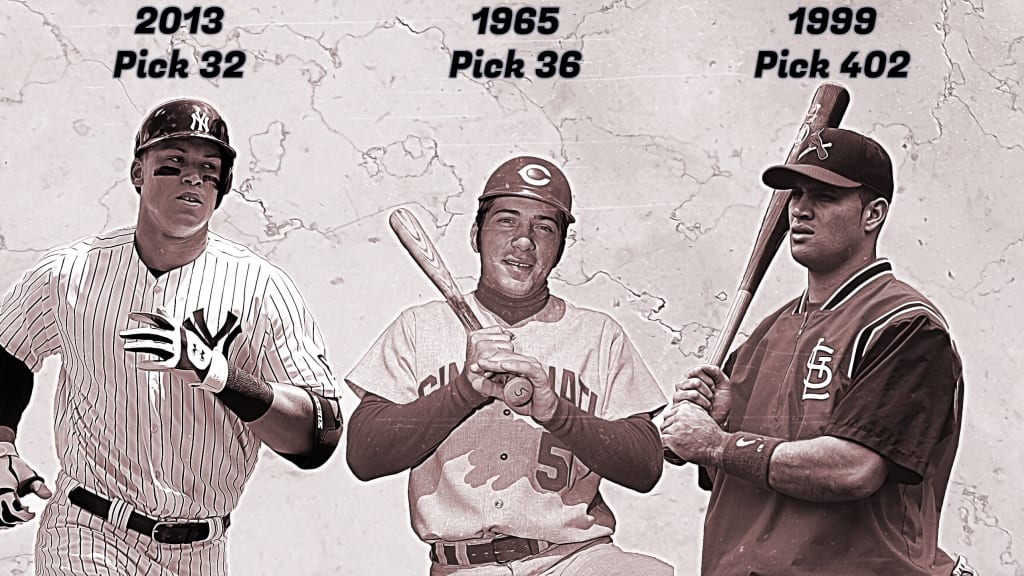
Should’ve picked: Aaron Judge, 32nd overall, Yankees (64.4)
Appel finally made a triumphant Major League debut with the Phillies in 2022, but Judge joined Kris Bryant (No. 2 overall) and Cody Bellinger (fourth round) as the third MVP Award winner from this class. (And remember, the Yanks got that 32nd pick as compensation for Nick Swisher leaving for Cleveland in free agency the previous offseason).
2012 (Astros): Carlos Correa (47.0)
Should’ve picked: Correa
Injuries have limited Correa at times. The 2015 AL Rookie of the Year still remains the most productive player in this class, although the likes of Byron Buxton (second overall), Max Fried (seventh), Corey Seager (18th) and Matt Olson (47th) could ultimately pass him.
2011 (Pirates): Gerrit Cole (43.8)
Should’ve picked: Cole
It's hard to argue with Cole here, even though he's behind Mookie Betts (fifth round), Francisco Lindor (eighth overall) and Marcus Semien (sixth round) in career WAR. During his AL Cy Young Award-winning 2023, Cole passed David Price for the most career WAR by a pitcher selected No. 1 overall.
2010 (Nationals): Bryce Harper (55.8)
Should’ve picked: Harper
Harper is a bit behind Manny Machado (third overall) and Chris Sale (13th) in WAR at present, but we're not going to nitpick the selection of a two-time NL MVP Award winner who is on a path toward Cooperstown.
2009 (Nationals): Stephen Strasburg (32.3)
Should’ve picked: Mike Trout, 25th overall, Angels (90.5)
Washington doesn't feel too bad about selecting the 2019 World Series MVP, even though injuries almost completely sidelined him afterward. Still, the Nats and many other teams passed on Trout, who became an all-time great.
2008 (Rays): Tim Beckham (3.2)
Should’ve picked: Buster Posey, 5th overall, Giants (44.8)
Beckham struggled to hold down a regular MLB role, while Posey became a seven-time All-Star catcher and three-time champion in San Francisco.
2007 (Devil Rays): David Price (40.2)
Should’ve picked: Price
Several other players would have been worthy top picks, including Freddie Freeman (second round), who now has a big lead in career WAR. With that said, Price was terrific for Tampa Bay, including his AL Cy Young Award season in 2012.
2006 (Royals): Luke Hochevar (3.7)
Should’ve picked: Clayton Kershaw, 7th overall, Dodgers (80.9)
Hochevar’s relief work helping K.C. win the 2015 World Series takes a bit of the sting out of passing up two all-time great pitchers in Kershaw and Max Scherzer (11th overall).
2005 (D-backs): Justin Upton (32.3)
Should’ve picked: Andrew McCutchen, 11th overall, Pirates (48.6)
Upton put together a solid career, but he didn't quite reach the heights of MVP winners McCutchen or Ryan Braun (fifth overall).
2004 (Padres): Matt Bush (1.8)
Should’ve picked: Justin Verlander, 2nd overall, Tigers (81.8)
Bush, a high school shortstop, finally made the Majors as a Rangers reliever in 2016, following years of issues on and off the field. Verlander is just now wrapping up his career, 22 years after this draft.
2003 (Devil Rays): Delmon Young (3.2)
Should’ve picked: Ian Kinsler, 17th round, Rangers (54.1)
Young did at least sprout a trade tree that brought Matt Garza, Chris Archer, Tyler Glasnow, Austin Meadows and Isaac Paredes to Tampa Bay -- and is still growing.
2002 (Pirates): Bryan Bullington (-0.2)
Should’ve picked: Zack Greinke, 6th overall, Royals (77.5)
While Bullington pitched fewer than 100 MLB innings, Greinke put himself on a Hall of Fame path.
2001 (Twins): Joe Mauer (55.2)
Should’ve picked: Mauer
The local kid from St. Paul certainly made good in Minnesota.
2000 (Marlins): Adrián González (43.5)
Should’ve picked: Chase Utley, 15th overall, Phillies (64.5)
Traded before he reached Miami, A-Gon did become a five-time All-Star, though not the well-rounded player Utley was in Philadelphia.
1999 (Devil Rays): Josh Hamilton (28.2)
Should’ve picked: Albert Pujols, 13th round, Cardinals (101.5)
Hamilton did eventually become a superstar for a short time, but not with Tampa Bay. Pujols reached that status two years removed from playing in junior college.
1998 (Phillies): Pat Burrell (18.9)
Should’ve picked: CC Sabathia, 20th overall, Cleveland (62.6)
Burrell’s nearly 300 homers don’t match Sabathia’s 251 wins and 3,093 strikeouts.
1997 (Tigers): Matt Anderson (-0.6)
Should’ve picked: Lance Berkman, 16th overall, Astros (52.0)
Anderson wound up with a 5.19 ERA in 257 career relief appearances. Berkman, a local pick from Rice, spent 12 of his 15 seasons in Houston.
1996 (Pirates): Kris Benson (12.9)
Should’ve picked: Jimmy Rollins, 2nd round, Phillies (47.6)
Benson started 200 MLB games but wasn’t quite the same after having Tommy John surgery in 2001. Rollins took home an NL MVP Award in ‘07.
1995 (Angels): Darin Erstad (32.3)
Should’ve picked: Roy Halladay, 17th overall, Blue Jays (64.2)
Erstad had a 240-hit season (2000) and was a key part of a championship team (‘02), but Halladay, Todd Helton (eighth overall) and Carlos Beltrán (second round) are Hall of Famers.
1994 (Mets): Paul Wilson (2.0)
Should’ve picked: Nomar Garciaparra, 12th overall, Red Sox (44.3)
While Wilson pitched only one season for the Mets before he was traded, Nomar became a superstar in Boston before injuries interfered.
1993 (Mariners): Alex Rodriguez (117.6)
Should’ve picked: Rodriguez
A-Rod made the Majors before turning 19 and was an elite player by 20.
1992 (Astros): Phil Nevin (15.9)
Should’ve picked: Derek Jeter, 6th overall, Yankees (71.3)
Nevin played 12 MLB seasons, hit more than 200 homers and was an All-Star in 2001, but it would take a lot more to overcome Jeter.
1991 (Yankees): Brien Taylor (DNP)
Should’ve picked: Manny Ramírez, 13th overall, Cleveland (69.3)
Taylor never made the Majors, while Ramírez became one of his generation’s most feared hitters.
1990 (Braves): Chipper Jones (85.3)
Should’ve picked: Jones
Fortunately for the Braves, they chose Jones over pitcher Todd Van Poppel.
1989 (Orioles): Ben McDonald (20.8)
Should’ve picked: Jeff Bagwell, 4th round, Red Sox (79.9)
Baltimore got a solid pitcher but missed on four Hall of Famers: Bagwell, Frank Thomas (seventh overall), Trevor Hoffman (11th round) and Jim Thome (13th round).
1988 (Padres): Andy Benes (31.5)
Should’ve picked: Mike Piazza, 62nd round, Dodgers (59.6)
Benes was arguably this Draft's best pitcher, and nobody saw Piazza coming, as the 1,390th overall pick.
1987 (Mariners): Ken Griffey Jr. (83.8)
Should’ve picked: Griffey
Between Griffey and A-Rod, Seattle absolutely nailed two No. 1 overall picks in a seven-year span.
1986 (Pirates): Jeff King (16.9)
Should’ve picked: Gary Sheffield, 6th overall, Brewers (60.5)
King was a useful big league hitter, but few were as dangerous with a bat in their hands as Sheffield.
1985 (Brewers): B.J. Surhoff (34.4)
Should’ve picked: Barry Bonds, 6th overall, Pirates (162.8)
That year’s top four picks (Surhoff, Will Clark, Bobby Witt, Barry Larkin) had careers ranging from good to great, yet they barely produced more combined WAR than Bonds.
1984 (Mets): Shawn Abner (-1.3)
Should’ve picked: Greg Maddux, 2nd round, Cubs (106.6)
Abner, a high school outfielder who had a .591 OPS in the Majors, was chosen over Mark McGwire (10th overall), while Tom Glavine joined Maddux as a second-round selection.
1983 (Twins): Tim Belcher (26.0)
Should’ve picked: Roger Clemens, 19th overall, Red Sox (139.2)
Belcher was a productive pitcher for 14 seasons, if not an ace like Clemens, but that was only after he didn’t sign with the Twins.
1982 (Cubs): Shawon Dunston (11.5)
Should’ve picked: Bret Saberhagen, 19th round, Royals (58.9)
Dunston was a two-time All-Star shortstop in Chicago, while Saberhagen narrowly leads a pitching class that also featured Dwight Gooden (fifth overall), David Wells (second round), Jimmy Key (third round) and Kenny Rogers (39th round).
1981 (Mariners): Mike Moore (27.9)
Should’ve picked: Tony Gwynn, 3rd round, Padres (69.2)
Moore started 440 MLB games on the mound, but Gwynn became a San Diego icon.
1980 (Mets): Darryl Strawberry (42.2)
Should’ve picked: Strawberry
While his last big season came at age 29, Strawberry’s prime was worthy of the top pick.
1979 (Mariners): Al Chambers (-0.4)
Should’ve picked: Orel Hershiser, 17th round, Dodgers (56.1)
Chambers, a high school outfielder, played only 57 MLB games. Hershiser and Don Mattingly (19th round) both were late-round gems.
1978 (Braves): Bob Horner (21.8)
Should’ve picked: Cal Ripken Jr., 2nd round, Orioles (95.9)
Horner was the NL Rookie of the Year in 1978, but Ripken was still playing 13 years after his final game.
1977 (White Sox): Harold Baines (38.8)
Should’ve picked: Ozzie Smith, 4th round, Padres (76.9)
Baines now has a plaque in Cooperstown, but this choice is a tossup between fellow Hall of Famers Smith, Paul Molitor (third overall) and Tim Raines (fifth round).
1976 (Astros): Floyd Bannister (26.4)
Should’ve picked: Rickey Henderson, 4th round, A’s (111.2)
Bannister made only 39 of his 363 starts for Houston, which missed not only Henderson, but also Alan Trammell (second round), Jack Morris (fifth) and Wade Boggs (seventh).
1975 (Angels): Danny Goodwin (-1.7)
Should’ve picked: Lou Whitaker, 5th round, Tigers (75.1)
Goodwin is the only player to be picked No. 1 overall twice (see below), but it only translated into 252 big league games and a .674 OPS.
1974 (Padres): Bill Almon (4.7)
Should’ve picked: Dale Murphy, 5th overall, Braves (46.5)
Almon played 15 years in the Majors but never at the level of Murphy, a two-time NL MVP.
1973 (Rangers): David Clyde (0.6)
Should’ve picked: Robin Yount, 3rd overall, Brewers (77.3)
While Clyde became a cautionary tale about rushing a young pitcher, Yount became the best player in Brewers history.
1972 (Padres): Dave Roberts (0.3)
Should’ve picked: Gary Carter, 3rd round, Expos (70.1)
Roberts (not the one who's the current Dodgers manager) had a .644 OPS in the Majors, while Carter was an 11-time All-Star catcher.
1971 (White Sox): Danny Goodwin (-1.7)
Should’ve picked: Mike Schmidt, 2nd round, Phillies (106.9)
Two of the best third basemen of all time, George Brett and Schmidt, went back-to-back with the 29th and 30th overall picks.
1970 (Padres): Mike Ivie (7.3)
Should’ve picked: Rich Gossage, 9th round, White Sox (41.1)
Ivie only got 500 plate appearances in a season once. Gossage became a Hall of Fame reliever.
1969 (Senators): Jeff Burroughs (17.7)
Should’ve picked: Bert Blyleven, 3rd round, Twins (94.5)
While Burroughs was the 1974 AL MVP, Blyleven’s 22-year career on the mound sent him to Cooperstown.
1968 (Mets): Tim Foli (5.7)
Should’ve picked: Thurman Munson, 4th overall, Yankees (46.0)
Foli’s 16 MLB seasons as a light-hitting shortstop pale in comparison to Munson’s 11 as a superstar catcher.
1967 (Yankees): Ron Blomberg (9.4)
Should’ve picked: Bobby Grich, 19th overall, Orioles (71.1)
Blomberg’s biggest distinction is as the first designated hitter in MLB history. Grich was a six-time All-Star second baseman, and an underappreciated Hall of Fame candidate.
1966 (Mets): Steven Chilcott (DNP)
Should’ve picked: Reggie Jackson, 2nd overall, A’s (74)
A shoulder injury prevented Chilcott, a catcher, from reaching the Majors, while Jackson became Mr. October.
1965 (A’s): Rick Monday (33.1)
Should’ve picked: Johnny Bench, 2nd round, Reds (75.2)
Monday had a stellar career, but Bench is arguably the greatest catcher of all time.