




The Cubs have the best offense in baseball, and by a large margin, too. It’s actually arguably the best in team history, and this is a team with a lot of history.
The Cubs have the best defense in baseball too, by another large margin. That undersells it; they’re going to be the best on record since Statcast began tracking a decade ago. While it’s hard to compare defenses across the eras, they’re at least in the conversation of the best you’ve ever seen.
Great hitting. Historically good defense. What else is there?
Oh, right. Pitching. The Cubs currently rank 30th – a nicer way of saying “last” – of the 30 teams in the FanGraphs version of Wins Above Replacement (WAR). Yes, below the Rockies, and the A’s, and everyone else. (This isn't a 'rank the ERA' exercise, as those pitching staffs who have allowed more runs have done so in worse ballparks and in front of much weaker defenses.)
So, how does a team with offense that great and defense that spectacular manage to sit 10 games out in the division, behind a Brewers team that just pulled off a three-game sweep in Milwaukee and clinched their season series? Pitching.
(Or, if you prefer to flip it around: How does a team with pitching that weak manage to make a playoff run? Because the offense and defense are that good.)
If not quite the old Washington Senators slogan of “first in war, first in peace, and last in the American League,” then “first in offense, first in defense, and last in pitching” is a decent enough modern day equivalent.
The Cubs, quite clearly, won’t win the NL Central, but they are currently in control of the second NL Wild Card spot, and assuming that holds up, it’s going to lead us to a fascinating question about the way October baseball is played. “Pitching wins in the playoffs,” goes the old saying, and while that’s not actually all that accurate, the 2026 Cubs are apparently planning to put that to the test.
Can you out-slug and out-field a lack of pitching on your way to a title? Has anyone ever pulled off anything like this?
There’s good news and bad news. The bad news is, “Not often!” The good news? There’s some comparables to the 1927 Yankees and the mid-70s “Big Red Machine” in Cincinnati, two of the most celebrated rosters ever.
Let’s start with the highlights. Yes, the offense really is that good:
- 1st in runs scored
- 1st in home runs
- 1st in on-base percentage
- 1st in slugging
- 1st in OPS+ and wRC+
Dating back to the start of the 20th century, this is either the best offense they’ve ever had (115 wRC+, where 100 is league average), or essentially tied for such, if you look only at position players batting and exclude all those pitchers hitting over the years.
It is, at the moment, one of the top 50 offenses in AL/NL history. It's really, really good, in a time where it's hard to be really good at hitting.
The defense is elite, too, having recently stepped to the top of the single-season list in Fielding Run Value, which Baseball Savant has going back to 2018.
- 66 // Cubs, 2026
- 64 // D-Backs, 2018
- 58 // Yankees, 2022
- 58 // Guardians, 2019
- 52 // Astros, 2022
- 52 // D-backs, 2019
That, obviously, is in large part due to Crow-Armstrong, a sensational outfielder who continues to test the limits of Statcast metrics.
It's not just him, though. Nico Hoerner, Dansby Swanson, Alex Bregman and Ian Happ all rate well at their positions, and Seiya Suzuki has taken strong steps forward on defense this year. More importantly, there’s really not a single trouble spot on the field, and the best way to show that is to take Crow-Armstrong out of the equation entirely. If we were to look at every team’s defense this year excluding center field .. the Cubs would still be No. 1, narrowly over Toronto and St. Louis.
But the pitching?
It’s the starters, who rank 27th in WAR, and the relievers, who are 28th. Given the flurry of moves they made at the Deadline, it would be fair to look only at recent performance and not worry so much about what some ex-Cubs did in April or May, but that doesn’t actually help much here – since Aug. 3, they rank 29th. (Top acquisition Kevin Gausman was lit up for seven runs over four innings in Wednesday's loss to the Brewers.)
No team in baseball has less fastball velocity than these Cubs, and while velocity isn’t everything, it’s worth noting the Dodgers, Phillies and Brewers are all in the top five. If you’re more of a Stuff+ type here – Stuff+ being a metric that tries to distill pitch movement, release point, arm slot and other inputs into a “is it nasty?” ranking – then the Cubs are 28th, on a list where the Rockies are last and the Brewers, Yankees, Dodgers and Phillies are four of the top five.
This was, to some extent, predictable, as the rotation was rated as 20th in the preseason projections. It’s true that losing Cade Horton after two starts couldn’t have been known; on the other hand, Ben Brown’s breakout was an unexpected boost before he, too, got injured. Regardless of the shape of it, these Cubs are almost certainly going to break the team’s all-time record for home runs allowed, currently held by the 91-loss 2021 team.
It’s dire enough that if the team doesn’t trust giving the ball to Shota Imanaga, who had a 5.96 ERA in August, then it’s possible that the three starters in a Wild Card series would be Matthew Boyd, Gausman and Clay Holmes – three solid pitchers who have combined for 2.3 WAR as Cubs this year.
It’s a problem, is the point. But is it a fatal one? Has any team ever won like, well, this before? It’s somewhat difficult to compare historically, because for a half-century all teams needed to do was to beat seven other teams over six months and they were advanced immediately to the World Series. But we’ll do our best.
The Cubs, as we said, are first in position player WAR and last in pitching WAR. It’s not the first time it’s ever happened. But it would be only the third …
- 2026 Cubs
- 1930 Yankees
- 1918 Reds
… and those long-ago teams played in a 16-team, pre-integrated sport. Neither of those teams reached the World Series, anyway. So far as anything resembling “modern baseball” goes, it would be the first time.
Another way to do this is to compare position player WAR (which includes, conveniently for us, both hitting and defense) against pitching WAR, just to see how unbalanced a team can actually be.
For the Cubs, entering Wednesday's game, that was 34.5 WAR (position players) against 3.6 WAR (pitchers), which is a huge gap of basically 31 wins. A more balanced team, like Milwaukee, was nearly even – 22.3 for position players and 19.3 for pitching is a gap of just 3 WAR, which, by our math, is “10 times less lopsided than the Cubs.”
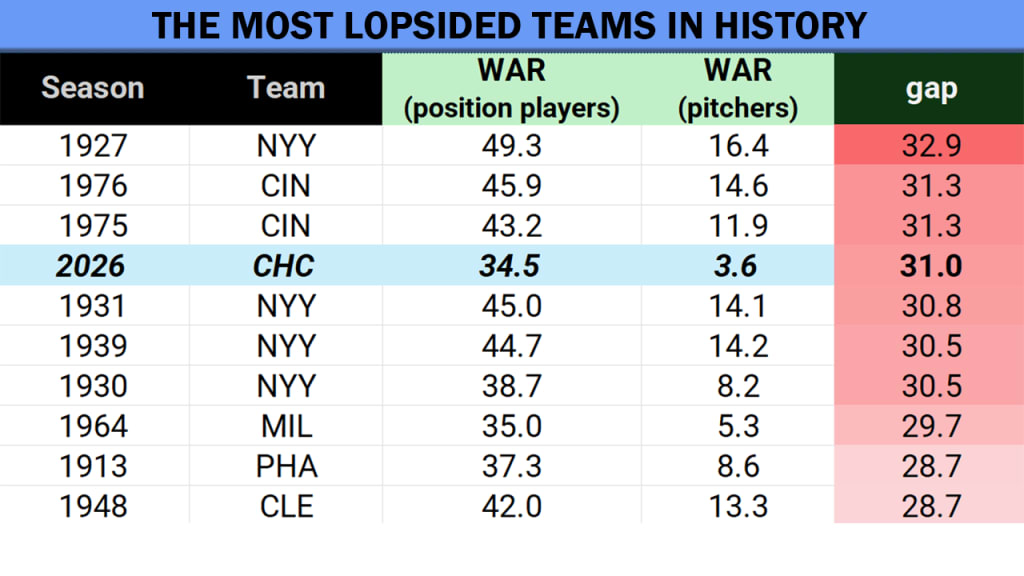
Well, we promised the 1927 Yankees and the mid-70s Reds, didn’t we?
But that’s not quite right, either. The ‘27 Yankees didn’t have a poor pitching staff by any means – they were fourth of 16 teams – it’s just that the lineup was so historically good, literally “Murderer’s Row,” that it caused some imbalance. That’s not what’s happening here. Instead, what we really want to see is the most lopsided teams among those who were in the bottom 25% of pitching teams for that year.
Only one team ever was more lopsided – and they did win the World Series that year.
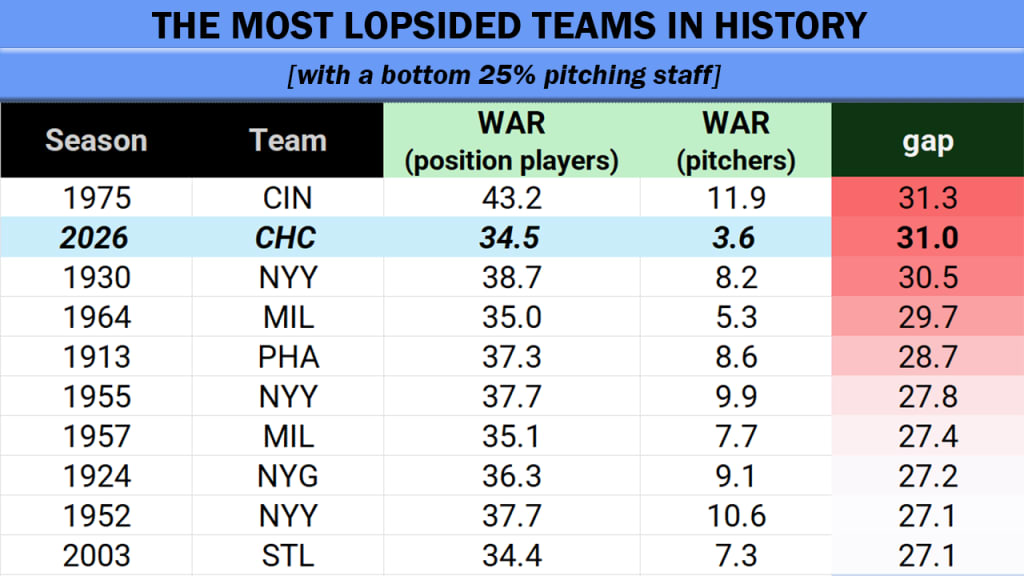
The ‘75 Reds and this year’s Cubs do have some similarities, namely a quality defense (four Reds won Gold Gloves that year) and an all-time great season by an up-the-middle player, as Joe Morgan had the best year of his Hall of Fame career, and indeed one of the best years any second baseman has ever had.
So it’s rare, but it’s possible. Those Reds are one of just five teams since the start of divisional play in 1969 to win it all with a pitching staff ranked in the bottom 25% for that season – and it’s happened just twice since the sport expanded to 30 teams in 1998.
- 1973 A’s
- 1975 Reds
- 1982 Cardinals
- 2006 Cardinals
- 2014 Giants
Those 2006 Cardinals, in most any other year, wouldn’t have made it to the playoffs in the first place; their 83 wins remain the fewest by any World Series champion. The 2014 Giants did it thanks in large part to Madison Bumgarner’s historic October.
So is it possible to win a World Series this way? Sure. It’s just really, really rare, and really, really hard. It generally requires an all-time player having an all-time year, and while it’s a bit premature to crown Crow-Armstrong an “all time player,” he’s also almost assuredly going to be the first player since 2022 to prevent Shohei Ohtani from winning the Most Valuable Player Award.
Pitching doesn’t win championships, at least not in the way you think it does. It sure can lose them, though. It might be on the Cubs offense and defense to prevent that from happening.