

In the midst of a wild 8-6 Cubs loss to Detroit on Monday, Pete Crow-Armstrong did something that he’s done so often that it almost feels routine: He made a truly great defensive play.
Stunning, we know: The defending Gold Glover, who rates as the best non-catcher defender in baseball over the last three seasons (+57 Fielding Run Value, by a sizeable margin over Bobby Witt Jr. [+45] and Jacob Young [+41]), who has played defense so incredibly well that we wrote about it twice last season, once in April and then again in August, made a great play that brought the home crowd to its feet.
This one, however, was different. Crow-Armstrong had 70 feet to get to the ball off of Zach McKinstry’s bat, and he had 4 seconds to do it. That kind of play doesn’t get made, and we mean that almost literally. The 5% catch probability given to that combination means that 95% of the time an outfielder gets a similar opportunity, it doesn’t get made. That’s what the probability is telling you: it’s not that this play never, ever gets made. It’s just extremely rare. ("One of the only people on the planet who makes that play," aptly noted the Cubs radio call. Quite right.)
Most of the time, really, they don’t even get close. That Crow-Armstrong was even near enough to it to make the spectacular diving catch was a little about his excellent speed (29.1 ft/sec, well above-average) and a lot about his excellent reaction to in the first place (a jump of +8.5 feet better than average, "getting a good jump" also being something he’s best in baseball at).
That counts as a “5-Star Catch,” or one that’s given a Catch Probability of 25% or lower (based mostly on time and distance, but also with adjustments for direction and wall). What made this catch stand out above all others is that it was Crow-Armstrong’s 33rd such elite catch of his career – and that broke a tie with Kevin Kiermaier, a pretty historic defender himself, who had 32. (At least since 2016, when data began, though that covers most of Kiermaier's career, which really got going in 2014.)
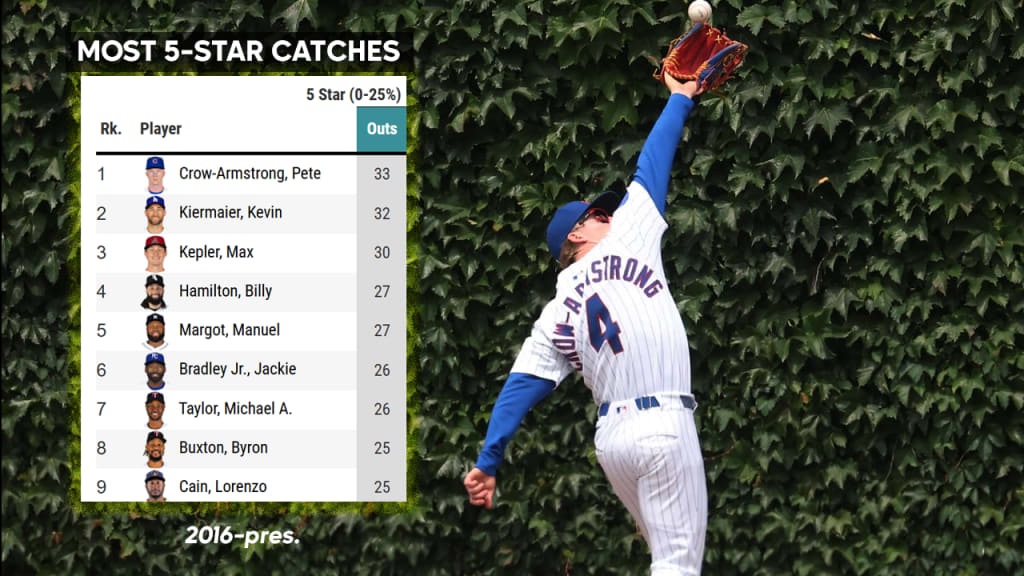
If “a 33rd 5-Star Catch” doesn’t quite hold the same place in your heart as “.406” or “1.12” or “755” might, it’s still a record he might hold for a very, very long time. Crow-Armstrong, it should be pointed out, is still only 24 years old. By the time he's done, that number should be far higher than 33.
Oftentimes, those plays look exactly like you want them to, like last year when he laid out to rob Milwaukee’s Brice Turang on a ball most outfielders don’t even come close to, because having just 3.8 seconds to go 71 feet is really, really difficult.
Sometimes, they don’t – like the time earlier this year when he took a hit away from Santiago Espinal on what looked mostly like a routine play, with a relatively unnecessary slide added at the end mostly for effect. That it’s a 5-star play regardless is because having just 3.6 seconds to go 60 feet is also really, really difficult; that it didn’t look that way is because Crow-Armstrong has such elite reaction times that he has, again, the best jumps in baseball. Great catches are often made in the first second, not the last one.
On this particular play, that was getting off to a jump 12 feet above average, much of which couldn’t have been seen on television before the broadcast camera cut to the outfield, and if you think that play looked easy, then imagine what it would look like if Crow-Armstrong had been 12 feet further away.
In fact, don’t imagine. We can show you. Two years ago, on the very same field in Los Angeles, Andy Pages (himself now a very good fielder) had a nearly identical opportunity, and he got a good jump, too, +6 feet better than average. Six feet, however, is not 12. Imagine how this play ends if he were six feet closer to the ball.
Or go even further, still on the same field. Brandon Marsh was given a nearly identical opportunity in 2024 as well, and his jump was slightly below average, at -2 feet. Whereas Crow-Armstrong didn’t have to leave his feet to make the play, and Pages had to slide in an unsuccessful attempt to get there, Marsh wasn’t even close enough to make a serious try at making the catch in the first place.
Sometimes, as it turns out, making the play is decided long before you can even see what’s happening.
It’s not only, then, that he’s now overtaken Kiermaier for the most 5-Star plays. It’s that he’s done in just over two full seasons what it took Kiermaier – who, again, was truly fantastic in center field – an entire decade to do. Let’s bring back that leaderboard from above, except this time with a little more context, showing success rate (how often a 5-star opportunity is converted) and opportunities. It's not that Crow-Armstrong makes the great plays; it's that he makes them so much more often than anyone, even Kiermaier.
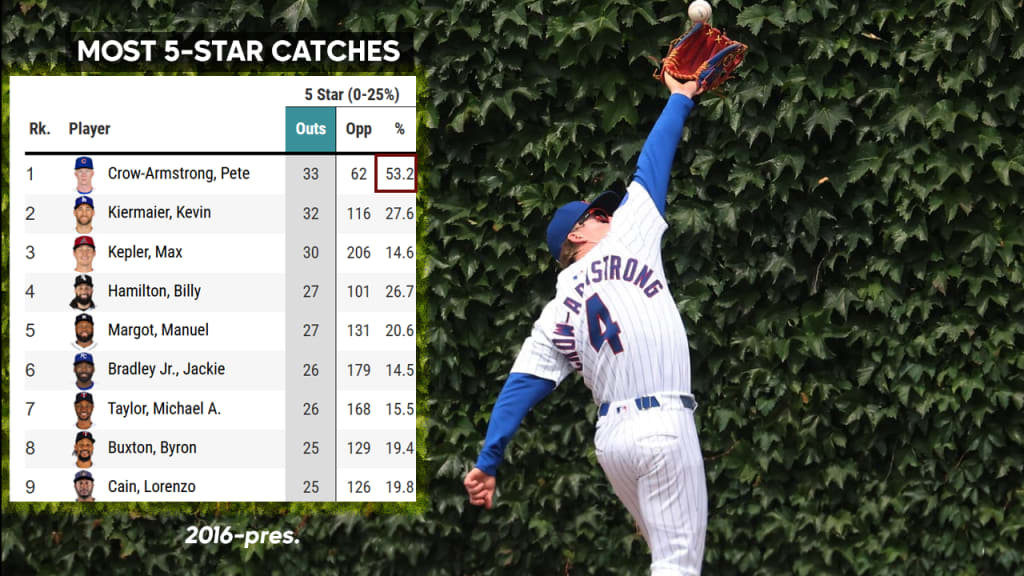
This year in the Majors, there have been nearly 1,600 opportunities for a fielder to make a 5-Star Catch. Only 131 times has it happened, which is to say: Something like 8% of 5-Star play opportunities actually get converted. Crow-Armstrong is six times better than that.
It’s not close, and it’s not just the hard ones. If we throw out probabilities at all and just look at success rate on any play whatsoever – a fancy fielding percentage, basically, though with less concern for whether a play was scored a hit or error – then of the nearly 400 outfielders who have at least least 200 opportunities over the last decade, Crow-Armstrong’s 83.7% success rate is, again, easily the best.
Next up, then: Best defensive year on record? Statcast’s Fielding Run Value (which combines tracking down batted balls, better known as Outs Above Average, along with the value of preventing extra bases, which means both throwing arm and what happens when you do things like letting a grounder get past you and gift the opposition free bases) goes back to 2018.
The best outfield year in that time is Victor Robles’s 2019, when he racked up +23 Fielding Runs. Crow-Armstrong is already at 20, so that seems a nearly guaranteed mark to fall. Include infielders, and now the mark is Nick Ahmed’s +28 in 2018; include catchers, and now we’re talking about Patrick Bailey’s +31 last year, though catchers are a different animal entirely. Out of reach, perhaps, but that it's a conversation in July tells you something.
It’s not, obviously, that Crow-Armstrong never makes miscues, because he’s had some high-profile disasters – like against the A’s, where a ball lost in the lights led to Shea Langeliers' inside-the-park homer, or against Milwaukee, when he failed to hang on to a Sal Frelick liner that hit him right in the glove. It happens to everyone. It happens to him, too. Perfection isn’t possible.
But at 24, Crow-Armstrong is playing the best outfield defense in the game, not by a little, and perhaps to a level where it’s going to be remembered for a very long time to come – which feels even more impressive when you remember that Wrigley Field is an incredibly difficult place to the play the outfield. With Shohei Ohtani sounding like he’s just may not pitch all that much over the rest of the season, maybe the long-closed door to the National League Most Valuable Player race is suddenly a little more open. Maybe a potential second consecutive 30/30 season would help Crow-Armstrong's case. Maybe, too, will off-the-charts defense, backed by both data and the eye test.