



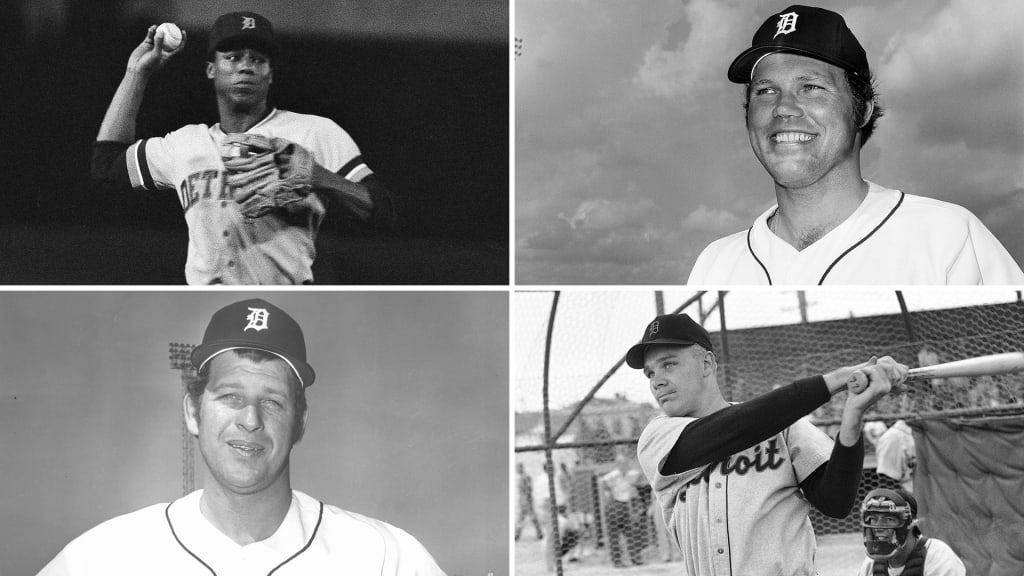
The brick wall beyond the outfield at Fifth Third Park is the Tigers’ version of a ring of honor or a monument park, adorned with names and numbers of franchise greats as a nod to the lasting impact of their contributions. For years, those spots were reserved for Tigers players, managers and officials inducted into the Baseball Hall of Fame, with the notable exception of Tigers legend and Detroit champion Willie Horton.
As others joined the wall, from Sparky Anderson to Alan Trammell and Jack Morris, the wait for Lou Whitaker to enter the Hall and join them rolled on. After 20 years, the Tigers decided they’d waited long enough.
The Tigers retired Whitaker’s No. 1 and put it on the wall on Aug. 6, 2022. They still haven’t given up hope that Cooperstown will someday open its doors for Whitaker, one of the greatest infielders of his era.
Here’s a look at the top 5 Tigers not in the Hall of Fame despite being eligible for induction:
1) Lou Whitaker, 1977-95
Key points: 1978 American League Rookie of the Year Award winner, five All-Star selections, three Gold Glove Awards, four Silver Slugger Awards
Whitaker’s 75.1 WAR, according to Baseball Reference, ranks 85th all-time and 52nd among position players. He has a higher WAR than Michigan native and former Yankees shortstop Derek Jeter, who was elected to the Hall of Fame by members of the Baseball Writers' Association of America on Jan. 21, 2020, in his first year on the ballot. When Whitaker retired after the 1995 season, he joined Hall of Famers Rogers Hornsby and Joe Morgan as the only second basemen to post 1,000 runs, 1,000 RBIs, 2,000 hits and 200 home runs.
Among position players eligible for induction, only Barry Bonds, Alex Rodriguez and Bill Dahlen had a higher WAR than Whitaker, something noted baseball historian and analyst Bill James has pointed out.
“Listening to all the fans bringing up the WAR, I think that was a big thing to me,” Whitaker said in December 2019 after plans to retire his number were announced. “They really showed over the years what I had done as a baseball player with the Detroit Tigers.”
2) Mickey Lolich, 1963-75
Key points: 1968 World Series MVP, three-time All-Star
Lolich has been up for consideration several times by the Veterans Committee for a career that ranks him among the best starters of his era. Not only was he remarkably durable, racking up 13 seasons with at least 30 starts and 11 years with at least 14 wins, but his peak stretch was also elite. After tossing three complete-game wins in the 1968 World Series and outpitching the great Bob Gibson in Game 7, Lolich enjoyed a four-year stretch with a 117 ERA+, 80 wins, 80 complete games and 1,059 strikeouts. He just missed out on a pitching Triple Crown in '71, leading the league with 25 wins and 308 strikeouts, but he finished a close second to Vida Blue in Cy Young Award voting. That lack of a Cy Young Award was long held against Lolich in voting.
The most similar pitcher to Lolich according to Baseball Reference is a Hall of Famer, Jim Bunning. Lolich’s 47.9 career bWAR tops that of Hall of Famer Jack Morris (43.6).
3) Bill Freehan, 1961-76
Key points: 11-time All-Star, five-time Gold Glove Award winner
While Al Kaline, Denny McLain and Mickey Lolich were the stars of the 1968 World Series champions, Freehan was the cornerstone. The former University of Michigan star was the best catcher in the American League in his time, earning 11 All-Star selections in a 12-year span. He finished third and second in AL MVP voting in '67 and '68, respectively, batting .263 with 25 home runs, 84 RBIs and a 145 OPS+ for the '68 champs. Freehan’s 44.7 bWAR ranks 16th all-time among catchers; 12 of the 15 catchers ahead of him are in the Hall of Fame.
4) Harvey Kuenn, 1952-59
Key points: 1953 AL Rookie of the Year Award winner, '59 AL batting champ, 10-time All-Star
Kuenn spent eight of his 15 Major League seasons in Detroit. He also spent 15 years on the Hall of Fame ballot among BBWAA voters; his highest vote share was 39.3 percent of ballots in 1988. Kuenn was an All-Star in every full season he spent as a Tiger, and he won a batting title with a .353 average in his final season with Detroit in '59. He was one of the best shortstops in the AL for the first half of the 1950s before shifting to center field for his final couple of seasons in Detroit.
5) Bobby Veach, 1912-23
Key facts: Led AL in RBIs three times, career 127 OPS+
Veach went overlooked in a Tigers outfield that included Hall of Famers Ty Cobb and Sam Crawford, but the sweet-swinging left fielder was one of the best run producers in the league in his prime. Despite low home run totals in the dead-ball era, Veach led AL hitters in RBIs three times in a four-year span from 1915-18, had a 158 OPS+ in '17 and a 159 OPS+ in '19. Jay Jaffe’s JAWS scoring system for measuring Hall of Fame credentials placed Veach 23rd among left fielders; 15 of the 22 players above him are in the Hall of Fame. A late-career fade hurt Veach's credentials, but his .310 career batting average ranks 114th all-time among qualified MLB hitters, according to Baseball Reference.