

At long last, player protest with ball or strike calls can be handled with something other than ineffectual arguing.
Beginning with the 2026 MLB season, players will have the power to appeal the strike-zone judgments of human home-plate umpires by turning to the Automated Ball-Strike (ABS) Challenge System, powered by T-Mobile – a technological advancement that will not only help ensure the most important calls are made correctly but also add a fun new layer of strategy to the sport.
The ABS Challenge System will make its formal debut on Opening Night tonight when the Giants host the Yankees at 8:05 p.m. ET in the first-ever live MLB broadcast on Netflix.
ABS Challenge System, powered by T-Mobile
• See what happened on the first ABS challenge
• Everything you need to know
• A visual guide to how ABS works
• Here are Major League Baseball's ABS firsts
• What does all the data mean
• Players get strike zones measured
• Player poll: Who'll be best at ABS challenges?
• ABS Challenge Dashboard
• ABS Challenge Leaderboard
Tested in the Minor Leagues since 2022 and in Major League Spring Training last year, this change is supported by fan polling and was approved the Joint Competition Committee last September. This system of replay recourse has been fully reviewed and is seen as a happy middle ground between so-called “robot umps” that could call every ball and strike and the long-standing tradition of human umps and the nuance that can come with their calls.
The ABS Challenge System monitors the exact location of each pitch, relative to the specific batter’s zone. Players can request a challenge of a ball or strike call they feel the umpire got wrong, and, when they do, a graphic displaying the result is then transmitted over a 5G network from T-Mobile’s Advanced Network Solutions and nearly instantaneously shown to those in attendance via the videoboard and to home viewers via the broadcast.
Once the ball-strike call is either confirmed or overturned, the game goes on, having only been briefly interrupted.
As straightforward as that all sounds, there are all kinds of particulars to the system, the way it will run, the way it will be shown to us and the impact it will have on play and decision-making that fans will find interesting.
So here is a comprehensive look at everything you could possibly want to know about the ABS Challenge System that will be in place throughout the championship season.
Let’s review!
How many challenges does each team receive?
Each team will start the game with two challenges apiece.
Do teams get an extra challenge in extra innings?
Yes, because teams are initially managing their challenges under the assumption that the game will be nine innings, not longer.
If a game goes into extra innings, any team that starts the extra inning out of challenges will get one challenge for the 10th inning. If they exhaust that challenge, they will then get another challenge for the 11th, and so on.
If a team has challenges remaining at the start of the 10th inning, they will not get an additional challenge for that inning, though they will for any subsequent inning if they are out of challenges at the start of the inning.
Will the ABS Challenge System be in use for every MLB game at every ballpark?
It will be used in every game at an MLB ballpark.
The lone exceptions for 2026 will be the Mexico City Series (Diamondbacks vs. Padres, April 25-26), the Field of Dreams game (Twins vs. Phillies, Aug. 13) and the Little League Classic (Brewers vs. Braves, Aug. 23), none of which will be played in an MLB park and therefore will not have the infrastructure to support the system.
Will it be in use during the postseason?
Yes.
Who can issue a challenge?
The batter, the pitcher or the catcher can challenge an umpire’s call. No one else -- no, not even the manager -- may do so.
Challenges must be made immediately after the umpire’s call, without assistance from the dugout or other players.
(Some teams have already indicated that they will forbid their pitchers from challenging, preferring they defer to the catcher’s vantage point.)
How is a challenge issued?
The player taps his cap or helmet to alert the umpire to his desire to challenge the call. Players are also encouraged to verbalize their challenge, to leave nothing to doubt, but the cap/helmet tap represents the official challenge.
How is the call reviewed?
An animated pitch result graphic is shown to those in attendance via the video board and to home viewers via the broadcast.
Are successful challenges retained?
Yes. A team only loses its challenge if the umpire’s call is confirmed.
Because challenges can be lost, it is incumbent upon the player to be judicious about asking for a challenge (i.e., not “wasting” it in a low-leverage spot so that it is available to his team in a high-leverage spot). So in that sense, the ABS Challenge System adds strategy to the sport.
How long do players have to issue a challenge?
Immediately after the pitch (roughly within two seconds). If there is an ensuing play (such as a checked-swing appeal or a play involving a runner), the challenge may be made at the conclusion of the play.
Can an umpire disallow a challenge?
Yes, if the umpire determines that the players’ decision to challenge was aided by other defenders, runners or the dugout, the request will be denied (with the team retaining its challenge). Same goes if the challenge was not requested in a timely manner.
The video below is an example from a Minor League game of what it looks like when an ump disallows a challenge.
Are there any scenarios in which a pitch may not be challenged?
When a position player is pitching, challenges are not permitted.
Also, challenges are not permitted after replay reviews, so as to avoid a complex series of challenges.
If there is potential for a replay review after an ABS challenge, umpires will check to see if either manager wants to initiate a replay review before restarting the pitch clock. (If a challenge and a replay review are requested simultaneously, the ABS challenge will be accepted first.)
How much time does the review add to the game?
In 288 games with the ABS Challenge System during Spring Training 2025, there were an average of 4.1 challenges per game, and those challenges took an average of 13.8 seconds.
So the average game saw about 57 seconds of added time, effectively “giving back” only a small portion of the 26 minutes that the average game time was reduced from 2022 (the last MLB season without the pitch clock) to 2025.
Does the system lead to more pitches per plate appearance?
No, according to the data from testing. In Triple-A, there were an average of 3.92 pitches per plate appearance before ABS and 3.9 afterward. In MLB Spring Training games, the average was static at 3.92.
How was the Challenge System received in Spring Training?
Of the fans surveyed by MLB in Spring Training, 72% said the Challenge System had a positive impact on their experience. Moving forward, 69% of those surveyed said they would like the sport to go ahead with full ABS, vs. 31% in favor of continuing with human umpires.
Following the Spring Training testing, some of the player representatives on the Joint Competition Committee voted in favor of the ABS Challenge System. Additionally, in a May 2023 survey of Triple-A players and coaches, 60% said they prefer the game format with the Challenge System (vs. 24% in favor of the fully umpire-called tradition and 16% in favor of full ABS).
Can challenges affect runner placement?
Yes. Inevitably, there will be instances in which teams want to challenge a pitch that was called during a play while other things happened on the field. So the umpires will determine whether that call on the field had an impact on the subsequent behavior of the defenders and baserunners. The umpires will let stand any calls unaffected by the incorrect call.
As an example, say there is a runner at second with none out, and the batter is in a full count. The 3-2 pitch is thrown and called a ball, while the runner attempts to steal third. The runner beats the throw from the catcher and is called safe at third, but then the catcher challenges the ball call. Upon review, the pitch is revealed to be a strike. Rather than send the runner back to second base, the runner gets to remain at third, because the initial ball/strike call did not impact the catcher’s ability to try to throw him out. The batter is now out, but the runner is still safe. The video below shows an example from Triple-A of how this works in practice.
Also note that if a catcher drops a pitch that is initially ruled a ball but is overturned for strike three, the batter is out without requiring the batter or first base to be tagged (as would be required in the event of a traditional dropped third strike).
How long was this tested in the Minor Leagues?
The full ABS system was first used in the independent Atlantic League in 2019. The Challenge System was first used in the Florida State League in 2022. During the 2023 and 2024 Triple-A seasons, both the Challenge System and full ABS were tested. By the end of 2024, full ABS had been pushed aside in favor of the Challenge System, which continued to be used in 2025.
Why the Challenge System and not full ABS?
Minor League (MiLB) testing revealed a clear preference among fans, players, managers and other personnel for the Challenge System. The reason, in so many words, is that fans and baseball people still desire a human element of umpiring that involves feel for the game. In MiLB games featuring full ABS, walks were more prevalent, causing games to drag on (and countering the improvements in pace made by the pitch clock).
Also, the art of pitch framing -- a craft catchers have studied and in many cases mastered -- would go away with full ABS. This is a change the players generally do not support.
The Challenge System is seen as a way to get more of the most important calls correct without dramatically altering the sport overnight. It is a middle ground between full ABS and tradition.
How did MLB arrive at allowing two challenges per team?
At the MiLB level prior to 2025, MLB experimented with three challenges per team per game and two challenges per team per game. Three-challenge games had an average of 5.8 challenges per game, while two-challenge games had an average of 3.9 challenges per game.
In surveys of fans at Triple-A games, 71% said the optimal number of total challenges per game is four or fewer. Two-challenge games met this criteria 62% of the time, while three-challenge games met it only 30% of the time.
How often are challenges successful?
During Spring Training, players challenged 2.6% of all called pitches, and the overturn rate was 52.2%. This was higher than the 50% overturn rate at Triple-A last year.
Interestingly, during Spring Training, defensive players (pitchers and catchers) were more successful in their challenges (54.4%) than hitters (50.0%).
Also, as was the case in MiLB, the overturn rate generally tended to decline as the game went on – from 60% in innings one through three to 51% in innings four through six to 43% in innings seven and eight to 46% in inning nine.
How is the ABS strike zone measured?
Like the plate, it is 17 inches wide. The top end of the zone is at 53.5% of the player’s height, while the bottom is at 27% of the player’s height. The depth of the zone is 8.5 inches from both the front and back of the plate to its center.
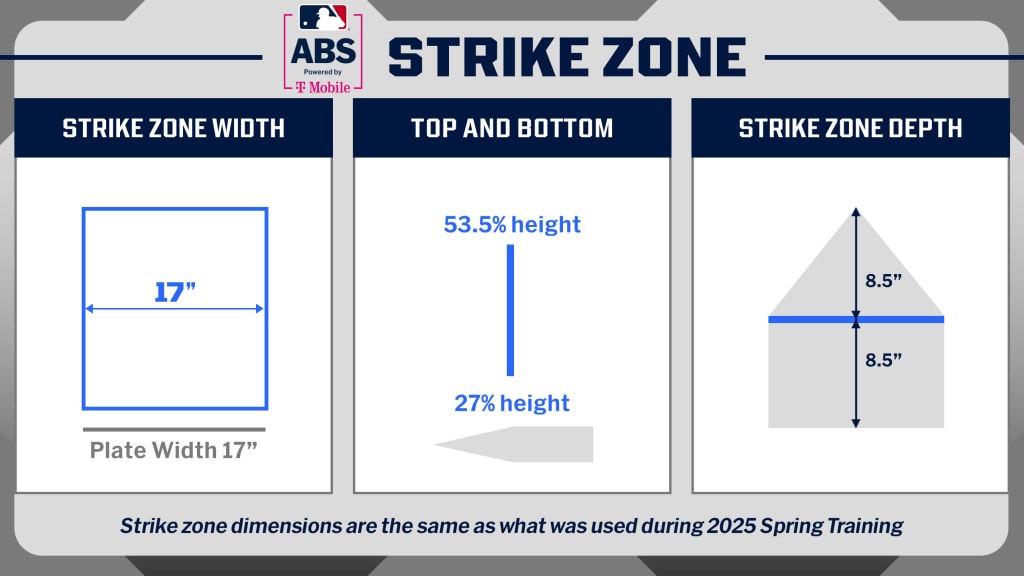
How does this compare to the human umpire zone?
The umpire-called zone has generally been more rounded and more lenient to pitchers, with a 55.6% max up top and 24.2% minimum at the bottom.
As an example of the impact this can have on a key call, MLB research found that, in 2-2 counts, the umpire-called zone was 449 square inches, while the ABS zone was 443 square inches.
Is the ABS strike zone three-dimensional?
No. Though the rulebook defines the strike zone as a three-dimensional box, the ABS strike zone is two-dimensional. A three-dimensional version was initially tested, but it allowed breaking balls to nick the edges of the zone, leading to inconsistency in strike calls.
Why is the ABS strike zone over the middle of the plate instead of the front?
In the past, TV broadcasts featured a zone set at the front of the plate. But similar to the 3D testing, having the zone over the front of the plate in initial testing produced odd outcomes, such as slow curveballs that clip the very front edge of the zone and land in the dirt being ruled a strike, even though no one who watches baseball would agree.
When the zone was moved to the middle of the plate, the results were much more in line with where the hitter stands and how the strike zone is traditionally called.
Will the ABS strike zone geometry affect strikeout and walk rates?
Based on the testing data, the ABS zone can be expected to slightly reduce the strikeout rate and slightly increase the walk rate.
Note that while the MLB strikeout rate rose from 11.4% in 1955 to 22.2% in 2025, the walk rate has been more static, never lower than 7.6% or higher than 9.6% in that timeframe.
How does the ABS zone account for different player heights?
All position players in Spring Training camps have their heights measured by a team of independent testers conducting manual measurements and by representatives from a research institute using biomechanical analysis to confirm the manual measurements and safeguard against potential manipulation.
Players are measured standing straight up without cleats.
Will ballparks display the number of challenges remaining?
Yes, clubs are required to display the number of ABS challenges remaining for each team on the scoreboard in the scoreline, signified by the code “ABS.”
This notation replaces mound visits remaining (MVR) in the scoreline, but MVR must still be prominently displayed in a place that is easy for the umpire and dugouts to view.
Are technical glitches possible?
Yes. Such is the nature of technology.
In the Spring Training trial in 2025, a grand total of four instances (out of 88,534) were not able to be tracked because of glitches. As that tiny percentage demonstrates, these issues are rare but not impossible.
So what happens in those instances?
If the pitch was tracked but the graphic cannot be displayed on the scoreboard, the challenge result will be communicated verbally from the ABS operator to the home-plate umpire, who will then inform the dugouts of the correct call.
If the pitch was not able to be tracked but the scoreboard display is functioning, the “Call Stands” visual will appear on the board.
If the pitch cannot be tracked and the scoreboard graphic cannot be displayed, then the ABS operator will relay to the umpire that the call stands.
A team keeps its challenge when there is a technical glitch.
Could the Challenge System be paused if these issues persist?
Yes, the umpire will inform both managers that a technical issue is preventing the reliable operation of ABS and that challenges are not accepted until the issue is resolved. An in-park announcement will also be made.
Once the issue is resolved, the umpire will inform both managers that challenges are back in play, and another in-park announcement will be made.
Are there safeguards in place to prevent cheating?
Yes. MLB has instituted a delay on all pitch location data (such as the Gameday App).
Additionally, the broadcast feed with the strike zone box will not be available live. There will be a delay of a few seconds.
Clubs are also prohibited from using their own ball-tracking systems, and MLB will review video from all challenges to monitor for suspicious behavior.
Will the broadcasts still feature the strike zone box?
It remains up to the individual broadcasters to determine whether and how to present the zone. The only change is that MLB is now requesting broadcasters to no longer differentiate the circle in the box depending on whether the pitch is a ball or a strike. In other words, some broadcasts would show a filled-in circle on the zone if the pitch was a strike and a hollow circle if it was a ball. MLB is asking its broadcast partners to do one or the other but not both.
Will challenge statistics be kept for individual players?
Yes. Baseball Savant will add this information to its treasure trove of data. So you’ll be able to see, for instance, which catchers are most successful not just at framing pitches but challenging calls.