


Sluggers will be teeing off in the 40th annual Home Run Derby at Truist Park in Atlanta on Monday night.
Big James Wood will be bringing his colossal power to the contest. The Big Dumper, Cal Raleigh, will likely be big-dumping ball after ball over the stands. Hometown hero Matt Olson may hit a few up over the Chop House and onto someone’s apartment balcony more than 500 feet away.
But nobody, not any one of these premier tater-mashers, will come close to the longest homer in Atlanta history – in maybe all of professional baseball history – from way back in 1954.
“Bob Montag finds a Norfolk and Southern employee on the sidewalk and he’s holding in his hand a baseball that’s covered in old dust and soot,” Tim Darnell, author of "The Crackers: Early Days of Atlanta Baseball," told me. “And Montag can barely make out what’s written on the baseball. It says: ‘Atlanta to Nashville to Atlanta, 518 miles.’ The longest home run in organized professional baseball history.”
Bob Montag nearly never played one inning of pro ball.
He fought in World War II in his early 20s, winning a Bronze Star and Purple Heart. But he was so severely hurt in the process, doctors warned even the simplest of daily activities would be doubtful.
“He was told he would never walk again,” Darnell said.
But somehow, the Cincinnati high school standout not only re-learned how to walk, but re-learned how to crush baseballs.
Montag signed a contract with the Ogden Reds, a Reds Pioneer League affiliate, in 1946 at the age of 23. He went on to play for 10 different teams and eight different leagues over 14 years. He never made it to the Majors because of very poor defense and injuries, but in the Minors, he became a sort of tall baseball tale.
He blasted 223 total homers, while putting up a .251/.374/.454 slash line. He had the best batting average in all of pro ball in 1949 with the Pawtucket Slaters (a Boston Braves affiliate), hitting an absurd .423 with 21 homers, 91 RBIs, 43 steals and a .720 slugging percentage. He moved on to the Atlanta Crackers and hit the most homers (113) in team history, second in Southern Association League history. In 1954 for Atlanta, he hit a single-season record 39 dingers with 105 RBIs, slashing at a .305/.450/.648 rate.
“He was one of the most popular Atlanta Crackers of all time,” Darnell said. “Very recognizable, an Atlanta fixture after he retired.”
"The fans were so good to me that no place else could be home again," Montag once told the Atlanta Journal-Constitution. "I used to get a bigger hand for hitting a fly ball than other guys would get for hitting a home run."
And during that record-setting year of 1954 for the Crackers, Montag did something that solidified him as the “Babe Ruth of the Southern Association League.”
The Crackers played at Ponce De Leon Park – an area that’s about a 20-minute drive from Truist Park in downtown Atlanta. It was beautiful, but also, as many ballparks were back during that time, quirky. For decades, there was a magnolia tree in play 462 feet away in center field. Eddie Matthews and Babe Ruth got fly balls stuck in there. The stadium is gone now, but the old magnolia remains.
More pertinent to this story, there was also a rail line right outside Ponce De Leon – it ran along the right-field fence more than 400 feet from home plate. Conductors would often slow down or even stop the train to take in the ballgame.
“Yeah, you can actually walk along the site of where the Norfolk and Southern railroad train tracks were,” Darnell said. “You can stand there and imagine what it must have been like to have a concrete and steel, double-decker Minor League ballpark – standing on what is now a Home Depot and a Whole Foods.”
And on a humid Georgia afternoon, against either the Mobile Baybears or the Mobile Bears, Montag crushed one way, way up to where you’d be standing. Over the right-field bleachers, over the low fence in front of the railroad, over everything. So far that nobody even knew what happened to it.
“Nobody really sees where the ball goes,” Darnell said. “It goes to right field, past the magnolia tree and disappears.”
Days later, Montag and his team find out what really happened to the homer.
"It lands in a passing railroad car," Darnell told me. "A train heading out to Nashville, Tennessee."
A Norfolk and Southern rail train had stopped to take in the Crackers-Bears game and, unbeknownst to the conductor, the ball landed in one of the cars. It then took off for Tennessee and once it arrived in Nashville for unloading, the ball was discovered buried in coal.
The train eventually came back to Atlanta, and when it did, the conductor contacted one of the Crackers' traveling secretaries to see Montag. The slugger met the conductor out on the sidewalk of Ponce De Leon Avenue and, well, was a bit surprised by what he found: The slugger was presented with his home run ball from days before -- a hit that had traveled 518 miles across two states -- on which to etch his signature.
Maybe, quite possibly, the longest home run ever home run'd.
"We don't know where the ball wound up, with the team or with the employee of the railroad who had it, but this is a pretty verifiable circumstance in baseball history," Darnell, who interviewed Montag multiple times about this story for his book, said.
The son of the Crackers owner, Earl Mann, talked about the moment in 2013. It was even noted in a 1977 article from the Atlanta Journal Constitution.
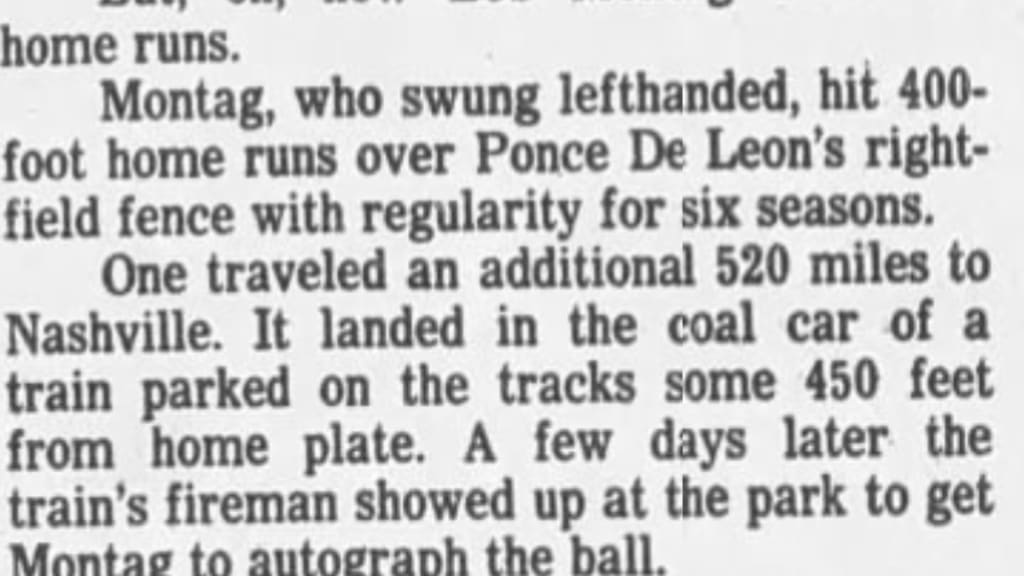
Sure, there have been other tales of home runs rocketing out onto trains, on board ships or into alligator ponds, but this one seems a bit more believable.
First, as Darnell relayed, the tracks were around 400-450 feet away in right, reachable by premier sluggers like Montag. It's physically possible. And trains did routinely stop to take in games, letting passengers off just near the rail-lines. Old Cracker fans claimed they used to sit out by the box cars when Montag came to the plate. A tough target, but possible.
Secondly, Atlanta is a city made for long, high homers. The old Atlanta-Fulton County Stadium, where Hank Aaron broke the all-time home run record, was known as "The Launching Pad." Truist Park has the third-highest elevation in baseball, just behind Coors and Chase Field. The humid Georgia summers make for an extremely fly-ball inducing climate.
Finally, what's the harm in not believing someone hit a 518-mile home run onto a passing train, that then traveled from Atlanta to Nashville and back again? That's no fun.
"Let's put it like this, if it didn't really happen, it's one hell of a story," Darnell laughed. "How are you gonna prove nowadays that it didn't?"