
Prior to 2025, of the 144 players who had received qualifying offers, only 14 had accepted -- roughly 10 percent -- including just one player (Reds right-hander Nick Martinez) accepting over the past two winters.
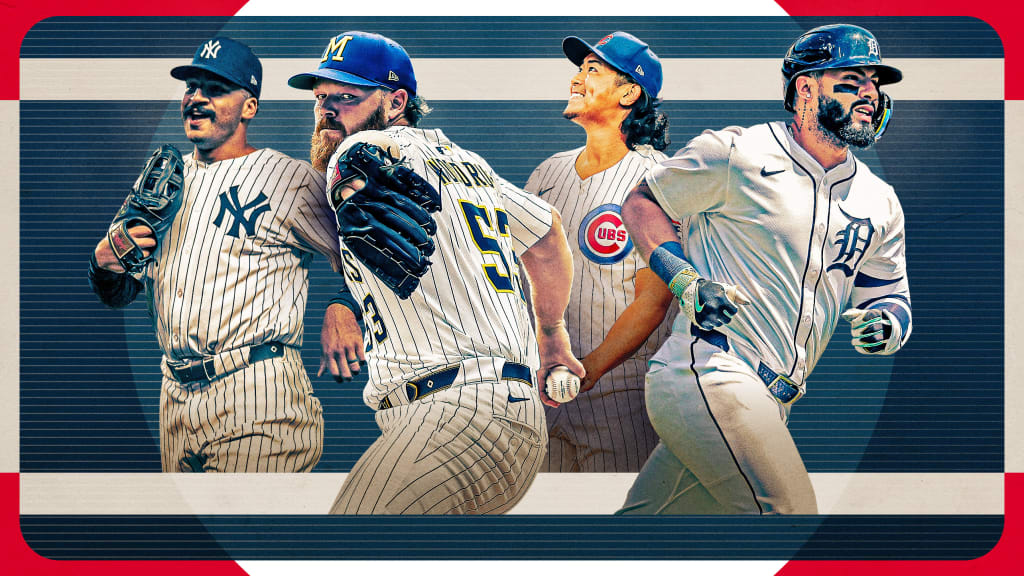
There was a drastic change on that front this year, with four players (out of the 13 offered) accepting the QO. The four players who accepted were Yankees outfielder Trent Grisham, Brewers righty Brandon Woodruff, Cubs lefty Shota Imanaga, and Tigers second baseman Gleyber Torres. We asked MLB Insider Mark Feinsand to explain the factors that led to this.
Why do you think so many players accepted the QO this year?
The four players who accepted the qualifying offers each did so for different reasons.
- Torres was an All-Star for the Tigers in 2025, but he struggled in the second half, slashing .229/.331/.339 with seven home runs in 73 games over the final three months of the season. Having the QO attached to him would have hurt his market, but now he can go back into free agency next year without one.
- Grisham had a career year with the Yankees, posting career highs in home runs (34), RBIs (74) and OPS (.812), but his lack of track record could have caused teams some pause when it comes to surrendering Draft picks to sign him.
- Imanaga’s contractual situation was one of the more interesting of the winter; the Cubs declined a three-year, $57 million option, then Imanaga declined a $15 million option for 2026. By accepting the QO, he will earn $7.025 million more than he would have with the option while not forcing him to pursue a deal with Draft-pick compensation attached. Imanaga’s 5.17 ERA over his final 12 starts may have also contributed to his decision.
- Woodruff returns to the only team for which he has pitched, and while he performed well when he was on the mound in 2025 (7-2, 3.20 ERA in 12 starts), a lat strain ended his season in September. His recent injury history may have caused some concern about his ability to land a multi-year deal.
Of the four players who accepted, which was most surprising to you?
Woodruff. The right-hander proved that his shoulder was healthy after his 2024 surgery, but with a deep starting pitching crop on the free-agent market, he decided to take the $22.025 million salary (which, on top of his $10 million buyout from the player option he declined earlier this month, guarantees him $32.025 million through 2026). Then again, while his numbers were good in 2025 -- he ranked in the top 10 percent in both strikeout and walk percentage -- Woodruff’s velocity was down: his fastball averaged 93 mph, down from the 96 mph he featured prior to his surgery.
How about least surprising?
Grisham. As good as Grisham was in 2025, his season was something of an outlier compared to the rest of his career. His 34 home runs were double his previous high (17 in 2022), while his career-best OPS (.812) and OPS+ (125) were his highest since the COVID-shortened 2020 campaign and easily the highest in a 162-game season. Ironically, Grisham’s numbers at hitter-friendly Yankee Stadium (.195/.326/.376, 13 homers in 70 games) paled to his road splits (.269/.367/.537, 21 homers in 73 games), but he’ll be back with the Yankees in 2026, hoping to replicate his breakout season before returning to free agency next winter.
The feeling throughout the industry was that while Grisham could have secured more than $20.025 million in guaranteed money on a free-agent deal, he would have had a difficult time landing a multi-year deal with an average annual value anywhere close to that, especially with Draft-pick compensation attached to him.
Which free agent(s) will be most affected by the players that did accept the QO? In other words, players whose markets might have improved with some of these names off the board.
The top starters on the market (Dylan Cease, Tatsuya Imai, Michael King, Framber Valdez, Ranger Suárez and Zac Gallen) were going to get paid regardless of what happened on Tuesday, but with Woodruff and Imanaga staying with their respective teams, some other starting pitchers could be beneficiaries of those decisions. Second-tier starters including Merrill Kelly, Chris Bassitt, Tyler Mahle and Zack Littell have two fewer arms to contend with in their search for new contracts.
Grisham’s decision to accept the QO also takes the top center-field option (or No. 2, if you’re counting Cody Bellinger as a center fielder) off the market, which should benefit free agents such as Harrison Bader and Cedric Mullins.
Of the four teams who had a player accept the QO, which one do you think is most pleased with the outcome?
I would think either the Cubs or Brewers, both of whom were going to be in the market for starting pitching. Even with Imanaga’s return, Chicago could still look to add another starter to its rotation, which currently includes Matthew Boyd, Cade Horton, Jameson Taillon and Colin Rea. The Brewers will have Woodruff, Freddy Peralta and Jacob Misiorowski in the top three spots of the rotation, followed by some combination of Quinn Priester, Chad Patrick, Tobias Myers, Robert Gasser and Logan Henderson. Woodruff’s return also opens the door for a Peralta trade, though he’s set to earn only $8 million this season, making him one of the most affordable frontline rotation options in the game.