

It’s hard to pick an adjective -- or, in our case, a research nugget -- that best captures the brilliance of Cam Schlittler in his postseason debut.
Last Thursday, facing elimination in Game 3 of the Wild Card Series against the Red Sox, the Yankees handed the ball to Schlittler, a 24-year-old with 14 career starts. The stage was not too bright: Schlittler blanked Boston across eight scoreless innings with 12 strikeouts and no walks. He’s the first pitcher in postseason history with that statline. His 12 strikeouts are the most by a Yankees pitcher in his playoff debut, breaking Dave Righetti’s 44-year record. In fact, no pitcher has ever recorded more strikeouts in a winner-take-all postseason game.
Schlittler’s encore is lined up for Game 4 of the ALDS on Wednesday night in the Bronx. Once again, the weight of a season will be on his shoulders. Via moxie and stuff, Schlittler has proven more than capable of meeting the moment.
“It’s easy gas,” Gerrit Cole told reporters on Thursday night.
That’s a good place to start our exploration of Schlittler’s dominance. He overwhelmed the Red Sox by throwing 89.7% fastballs -- 96 of his 107 pitches were either four-seamers, sinkers, or cutters. In the pitch-tracking era (since 2008), there have only been 11 instances of a starting pitcher throwing a higher percentage of fastballs in a postseason game (min. 50 pitches). Only one pitcher appears on that list twice, and it’s Lance Lynn, who made a career out of throwing strictly fastballs. The last to do it? Cal Quantrill in Game 1 of the 2022 ALDS, against the Bombers.
Schlittler’s fastball usage contradicts what’s happening around the league. There were fewer fastballs thrown this season than any other year in the pitch-tracking era. In the postseason, fastball usage rate (55.9%, through play on Saturday) has only been lower in 2019, in that same timespan.
Then there’s Schlittler, etching his name into the history books with a legendary 107-pitch outing punctuated by 96 fastballs and just 11 curveballs. On the season, he threw fastballs 88% of the time to right-handed hitters and 79% of the time to lefties.
“It's just a four-pitch mix, and I've seen really good results with it,” Schlittler said.
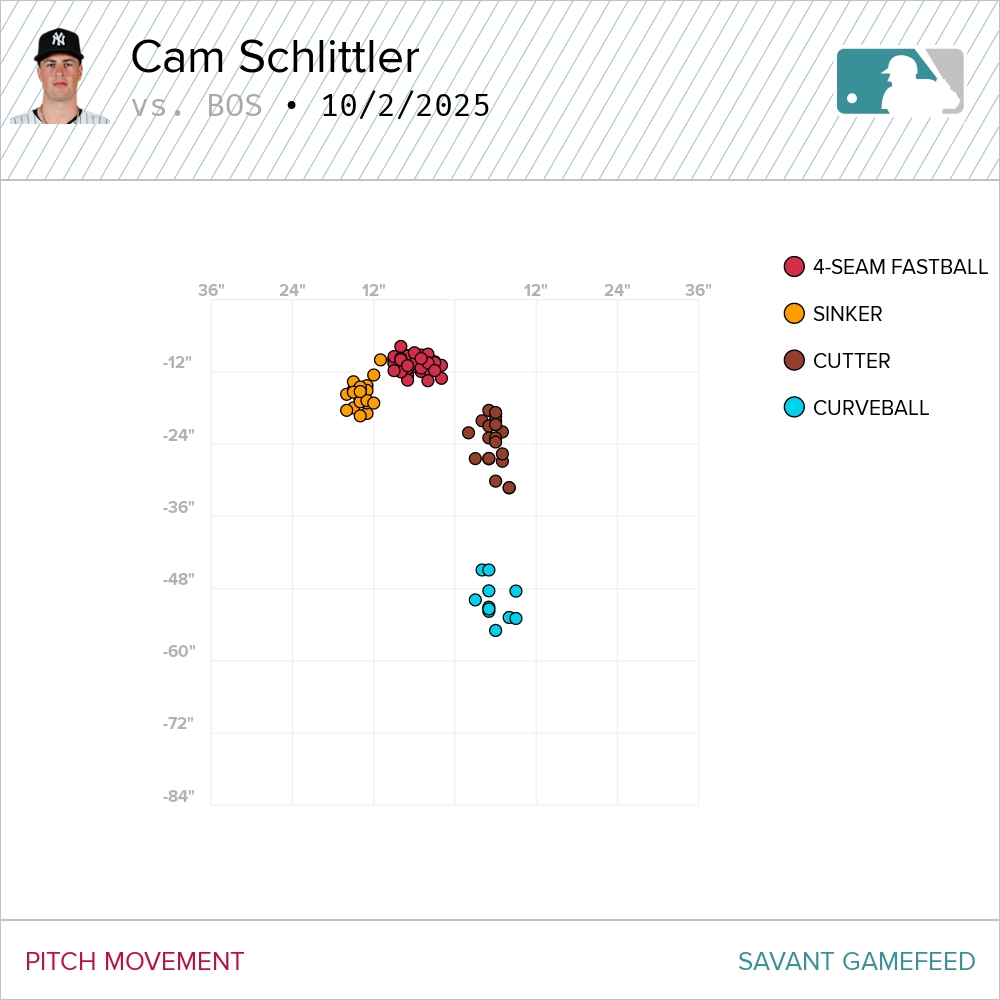
What gives? One difference is that Schlittler throws three fastballs -- four-seam, sinker, cutter -- and is a part of a new trend sweeping across baseball. As MLB.com’s David Adler recently noted, the number of starters throwing all three fastball types has increased. Tigers ace Tarik Skubal -- who throws two fastball variants -- called it “the biggest change” across pitching this year.
When a pitcher throws three pitches at similar velocities with distinct movement profiles, it’s difficult for a hitter to match their bat path with the ball. Therein lies the benefit of multiple fastballs. Hitters can’t rely as heavily on spin -- like they do to identify breaking pitches -- because there’s not much of a difference to pick up on. Multiple fastballs are difficult to recognize, let alone barrel.
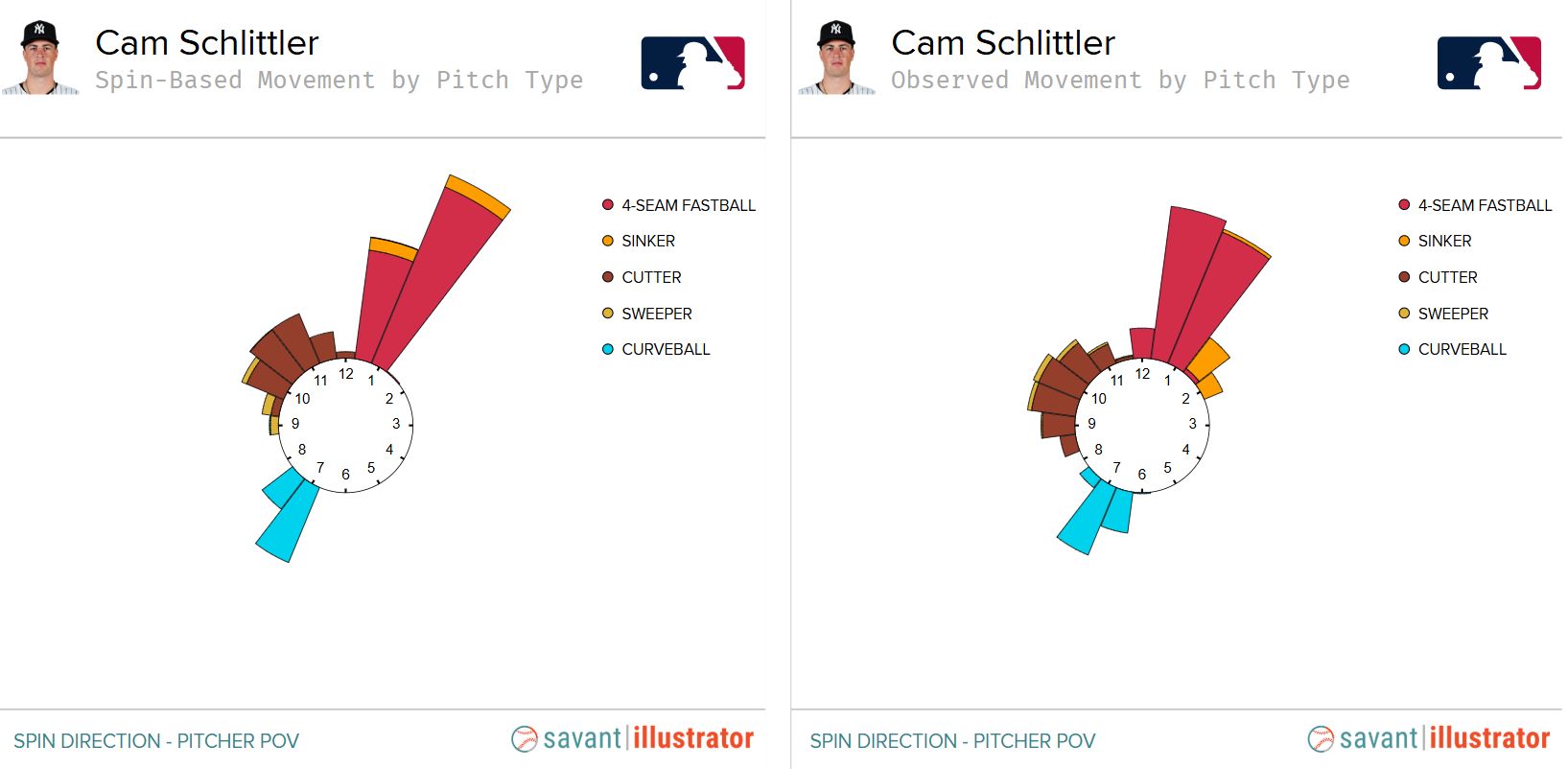
The images below show Schlittler’s spin profile, comparing the spin-based movement out of the pitcher’s hand (left) with the observed movement from spin direction at the plate (right). The four-seamer (bright red) and sinker (orange) look the same to the hitter when Schlittler first releases them; by the time they get to the plate, they are behaving differently. The sinker has more horizontal movement than Schlittler’s cut-ride four-seamer. The cutter (dark red) changes on its way to the plate, too; it’s released at a 10:45 spin direction -- each “slice” is 30 minutes -- and arrives at the plate at 9:45.
The other component here is velocity. Schlittler’s four-seamer sits at 98.0 mph; only Hunter Greene, Jacob Misiorowski, and Paul Skenes throw harder, among qualified starters. His sinker averages 97.5 mph, while his cutter comes in at 91.9 mph, on average. This is pure heat.
So, not only do Schlittler’s three fastballs move differently, but they are atypically fast, giving the batter even less time to react. How difficult is that to hit? Here’s what then-Yankees infielder DJ Lemahieu told then-Yankees pitcher Michael King, back in 2022: “He was like, ‘If you throw two different fastballs at 95-plus with an actual separation of movement, it’s impossible for a guy to match his bat paths to the pitches.’”
For Schlittler, 95-plus is actually 97-plus. Here’s where things get weird: Schlittler was not always throwing “easy gas,” as Cole called it. In ‘23, he averaged 90.0 mph on his four-seamer in five starts with Single-A Tampa. Yes, that’s the same guy who threw 64 pitches at 98.0 mph on Thursday, six more than any other pitcher in a postseason game, since 2008.
When the Yankees drafted Schlittler out of Northeastern in the seventh round of the 2022 Draft, they told him to add 20 pounds of muscle to his 6-foot-6 frame. It took time. He overhauled his diet, toiled in the weight room, and worked closely with Eric Cressey, the organization's Director of Player Health and Performance. The team also helped Schlittler change his fastball grip to produce more carry -- and the new shape unlocked more velocity, too.
That labor created the dominant pitch we see today. In the regular season, the opposition hit .176 off Schlittler’s four-seamer with a 27.7% swing-and-miss rate -- 11th highest among 148 SP who generated at least 200 swings off their fastball. From an average release height of 6.39 feet -- higher than the vast majority of pitchers -- Schlittler’s fastball zips to the plate.
Against Boston, Schlittler had all three fastballs working in concert with one another. He induced 11 whiffs on 26 swings against his four-seamer, pounding his heater up in the zone. He threw 25 sinkers -- 12 more than he had ever thrown in a single game -- with a 36% usage rate against right-handed hitters. The cutter kept both sided hitters off balance, inducing soft contact on four balls in play.
“The stuff was outstanding,” Red Sox manager Alex Cora said. “That was electric.”
The Red Sox had not seen Schlittler before. But the Blue Jays will be facing him for the third time. The first outing, on July 22, went well. But on Sept. 5, Toronto knocked Schlittler out in the second inning, and the right-hander believed he was tipping his pitches.
Whether he was tipping or not, Toronto’s offense has different strengths from Boston’s. For one, the Blue Jays handle velocity better. Weighted On-base Average -- wOBA -- is a version of on-base percentage that values extra-base hits more than singles. This season, against pitches 98.0+ mph, Toronto ranked 10th in MLB with a .296 wOBA; Boston ranked 25th (.257). That’s certainly relevant, because Schlittler overwhelmed the Red Sox with high-octane velocity.
Toronto is also adept at hitting elevated velocity -- which we’ll define as pitches 95.0+ mph in the upper-third of the strike zone or higher. On these pitches, the Blue Jays posted a .323 wOBA, third best in MLB; the Red Sox had a .275 wOBA, which is seventh worst. Alejandro Kirk (.813 SLG) and Vladimir Guerrero Jr. (.667 SLG) are two of the best hitters in baseball against high heat.
That doesn’t mean they’ll hit Schlittler. What it does mean is that this will be a tantalizing matchup, one that the 24-year-old won’t shy away from. Schlittler will take the mound Wednesday night to a hero’s ovation, ready to throw three different high-velocity fastballs and see where they take him.