

With Dylan Cease off the market, one of the best free-agent starting pitchers you can still get is Framber Valdez. But it's for a very different reason.
When you look at what got Cease his seven-year, $210 million deal with the Blue Jays, it's strikeouts. He's a strikeout machine. Cease gets 200 K's a year, like clockwork, and that high-strikeout skill set made him a top-tier free-agent starter.
For Valdez, it's not quite that. Yes, the former Astros ace gets a lot of strikeouts, too -- 187 a year from 2022-25 -- but the 32-year-old left-hander doesn't get them at the rate Cease gets them. The No. 1 standout skill Valdez has, the one that makes him a top-tier free agent starter, too, is that he's a ground ball machine.
Valdez is the most consistent ground ball pitcher in baseball. All those ground balls let him chew up innings (an average of 192 per year since 2022), and make him one of the most valuable workhorse starters available entering 2026.
You can't find many ground ball specialists in Valdez's class in the Majors, let along on the starting pitching free agent market.
Since his breakout season for Houston in 2020, Valdez has never ranked outside the top 10% of MLB pitchers in ground ball rate induced. And usually, he's better than that -- at least in the top 5%, if not the top 1%.
Valdez's ground ball rate by season
With MLB percentile ranking
- 2020: 60% -- 96th percentile
- 2021: 70% -- 100th percentile
- 2022: 67% -- 100th percentile
- 2023: 55% -- 91st percentile
- 2024: 62% -- 99th percentile
- 2025: 59% -- 97th percentile
That's six straight seasons with a ground ball rate of 55% or higher -- two more than any other starting pitcher since 2020. Giants ace Logan Webb has four such seasons. Phillies ace Cristopher Sánchez has three. Those are the only other starters who are even in the ballpark of Valdez's ground ball consistency.
Since 2020, Valdez has induced a grounder on 62% of the batted balls he's allowed. That is the highest ground ball rate this decade among regular starting pitchers.
Highest ground ball rate induced, since 2020
Min. 1,500 total batted balls allowed
- Framber Valdez: 62%
- Logan Webb: 58%
- Cristopher Sánchez: 58%
- Max Fried: 55%
- Brayan Bello: 53%
- Ranger Suárez: 53%
- Marcus Stroman: 53%
That is just a ton of unproductive contact. Ground balls might turn into hits some of the time, but they rarely turn into extra-base hits, and they never turn into home runs.
And that's only looking at when hitters do put the ball in play off Valdez. Add the 951 strikeouts he's collected since 2020, a top-10 mark in the Majors, to the 1,666 ground balls he's induced (second-most behind only Webb's raw total), and you get a massive amount of unproductive plate appearances.
You get a frontline starter who, year in and year out, is one of the hardest to do damage against.
Nearly two thirds of the batters to face Valdez over the last six years have either hit a ground ball or struck out. There are 109 pitchers who have faced at least 2,000 batters over that time. None have induced those two outcomes, ground ball or K, more often than Framber.
Highest % of PA ending in ground ball or K, since 2020
Min. 2,000 batters faced
- Framber Valdez: 65%
- Cristopher Sánchez: 64%
- Logan Webb: 64%
- Max Fried: 61%
- Shane Bieber: 59%
- Corbin Burnes: 59%
- Ranger Suárez: 59%
- Hunter Brown: 59%
Valdez's pitch arsenal is precisely engineered to get either a ground ball or a K. He has three standout ground ball pitches -- his sinker, curveball and changeup -- with one, the curve, that doubles as a plus strikeout pitch.
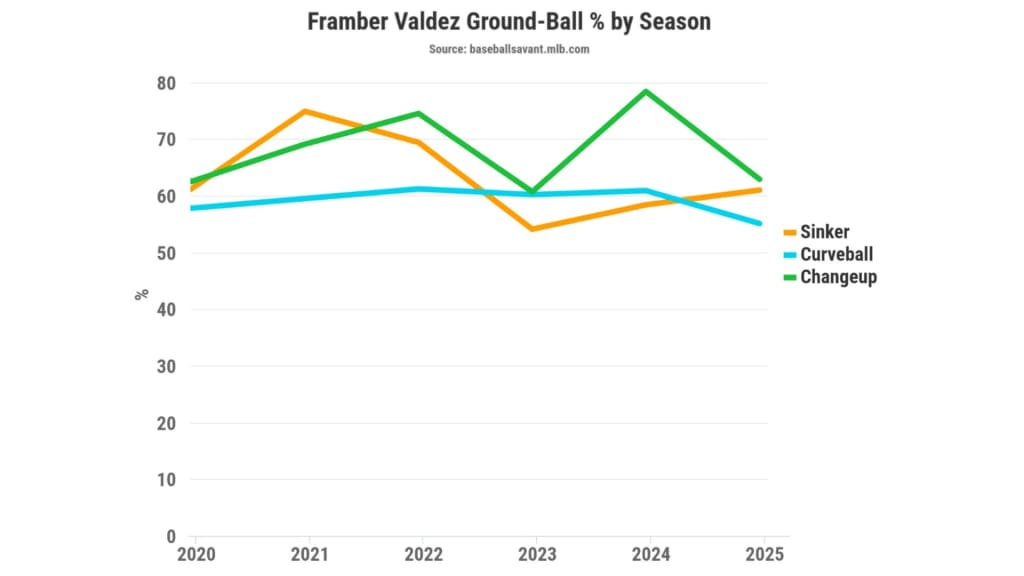
Valdez's sinker, curve and changeup account for about 90% of the pitches he throws every season. And those three pitches, individually, all generate ground ball rates of 55% or higher essentially every season.
That pitch combination forces hitters into the ground because Valdez's sinker, curveball and changeup all generate a ton of vertical drop. Each of the three pitches is well above the Major League average in downward vertical break induced.
Compared to the average big league lefty in 2025, Valdez's sinker induced an extra two inches of drop. His changeup induced an extra four inches of drop. And his curveball induced five extra inches of drop.
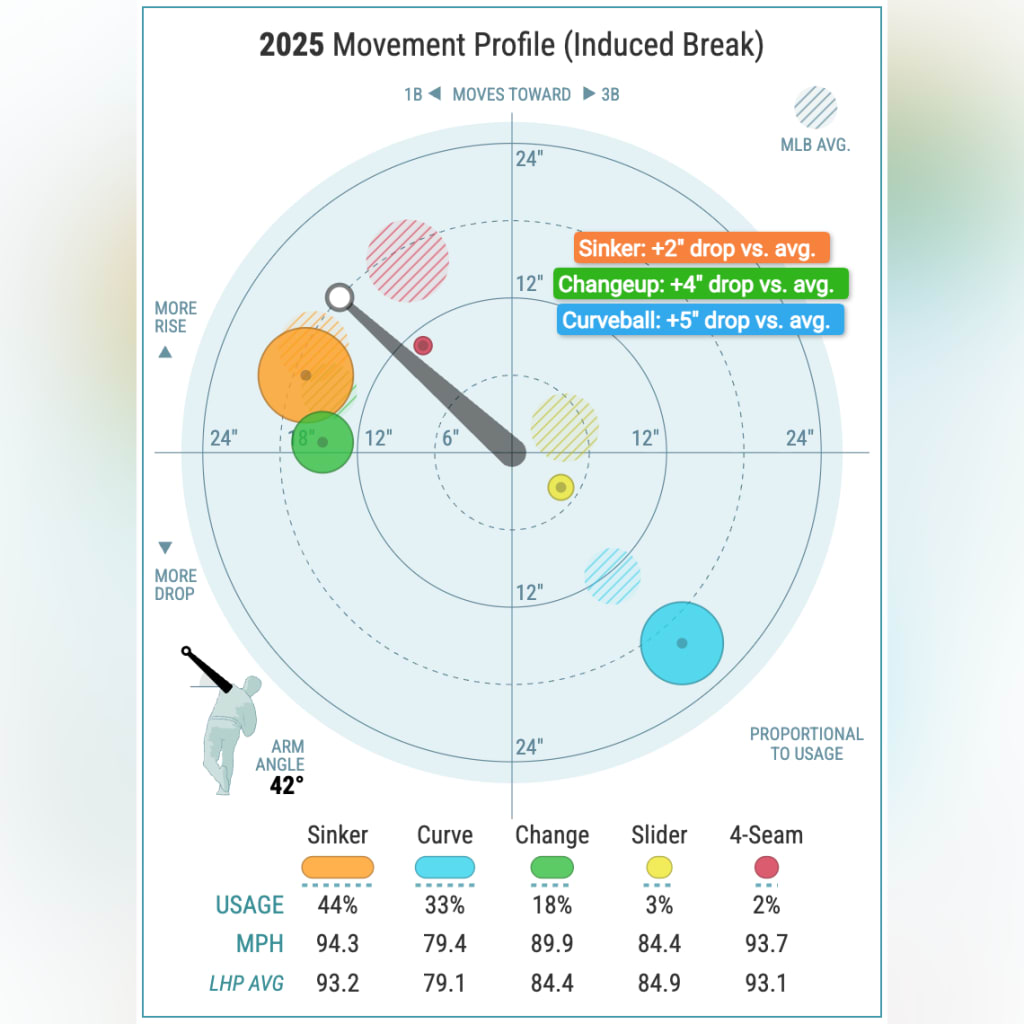
That pitch movement profile is the foundation of Valdez's identity as a ground-ball innings-eater. But the fact that his curveball can also carry the load as a putaway pitch takes him up a level.
Valdez throws a high-spin curve -- his spin rate was 2,943 rpm in 2025 -- which lets him generate his sharp downward movement. A curveball with sharp downward movement is good for two things: Ground balls, because hitters have a hard time lifting a ball spinning down to the bottom of the zone, and K's, because they swing over the top of it.
Valdez's curveball regularly produces swings-and-misses at a 40%-plus clip, and it's the pitch that accounts for the vast majority of his strikeouts every year. In 2025, he got 121 strikeouts on curveballs -- the most K's by any pitcher on curves, and the second-most K's by any pitcher on any pitch type. He was one of just 11 big league pitchers to notch triple-digit strikeouts on an individual pitch.
Most K's on single pitch type, 2025
- Cristopher Sánchez's changeup: 130
- Framber Valdez's curveball: 121
- Dylan Cease's slider: 116
- Chris Sale's slider: 113
- Sonny Gray's sweeper: 111
- Nick Pivetta's 4-seamer: 111
Valdez's curveball even managed to rack up more K's than the top strikeout pitch of his fellow marquee free agent, Cease.
And his 2025 strikeout total on his curveball was not an outlier. In the five full seasons since his breakout (we're excluding the shortened 2020 season), Valdez has averaged 102 curveball strikeouts a year, and his lowest full-season total is 85.
As a matter of fact, Valdez's curveball has been one of the best strikeout pitches in baseball this decade. The only pitches to generate more K's than Valdez's 570 on curveballs since 2020 are Kevin Gausman's splitter (617), Cease's slider (615) and Charlie Morton's curve (588).
The curveball K's are the icing on the cake that is Valdez's sinker-curveball-changeup extreme-ground-ball combo.
So what does Valdez's profile mean for his free agency? Well, even with the punchouts, the sheer volume of ground balls he generates mean he would benefit from a team that will play sharp infield defense behind him.
The Astros were very consistent about supporting Valdez with their fielding. Since 2020, Valdez has had the second-best defense behind him of any pitcher, according to Statcast's Outs Above Average -- both in terms of overall defense (+35 OAA) and infield defense specifically (+26 OAA).
Pitchers with best INF defense behind them, 2020-25
- Merrill Kelly: +28 OAA
- Framber Valdez: +26 OAA
- Yu Darvish: +24 OAA
- Cal Quantrill: +23 OAA
- Max Fried: +22 OAA
Of the teams that have been linked to Valdez so far this winter, three stand out as good fits for Valdez for the strength of their infield defense entering the 2026 season.
One is the Mets, especially now that they've brought in Marcus Semien to play second base. Semien and shortstop Francisco Lindor are two of the top five most valuable middle infielders of the last five years, worth a combined +85 runs saved from their defense.
Another is the Giants. Their left side of the infield is particularly strong, with five-time Gold Glover Matt Chapman at third base and Willy Adames at shortstop. Chapman has been worth +70 Outs Above Average since his debut in 2017, one of the best third basemen in the game, and Adames has emerged as a high-level defender in recent seasons, with +31 OAA since 2022. Plus, Webb has thrived in San Francisco under the same ground ball blueprint as Valdez, he's just a right-handed pitcher instead of a southpaw.
And a third is the Cubs. The Cubs, who are looking for another impact starter even with Shota Imanaga returning via the qualifying offer in 2026, have an elite up-the-middle duo in shortstop Dansby Swanson and second baseman Nico Hoerner. In their three seasons together in Chicago, Swanson and Hoerner have been worth a combined +62 runs saved from their defense, according to Statcast. No teammate middle-infield duo has been better over that time.
So Valdez has options. Going to a team with great infield defense isn't a must for him -- he's going to pitch tons of innings and get tons of outs regardless -- but it could help his 2026 team really get the most out of one of the top left-handed starting pitchers in the Majors.