ANAHEIM -- By 1960, Gene Autry was long known as one of the most famous entertainers in the United States, earning his nickname “the Singing Cowboy.”
His career started in the 1930s, as he appeared in 93 movies from 1934-1953 before hosting "The Gene Autry Show" on television from 1950-56. He brought the country western genre to the forefront with his songs and films and was the epitome of a straight-shooting western hero.
But Autry also had an interest in baseball, playing semi-pro ball in Oklahoma and serving as a part-owner of the Minor League Hollywood Stars in the 1950s. He also owned Los Angeles' KMPC radio, so when he heard that Major League Baseball was set to add an expansion team to join the Dodgers in Los Angeles in 1961, he planned to attend the annual MLB Owners’ Meeting in St. Louis in 1960 to express an interest in the broadcast radio rights for the new club. KMPC had previously broadcast the Dodgers’ games on radio for their first three years in LA from 1958-60 but lost the rights heading into the 1961 season.
Initially, former Tigers slugger Hank Greenberg was on the fast track to become the owner of the new expansion team. But Dodgers owner Walter O’Malley didn’t want to share the Los Angeles market with Greenberg, especially once he heard master promoter Bill Veeck was going to be a partner of Greenberg’s.
With the help of MLB Commissioner Ford Frick, O’Malley got his way and Greenberg backed out of the deal. The often-told story is that Autry simply wanted the radio rights but impressed baseball executives so much at the Owners’ Meetings that he was persuaded into owning the club instead.
But there were published reports ahead of the Owners’ Meetings that Autry was interested in submitting a bid for the new club. He also brought former player and manager Fred Haney along with him to the meetings and said he planned to have Haney serve as general manager of the new franchise.
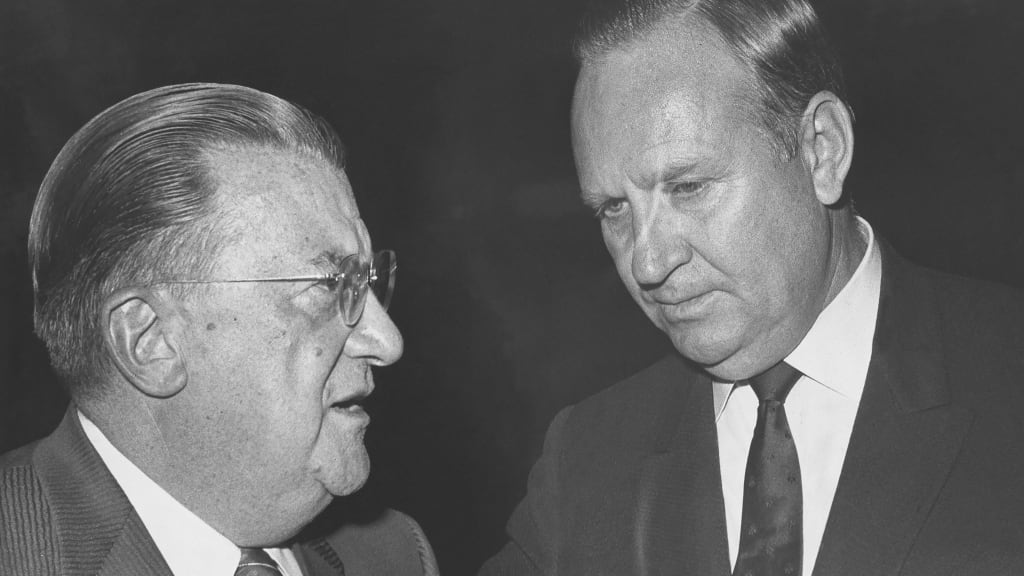
With his national popularity and wealth, Autry made it easy on the league to approve him as the new owner of the 10th club in the American League. Autry wanted to name his team the Los Angeles Angels after the Minor League club of the same name.
O’Malley, though, owned the rights to the name, so Autry had to pay him $300,000 for the organization to be named the Los Angeles Angels. Autry also made several other concessions, including playing the first season in club history at the Minor League stadium, Wrigley Field, in Los Angeles instead of sharing the L.A. Memorial Coliseum with the Dodgers. The Angels also played their home games at Dodger Stadium under the name of Chavez Ravine from 1962-65. O’Malley and the Dodgers charged the Angels a minimum of $200,000 rent per year and kept the parking revenue.
But Autry, who was friendly with O’Malley, proved to be a likable owner from the start despite the challenges that came with sharing the market with the Dodgers and not having a stadium for their first five years of existence.
Their first season was a tough one, as the Angels lost 91 games while playing in a stadium that held just 20,457 spectators. But they were surprise contenders in their second season, winning 86 games while seeing their attendance nearly double at Chavez Ravine.
But it became clear the team had to forge its own identity, and Autry moved the Angels south to Anaheim in Orange County. He renamed the club the California Angels, and Angel Stadium, then called Anaheim Stadium, opened in 1966.
Autry was known for being friendly with his players, coaches and media while always wearing his signature white Stetson cowboy hat. He also realized that star players are a draw after seeing the success of superstar Nolan Ryan, so he signed top free agents like Don Baylor, Joe Rudi and Bobby Grich ahead of the 1977 season while inking future Hall of Famer Rod Carew ahead of the ’79 season.
It led to success, with the Angels winning the AL West in both 1979 and '82 and later in ’86, but the World Series eluded Autry. He turned over control of the franchise to his wife, Jackie, in 1990 but was still a constant at the ballpark.
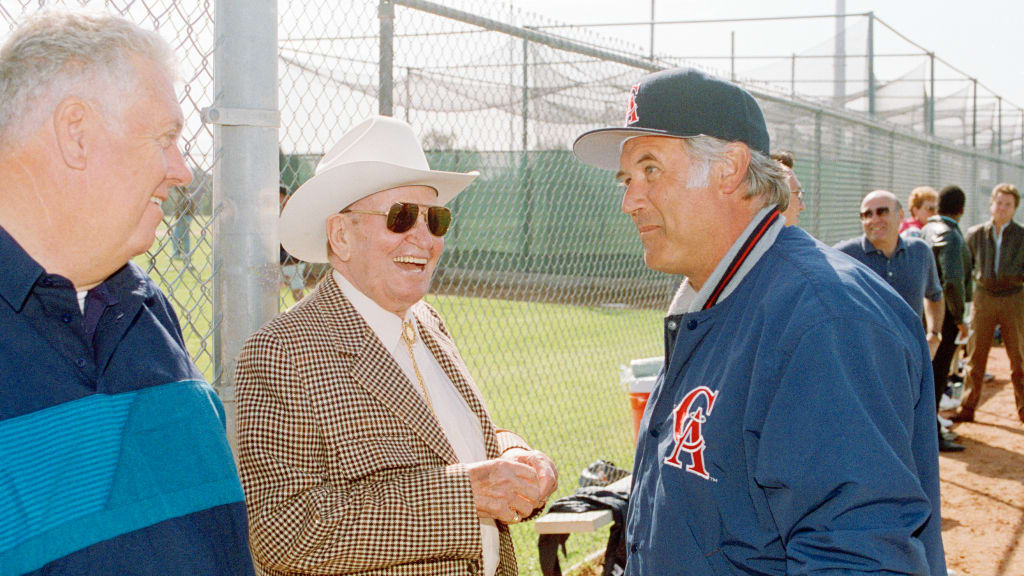
Autry agreed to sell the club to Disney in 1995 and passed away on Oct. 2, 1998, at the age of 91. He had attended an Angels game just 10 days before his death.
With Autry’s fame as a country star, the line “win one for the cowboy” has become synonymous with the Angels. The club retired No. 26 in honor of Autry, who was the club’s “26th player,” and his family, including his wife Jackie, still has a suite located next to the press box at Angel Stadium.
And when the Angels finally won the World Series in 2002 four years after Autry’s death, the team dedicated it to him by finally “winning one for the cowboy.” Tim Salmon, one of the most beloved players in franchise history, memorably wore a white cowboy hat during the club’s championship parade at Disneyland to honor Autry.