

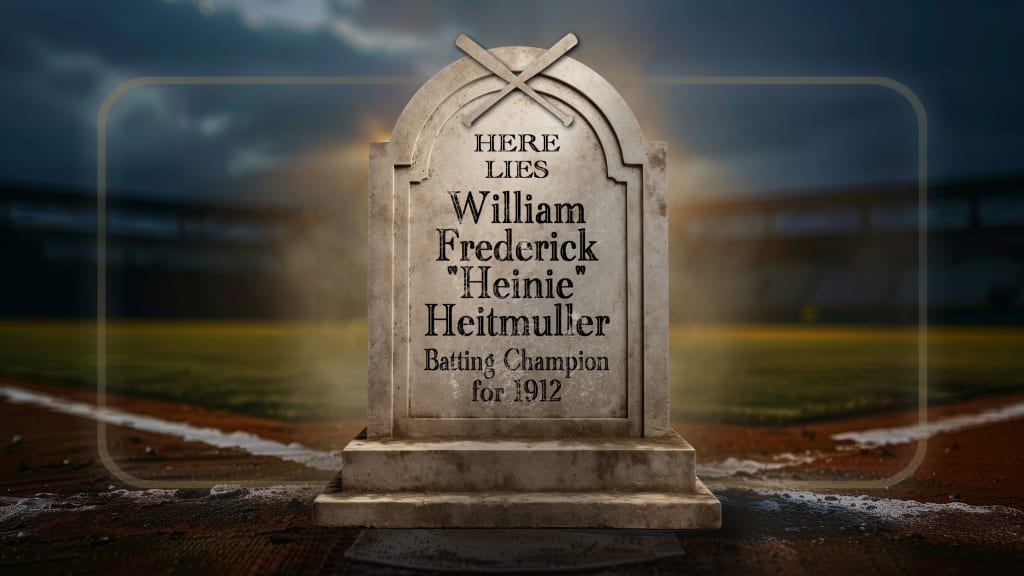
Heinie Heitmuller could always hit.
The San Francisco native started playing independent ball for Oakland in the Pacific Coast League in 1904 after graduating from the University of Berkeley. Along with being a standout outfielder in college, he was also a great football player -- blocking punts that were then recovered for a TD by future two-time World Series champion Orval Overall.
Some might say, although I haven’t seen anybody actually say it, that the mammoth 6-foot-2, 215-pounder was the Bo Jackson of the early 20th century.
But on the diamond is where Heitmuller would make his mark.
After six years of above-average hitting in the PCL, Philadelphia manager Connie Mack took notice. He signed the 26-year-old to his Athletics team for the 1909 season. The Sporting Life reported the move should be a slam dunk:
“If Heitmuller hits for the Athletics like he did for Oakland last year, his job will be secure. There will be nothing to it.”
Heitmuller was already notorious for his power, hitting maybe the longest ball ever hit in Japan on a 1908 All-American Tour. If all went to plan, there would be swatting galore.
“Should he hit the ball as hard for Philadelphia this summer, he will be quite the biggest thing in baseball,” wrote H.G. Baggerley. “And there is no reason why Heinie shouldn’t swat the ball.”
Heitmuller made the team out of the spring in 1909 -- Mack chose him over a young Shoeless Joe Jackson, who was sent back to the Minors for not "hustling" enough. Heinie had a good year, hitting .286 with a .351 OBP. But his average dipped the next season, and he lost his job to Topsy Hartsel -- another unmistakable turn-of-the-century baseball name that would lead the A's to the 1910 World Series.
Heitmuller went back to the PCL, to his familiar West Coast. He hit .343 with Los Angeles in 300 at-bats in 1911, but it wasn't good enough, for long enough, to win a batting title. In 1912, at the age of 29, he was even better.
The slugging outfielder racked up a personal record of 15 dingers and, after a 6-for-6 day on Sept. 27, was second in the league in hitting. But just two days later, Heitmuller was forced to leave a game after falling ill with typhoid fever. He quickly, tragically passed away on Oct. 8. The L.A. Times memorialized the PCL legend beautifully in a story headlined: "Heinie Heitmuller was lovable man in baseball."
"The powerful muscles were no longer pliant, the keen eye was unseeing and the ears which had heard cheers of applauding thousands were deaf to the farewells of his baseball mates, who were gathered at the depot in a mournful group."
“The entire team is depressed in the loss of Heitmuller," manager Pop Dillon said. "We have lost one of the best-liked members of our baseball family."
But even from the grave, Heitmuller would deliver one more reason for his teammates and family to smile. A final, inconceivable impression from his final destination.
The PCL's leading hitter, and fellow Los Angeles Angel Pete Daley, was sitting at .338 on Oct. 8. Heitmuller, who had enough plate appearances to qualify, finished at .335. Daley went into a deep slump during the last few weeks of the season -- dropping his mark from .338 to .332. That meant that, yes, Heitmuller's .335 stood as best in the league.
Passed away on Oct. 8, laid to rest on Oct. 11, a batting champion on Oct. 27.
Famous British poet Robert Chandler once said about dying, "Without an ounce of pity, death strikes all things, brings to nothing stars, and suns are quenched by her cold breath -- destroyer of the universe.”
Sure, but also sometimes, it can lead you to a Pacific Coast League batting title.
h/t Tim Hagerty's Tales from the Dugout