
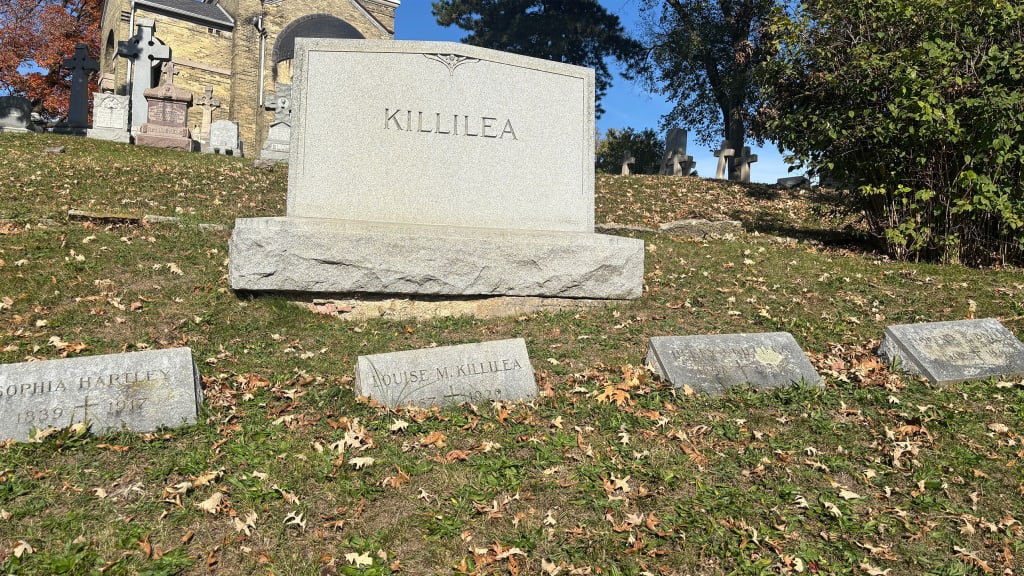
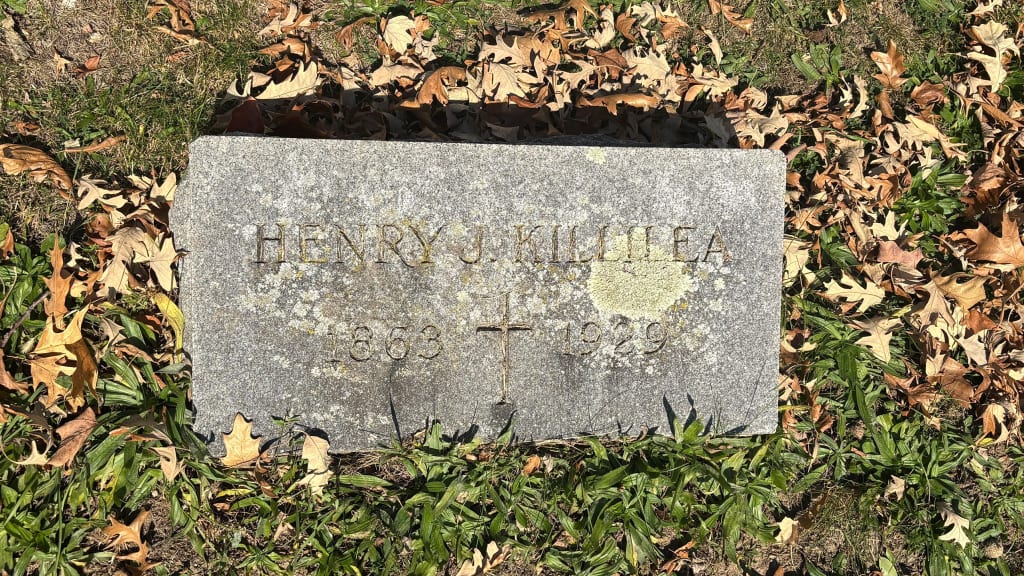
MILWAUKEE -- His tombstone is precariously perched on a hillside, among the scattered leaves and faded memories contained within the city’s oldest Catholic cemetery.
When they buried Henry J. Killilea here at Calvary Cemetery and Mausoleum on Story Hill in 1929, they could not have known how appropriate this final resting place would be. Because nearly a century later, standing here at the grave of the man known as the “Godfather of the American League,” you can look off in the distance and see the site of the World Series that he helped create.
Killilea’s is a name largely lost to baseball history. He’s not in the Hall of Fame or known to more than the most astute of the sport’s historians. But he had a vital role in the modern Major Leagues and in the thawing of the Cold War between the National and American Leagues.
The son of Irish immigrants, Killilea was born in rural Poygan, Wis., in 1863, and went on to study law and play ball at the University of Michigan.
“No one would ever surmise that Henry J. Killilea was at one time one of the crack baseball pitchers in amateur circles,” a fellow lawyer once remarked to the Milwaukee Journal Sentinel, according to a bio by the Society for American Baseball Research, “but I can remember the time when he pitched for the University of Michigan team that he was one of the most effective twirlers in the West.”
After rising within the law profession to a prominent role as a corporate lawyer for large industries, Killilea got involved in baseball. He invested in the Milwaukee Brewers. Not today’s Brewers, but the club that competed in Ban Johnson’s Western League from 1894-99, then as members of the nascent American League in 1900 and 1901. An 1899 meeting considered foundational to establishing the AL as a “Major League” took place in his Milwaukee home.
Following the 1901 season, the Brewers were transferred to St. Louis over Killilea’s objections. He sold his stake in the team, but then headed a group that purchased the AL’s Boston Americans in 1902.
This was a time when the AL and NL were at odds, to put it lightly. The two leagues were in a fierce battle over player contracts and territorial rights. But in the offseason between the 1902 and 1903 seasons, the two sides agreed to a peace treaty known as the National Agreement, and Johnson and Killelea are considered the principal figures in negotiating it.
In August 1903, with the Pittsburgh Pirates en route to the NL championship and the Americans headed toward the AL championship, Pirates owner Barney Dreyfuss wrote a letter to Killilea.
“The time has come for the National League and American League to organize a World Series,” Dreyfuss proposed. “It is my belief that if our clubs played a series on a best-of-nine basis, we would create great interest in baseball, in our leagues, and in our players. I also believe it would be a financial success.”
He was right about everything. (Except maybe the best-of-nine part.) But while Killilea was up for the challenge, it wasn’t as easy as it sounds.
Player contracts ran through Sept. 30 of that year. And though Killilea and Dreyfuss negotiated the winning team getting 75% of the receipts and the losing club taking in 25%, the players wanted both a contract extension and a share of the receipts. It took some negotiation between all involved, but ultimately the player contracts were extended, and they wound up receiving 50% of the club’s receipts to split among themselves.
So the “World’s Series” was on. It did, indeed, begin as a best-of-nine, and Killilea’s club prevailed in eight games.
Like this year’s World Series games at American Family Field, it was a tough ticket in Boston, where many of the grandstand tickets wound up in the hands of resellers who reaped what Sporting Life called a “rich harvest.” This, along with allegations that the games might not have been on the level, drew the ire of fans and press, and Killilea wound up selling the franchise for around $135,000 the following spring.
Though he returned to his business interests in Milwaukee, Killilea remained deeply involved in the game. He was the legal advisor to baseball’s National Commission and the legal counsel to the AL. He resolved differences of opinion between his friends, Johnson and White Sox owner Charles Comiskey. He compelled Johnson to retire when his health was failing him. And in 1928, he purchased another iteration of the Milwaukee Brewers, this time an American Association franchise.
When Killilea passed in 1929, his funeral was attended by Commissioner Kenesaw Mountain Landis, Johnson, Connie Mack and many other of the sport’s principal figures. They paid their final respects at his gravesite, where, if they turned and looked southeast, they could have seen the land where the ballpark initially known as Miller Park would open in 2001. And where the "World’s Series" made possible by Killilea’s communications would one day be played.
Of course, he probably wouldn’t approve of the Brewers being the NL’s representative. But we think he’d still probably be rooting for them.