

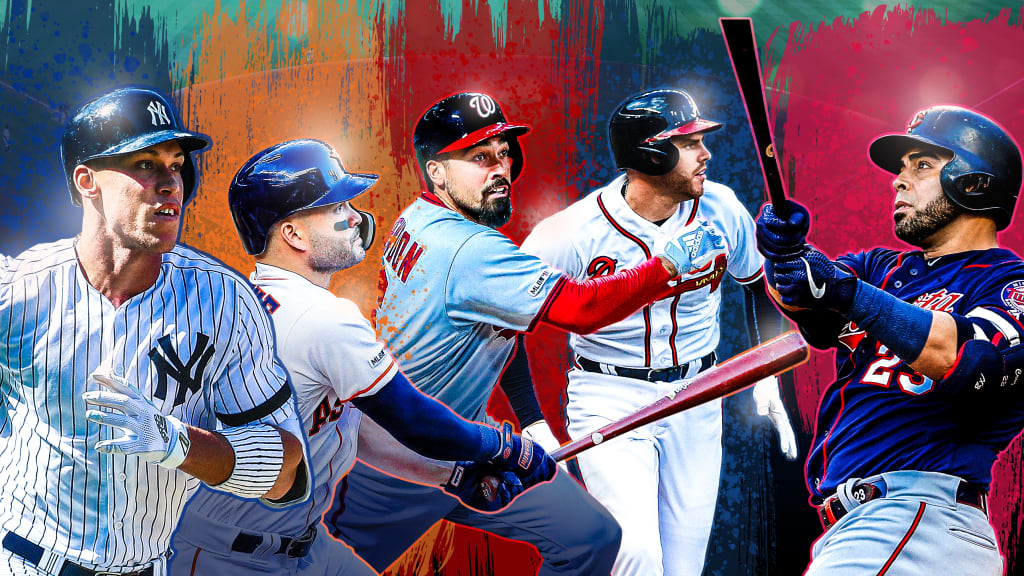
Everything is heightened in October: The awareness. The anxiety. The stakes. When pitcher and batter are locked in an epic battle with the game on the line, there’s nothing better.
With that in mind, we sought opinions from a few evaluators on which three-batter sequences -- i.e., a group that could conceivably be due up at the start of a consequential inning -- pose the most problems for an opposing pitcher. What are the toughest “gauntlets” among this year’s October teams?
Here are the five that elicited the most fervent responses, along with some demonstrative data.
(Note: Batting orders change all the time in today’s game, so we’re listing the orders most frequently used by these clubs in 2019.)
1. Astros
No. 2 José Altuve, No. 3 Alex Bregman, No. 4 Michael Brantley
Facing this lineup is hard, and choosing a particular subset of three for this discussion ain’t no picnic, either. If you’d prefer a variation that involves George Springer or Yordan Alvarez or Yuli Gurriel or Carlos Correa (even amid his late-season physical woes), you are well within your right.
“They’re so deep,” an AL scout said. “They don’t have a weakness.”
These three were selected because, in one order or another, each is among the best in baseball at putting together quality at-bats.
It’s hard to get much past Altuve, who had a 72.5% contact rate on swings outside the strike zone (24th in MLB, per FanGraphs) and the second-most hits (25) in MLB on pitches outside the zone in the second half, per Statcast. Even if you get him to put it on the ground, he can beat it out. He had the most hits (11) in MLB with a home-to-first time under four seconds.
Meanwhile, both Brantley (90.8%) and Bregman (87.0%) ranked in the top five in contact percentage in the Majors this season. Bregman took the lowest percentage of swings (18.8) outside the zone in MLB, and his selectivity helped him post the second-highest OBP (.423) and third-highest SLG (.592) in the AL, as well as strikeout (12.0%) and walk (17.2%) rates that were both in the top six in the AL. Brantley struck out even less, at 10.4%.
“It’s the damage and the contact,” an NL pitching coach said. “There’s damage for all three of them and a ton of contact for all three of them. So the ability to get a punchout is limited and the ability to create damage is high. It’s a really tough combination.”
2. Nationals
No. 3 Anthony Rendon, No. 4 Juan Soto, No. 5 Howie Kendrick
If you see Josh Hader on the street, ask him about the difficulty of facing Rendon and Soto in succession in a big spot.
Better yet, don’t ask him. Rendon and Soto traumatized the Brewers and their fans with that eighth-inning comeback in the NL Wild Card Game, with Rendon grinding out a six-pitch walk to load the bases and Soto bringing everybody home on a line-drive single on a 1-1 four-seamer.
Rendon and Soto have two of the most advanced hit tools in MLB. Rendon’s 88.3% contact rate ranked third in MLB, his 5.1% swinging strike rate ranked fourth and his 12.4% walk rate ranked 21st.
Soto turns just 21 this month, but his feel for hitting has put him in some crazy company early in his career. Hall of Famer Mel Ott (63) is the only player to accrue more Batting Runs (the main offensive component in Wins Above Replacement) than Soto (62.3) through his age-20 season. You can strike Soto out (20% K rate), but his 16.4% walk rate ranked sixth in MLB, and his 47.8% hard-hit rate (per Statcast) was in the top 8% of the league.
We’re including Kendrick in the Nats’ group because of his 13.2% K rate and 48.3% hard-hit rate in this turn-back-the-clock age-36 season.
“Anthony Rendon was the toughest out in the NL in my mind this year,” an NL pitching coach said. “He doesn’t swing outside the zone, he doesn’t swing and miss in the zone and he absolutely damages fastball and strike spin. So you’re left with limited ways to try to get him out. Then he’s on base and you’ve got the lefty behind him. They’ve opened the hole and now you’ve got a lefty who doesn’t swing at balls. Then Kendrick behind him stays in the strike zone well. Three guys with tremendous feel and the first two can absolutely take you out of the ballpark.”
3. Braves
No. 1 Ronald Acuña Jr., No. 2 Ozzie Albies, No. 3 Freddie Freeman
It’s hard to leave cleanup man Josh Donaldson out of this conversation, but then we’d have to cut Acuña. And while Acuña does have a high strikeout rate (26.3%), he takes 54.5% of pitches seen and lays off pitches outside the zone at a rate better than league average (26.7%). Acuña is one of the most explosive players in the Majors, and he broadens the value of his .365 on-base percentage with his elite ability to swipe a bag.
Albies is uber-aggressive (he only takes 44.3% of pitches, and he swings at 44.5% of first pitches), and the opposing pitcher who makes that aggressiveness work in his favor can buy himself a breather in this group. But then you’ve got to deal with Freeman, whose strike-zone awareness regularly results in him posting one of the highest swing rates on pitches inside the zone in all of MLB (he was second this year, at 82.6%). Freeman’s contact rate on pitches outside the zone (69.0%) is also well north of league average. His approach is selectively aggressive.
“Freddie has such incredible barrel control and accuracy that you can’t pitch him the same way twice in a row without him making the adjustment,” an NL pitching coach said. “He’s such a good bad-ball hitter because of the barrel accuracy. You can pitch to Albies and Donaldson, but you’re going to have a hard time getting Acuña out and a really hard time getting Freddie Freeman out.”
4. Yankees
No. 1 DJ LeMahieu, No. 2 Aaron Judge, No. 3 Brett Gardner
Sometimes it’s Didi Gregorius or Gary Sánchez or somebody else in the three-hole, but the real point here is how LeMahieu sets up Judge.
LeMahieu’s contact rate (85.5%) was 14th in MLB, and his 6.6% swinging strike rate was 10th. He’s been in the top 10 in his league in batting average in four of the past five seasons, and he was 10th in the AL in OBP (.375) this year.
Judge is certainly more pitchable (31.5% K rate), which is why we’ll put the Yanks on the low end of this list. But his 14.3% walk rate is in the top 5% of the league, and, well, you know what happens when he gets ahold of one.
“I’d be more scared of them than anyone,” an NL scout said. “You’ve got a guy with power on the front end that also is an on-base guy, and the next guy can hit it past Mars.”
5. Twins
No. 1 Max Kepler, No. 2 Jorge Polanco, No. 3 Nelson Cruz
By this point, we all know the signature strength of this Twins offense. As one pitching coach put it: “They can bang.”
They’ve got a Major League-record 307 homers to prove it.
The Twins, however, got to that total with an aggressive approach. Their 3.84 pitches per plate appearances was the fourth-lowest in MLB, and only four teams swung at a higher percentage of first pitches than the Twins (32.1%). Sometimes power-heavy lineups are more pitchable in the postseason, and a handful of Twins regulars, including Cruz, have strikeout rates higher than the league average.
But this grouping is selected because Kepler and Polanco both had strong K rates (16.6% and 16.5%, respectively, when the Major League average is 23%), which puts them in position to set up RBI opportunities for Cruz, who at age 39 still managed to finish in the top 1% in the league in hard-hit percentage (51.5%) and weighted on-base average (.424).
Banging with baserunners is the best way to bang.