

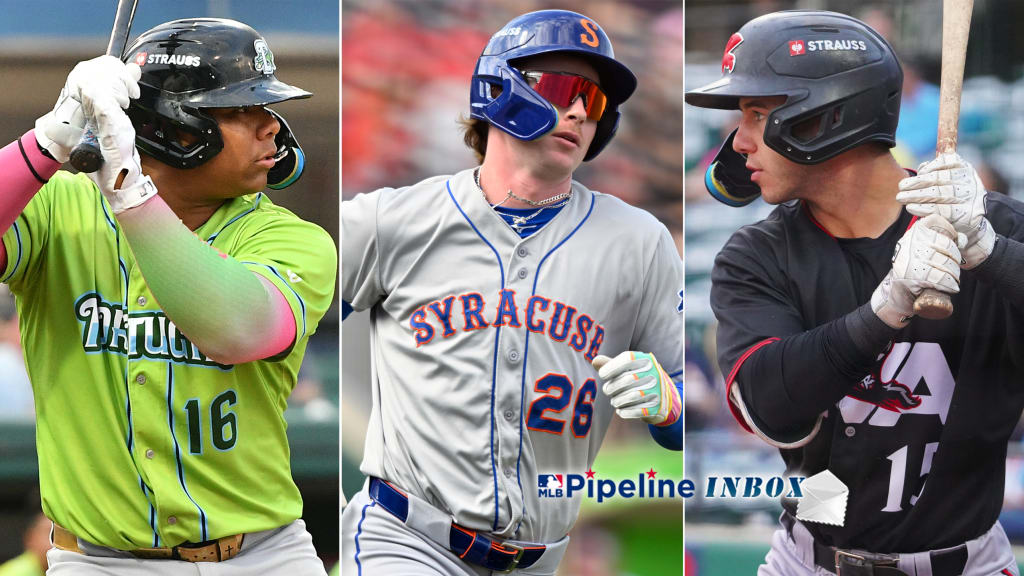
What a great week for baseball and prospect fans. At the big league level, we’ve seen prospects like Trey Yesavage dominate and recently graduated ones like Jacob Misiorowski shine. Meanwhile, the Arizona Fall League opened up on Monday. There’s plenty to talk about, so let’s get to it in this week’s MLB Pipeline Inbox.
More from MLB Pipeline:
• Top 100 prospects | Stats | Video | Podcast | Complete coverage
We answered this one on this week’s MLB Pipeline Podcast, so go take a listen to that, as well as Jim Callis’ interview with No. 2 overall prospect Kevin McGonigle. Jim and I came up with five potential candidates, starting with our usual caveat that you shouldn’t put too much weight into Fall League performances, good or bad. It’s a small sample size and it’s typically very hitter-friendly, so you don’t want to go too crazy over someone who has a strong AFL. Just ask someone like former AFL MVP Nelson Velázquez. That said, we came up with:
- Astros catcher Walker Janek (HOU No. 4) and Marlins shortstop Starlyn Caba (MIA No. 5) both fit in the "superb defender, but will they hit?" category. Caba’s been on the Top 100 before and Janek is a former first-rounder. Both can really defend at premium positions and if they show a bit more consistency at the plate, they could sneak into, or back into, the Top 100 conversation.
- Both Jim and I really like the A’s Tommy White (ATH No. 7). “Tommy Tanks” is a better overall hitter than a lot of people give him credit for because of his past power-hitting resume. Somewhat surprisingly, he didn’t get to that much pop in his first full season (though 11 homers over 66 games at High-A Lansing isn’t bad), but he did reach Double-A and hit well. When the power starts to show up, even if he ends up at first base, he could belong.
- The Rays’ Aidan Smith (TB No. 6) is a player we’ve talked about when we’ve needed replacements for the Top 100, but he hasn’t quite gotten there. But the power-speed combination (14 homers and 41 steals in 2025) is intriguing, and he could make a leap with some approach adjustments. And finally, we threw out Rockies outfield Jared Thomas (COL No. 8) as a future candidate after a sneaky good year that saw him slash .300/.398/.452 in his first full season of pro ball, reaching Double-A in the process.
Fourth. At least, that’s where we have him on our current Top 10 catching prospects list. And the top three are all backstops who, as you put it, cracked the big leagues recently: the Orioles’ Samuel Basallo (MLB No. 7/BAL No. 1), the Royals’ Carter Jensen (MLB No. 39/KC No. 1) and Harry Ford (MLB No. 42/SEA No. 4) of the Mariners.
It is a fun time for young catchers getting to the highest level, with those three -- along with No. 5 Moisés Ballesteros -- getting big league time at age 22 or younger. Of that group, Jensen is the one who seems most likely to be a big league regular for his team. I think Ford can do it, though there’s still work to be done on his defensive game. But how will that work in Seattle with Cal Raleigh ensconced? Basallo showed off his impressive arm strength during his debut, but he might be better suited for first base, and Adley Rutschman is the man behind the dish there, right?
Duno has the chance to be very good on both sides of the ball. The right-handed bat certainly isn’t in question, not after he posted a .944 OPS in the Florida State League at age 19. I’m excited to see how he responds to the challenge of more advanced competition in the Arizona Fall League. He also has a plus arm and has shown athleticism behind the plate, though he’ll have to manage his conditioning to maintain that agility. It’s in the early going given his age and level he played at, but it wouldn’t surprise me if we look back when he’s knocking on the door like those other guys are (there’s no one in the Reds’ system standing in his way) and he’s at the top of our catching rankings, belonging in the same conversation with those other backstops.
There are certainly believers that the Mets’ No. 8 prospect can be an everyday guy in the future. The main cause for optimism is that he was actually better, expected-stats wise, in Triple-A than his actual numbers (an xBA of .243 compared to his actual .219), and that’s more in line with his career batting average. There are also some underlying data that point to some good things.
His in-zone contact rate in Double- and Triple-A was above-average, and some people in the organization think he might be a little underrated from a hit tool perspective, with his strikeout rates in the past (career 27.7 percent K rate) inflated more by too much passivity in his approach. The main concern is his splits (.654 OPS vs LHP), after they were better the year prior.
Will he ever win a batting title? No. Could he be a three-true-outcomes type with enough hittability to get to his power? I’ll say yes.
We spend a lot of time talking about ranked prospects, so I was happy to see this about unranked Nate Furman, originally a fourth-round pick of the Guardians out of UNC Charlotte who was the player to be named later in the 2024 trade between Cleveland and San Francisco for Alex Cobb. The positives about Furman are his bat-to-ball skills and speed/baserunning acumen. He’s walked more than he has struck out in his career and has gone 50-for-58 in stolen base attempts.
The downside: While he did hit seven homers in High-A this past season, there is virtually no power projection and a general lack of bat speed. He also had an arm injury that required surgery, further weakening a throwing arm that was already short for second base, so he doesn’t really have a place to play defensively. It’s worked OK offensively in lower levels, but there are questions about whether he can consistently hit premium velocity as he gets to the upper levels or the big leagues. So if I were to guess, he won’t be protected in the Rule 5. But I also don’t see anyone taking him.