

KANSAS CITY -- Kauffman Stadium will look slightly different in 2026. The Royals are moving the outfield fences inward, the club announced on Tuesday.
The left- and right-field walls will be moved in nine to 10 feet, starting close to the foul poles and then tapering toward center field, where 410 feet will remain the distance from home plate. The wall height is going from 10 feet to 8 1/2 feet in most places. There will be more seats available, about 150 in left field and about 80 new drink-rail seats in right.
According to a team-provided diagram, the left- and right-field corners are being pulled in nine feet, from 356 and 353 feet, respectively, to 347 and 344 feet. The previous distances of 373 in both left and right fields will be nine feet closer, at 364 feet. Left-center and right-center fields will be moved in 10 feet, from 389 feet to 379 feet.
“There’s a lot of different things that go into it,” general manager J.J. Picollo said. “During the course of the season, we just started doing some research, running some numbers and trying to figure out how much this really impacts our offense. Consequently, how would it affect our pitching staff? Ultimately, we concluded that we would be a better team offensively. With our current pitching staff, the changes in the dimensions wouldn’t impact [pitching] negatively as much as it impacts our offense positively.”
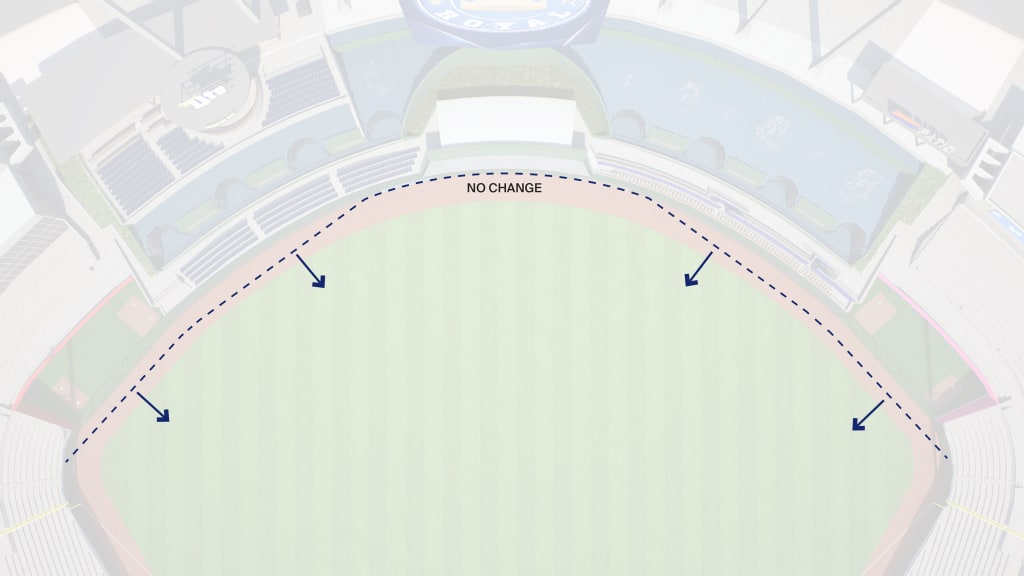
The Royals have had the same outfield dimensions for most of their time at Kauffman Stadium, outside of a nine-year span when the fences were moved in 10 feet. They were moved back to the original distances before the 2004 season.
The common perception is that The K is unkind to hitters, but that’s not always the case, as MLB.com’s Mike Petriello outlined here during the 2024 playoffs. It should be labeled as homer-unfriendly. Using Statcast Park Factors, which consider all output at each venue by both home and road teams -- and with 100 being league average -- Kauffman Stadium had a slightly hitter-friendly park factor of 101 over the last three seasons.
Breaking it down by specific events offers further insight (with 100 still league average):
- Singles: 103 (tied for seventh highest)
- Doubles: 113 (fifth)
- Triples: 183 (third)
- Home runs: 85 (tied for 26th)
The K has the second-largest playing field area in the Majors, at 115,737 feet. There’s a ton of outfield where balls can fall, but not necessarily go over the wall. The Royals have historically constructed their team to fit the ballpark in which they play: Employing good pitching and good defense to allow for the spacious park while prioritizing speed and baserunning to take advantage of doubles and triples.
That’s still who the Royals want to be -- just with more homers.
“Our goal here isn’t to have an offensive ballpark,” Picollo said. “It’s to have a very fair ballpark. We don’t want it to turn into a bandbox and every ball up in the air turns into a home run. We just want hitters to be rewarded when they hit the ball well, particularly in the gaps.”
Dr. Daniel Mack, the Royals’ vice president of research and development/assistant general manager, led this project alongside senior analyst Alan Kohler.
“These sorts of conversations about the park have been pervasive my entire time with the Royals,” said Mack, who is entering his 14th season with Kansas City. “I think it’s informed the philosophy of how we’ve tried to build this team. It was a fact, almost, that what the stadium is and what the club is have to be intermeshed with one another.
“Alan and I started breaking it down. What’s the effect of the walls? What’s the effect of the altitude? What’s the effect of the temperature and wind? Trying to figure out how to take all those effects into account and balance them.”
New technology that provides data on weather-applied metrics was a big part of their research, including the ball flight in both hot and cold temperatures, as well how the altitude affects it. Kansas City can have some of the most variance in weather throughout the season among all ballparks in the league. It also has the fourth-highest elevation of any park.
The overall goal was to modify the dimensions in a way that made the park play more consistently compared with the rest of the league.
“You don’t want to make the park so offensive that it hurts your pitchers,” Mack said. “But one of the things we know is that our fly balls, particularly in parts of this park -- the run value per fly ball is significantly less than the league. It’s in the bottom third. We know our players feel that viscerally.”
It’s apparent every season: Hitters will be perplexed as they get back to a dugout after hitting a near-perfect ball (exit velocity and launch angle) yet seeing it drop into an outfielder’s glove for an out.
Pitchers, for the same reason, love The K. But the Royals don’t believe that these new dimensions will affect their pitchers as much as one might think. There will be home runs that weren’t homers with the old walls, but that will also happen when the Royals are batting. Limiting hard-hit fly balls is generally a good strategy, no matter the venue. In 2025, Kansas City’s home run-per-nine allowed was 0.99, eighth-best in MLB. On the road, it was 1.16, 12th best.
“The idea was to find a way to improve [the run value per fly ball] without improving it to a point that it hurts our pitching staff,” Mack said. “Do it in a way that helps our players. When they play at Kauffman, they don’t have to play one specific way, and then when they go to another ballpark, even if it’s way on the other extreme, all of a sudden, they’re thinking about, ‘Do I have to do something different offensively there in order to be successful versus what I do at Kauffman?’ Trying to find that fairness and consistency across the board.”
Research reinforced that center field plays well, which is why it will remain the third-longest distance in MLB. There are speculative reasons for why this is, one of which is the excellent batter’s eye. There’s no stadium that suppresses strikeouts more than Kauffman Stadium, and that’s something the Royals don’t want to change.
Another factor in this project was the fact that the Royals were only projecting for the next five years, because the organization will build a new ballpark -- location not yet known -- after the 2030 season, when its lease at the Truman Sports Complex ends.
The roster will change across those five years, but there are enough young players and several signed through at least the next two or three years that the Royals have a good idea of who will be playing for them in the final years of this ballpark. That helped with trying to predict outcomes.
These alterations aren’t changing Kauffman Stadium too much. There won’t be jagged edges. Center field will remain the same, but the walls on the left and right of it will just be a bit closer.
Time will tell how much the new dimensions will change the Royals’ offensive outlook in 2026 and beyond.
“I was going to be bummed if we found [a plan] that forced the park to look asymmetrical,” Mack said. “Between that and keeping center field in its configuration, it’s a good way of trying to find consistency that can help with our roster construction while at the same time continuing to honor the history and tradition of what this ballpark does and means to the fans and the organization.”