
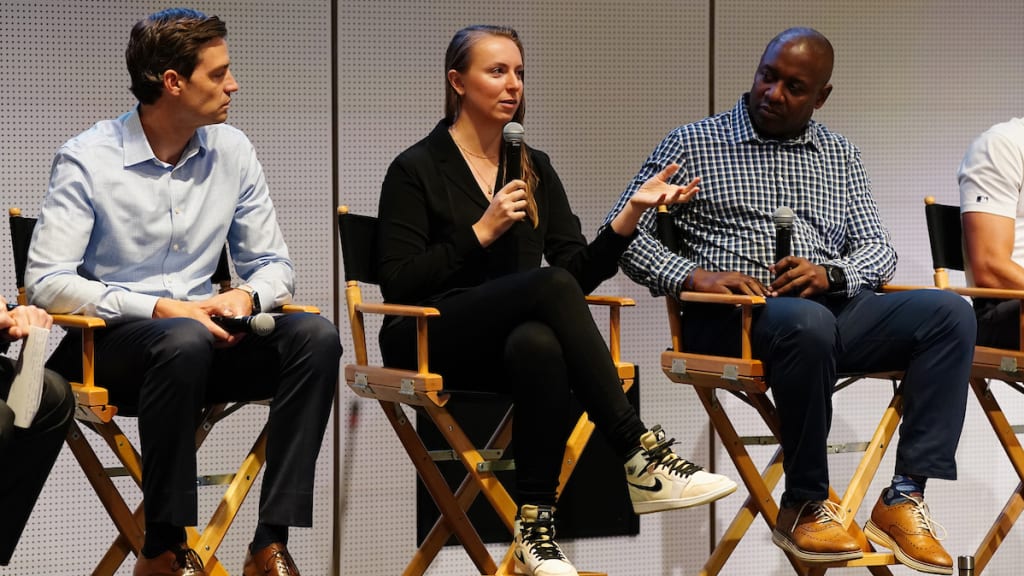
NEW YORK -- Life in baseball is never really over, even after a player retires from the game. That point was driven home at Major League Baseball headquarters on Thursday, during a panel discussion hosted by A2E (Athletes to Executives) and the Employee Resource Group titled “Transitioning from On-Field to the Office.”
The panel included former Major Leaguer Rajai Davis, who is part of the on-field operations team at MLB; MLB Network analyst Harold Reynolds; MLB Chief Operations and Strategy Officer Chris Marinak; Mets Director of Major League Operations Liz Benn (the highest-ranking female baseball operations employee in franchise history); MLB Senior Vice President of On-Field Operations Mike Hill and MLB Vice President of On-Field Strategy Joe Martinez.
The conversation was moderated by Frank Caleca, who is the head of learning and development at MLB.
Davis was a 19-year veteran in professional baseball. His playing career ended in 2020 while attempting to play in the Mexican Baseball League. He never had a plate appearance, because the pandemic canceled the season.
Davis returned home and continued to train, but eventually, he lost the desire to play. His wife, Marissa, encouraged him to seek post-playing-career employment, and Davis remembered all the relationships he accumulated in baseball.
The first call he made was to Reynolds. At first, Davis wanted a similar role that Reynolds had at MLB Network, but, instead, took a job with MLB. Davis works closely with the umpiring and replay operations departments.
“I’m thankful for the relationships that I did gain during my career because that was really the deciding factor -- just being able to reach out to people that I knew through the game and figure out what I wanted to do next,” Davis said, via Zoom.
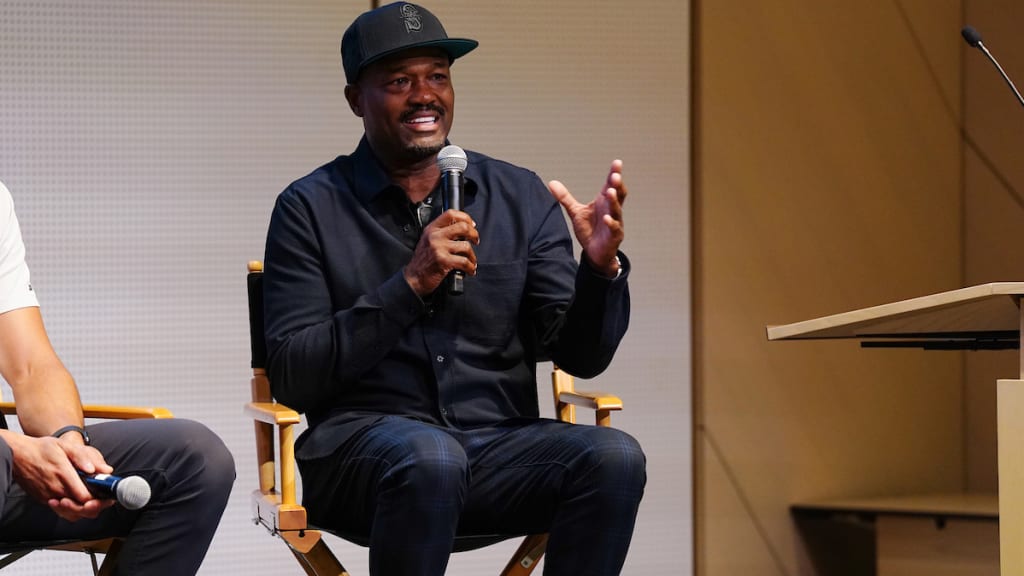
Building relationships in the game of baseball, Reynolds said, is the key to the future after the playing career comes to an end.
“If you carry yourself properly and you treat people right, doors are going to open," Reynolds said. “If you don’t, the doors are not going to open. I don’t care what you want to do, you are shutting doors on yourself. So whether you are finishing college … or you are a 30-year veteran in the business, it’s all about relationships.”
Prior to her role with the Mets, Benn worked at MLB as a senior coordinator of baseball operations, working with baseball operations, girls baseball development and professional development for female baseball operations and coaching candidates. Benn grew up playing baseball, played softball at the University of Toronto and became the first woman to play in the New York City Metro Baseball League.
Benn said having a mentor like Paul Mifsud, vice president of head baseball operations counsel for MLB, helped her understand the nuances of the game.
“I was doing a youth program internship. I thought it was fun to do, but I didn’t think it was a career,” Benn said. “A few things fell into place. I met Paul. He has this passion for women in baseball. He is a good person and cares about representation in baseball. When Paul found out I was here in the office -- he knew my background as a baseball player, knew about a paper that I wrote about women in baseball -- he figured he would talk to me and that ended up resulting in switching internships into his department.
“… Once he saw I did good work, he kept opening doors for me and gave me more opportunities. My last job [with MLB] was helping out with the day-to-day transactions and league administrations for all 30 teams. I worked with all 30 teams and they got to know me. The Mets decided they needed somebody who knew transactions really well. I did. Having a mentor, doing good work for them and having a close relationship with them, in my career has been the biggest thing to lead me to where I am.”
Hill was selected as a first baseman by the Rangers in the 31st round of the 1993 Draft, and after graduating from Harvard, he planned to have a career in the big leagues, retire and move into the front office. But two-plus years after being drafted, a shoulder injury ended his career, and he had to change gears.
Hill’s front-office career started at age 24 with the Rays in 1995 as an assistant in the scouting and player development departments. He then joined the Rockies front office in 2000 as their director of player development before moving to the Marlins in '02 as an assistant general manager. Five years later, Hill worked his way up to general manager, becoming the fifth African American to hold such a title. Hill then became Miami's president of baseball operations from 2013-20, and he was the sixth African American to hold that job.
“I always knew at some point my playing career was going to end. Nobody’s career lasts forever,” Hill said. “When I was still playing, I always wanted to talk to people who were in the business. I would talk to scouts. I would talk to front office people. Whomever I would see, I would just try to talk to them, get their background, experiences and have an understanding of what they did [to stay in baseball]. It was that type of networking along with relationships that I tapped into [that helped me get opportunities].”