

If you remember one thing from the 2023 World Baseball Classic, it’s almost certainly the way in which it ended. Shohei Ohtani, operating as Team Japan’s closer, didn’t just strike out Team USA captain – and then-Angels teammate – Mike Trout to give his side a 3-2 win in the championship. He created one of the most memorable baseball moments of the century.
Three years later, 19 of the same 20 teams we saw in 2023 are back for the 2026 edition, with Brazil entering in lieu of China, and dozens of active Major or Minor Leaguers across every roster, including some of the best prospects in the sport.
The spectacle, obviously, is the point. But there’s more to it than just winning and losing, too. You can learn a lot about these players and teams, in some cases getting a head start on knowing something about international stars who later find their way to the bigs. Let’s take a spin through Baseball Savant’s World Baseball Classic 2023 search and see what happened last time – and how that can inform what you’ll see this time.
2026 World Baseball Classic
Final presented by Capital One
• Champs! Venezuela beats USA in final
• Box score: Venezuela 3, USA 2
• Maikel Garcia named Classic MVP
• '26 Classic All-Tournament Team
• Final bracket, full results
• Complete coverage
1. It’s a very different brand of offensive baseball than in the Major Leagues.
As expected, of course; when one of the best moments from the last Classic was Ohtani being struck out by a Czech electrician, you know things are going to play a little differently.
They did, though not in terms of strikeouts; the 2023 WBC had a 22% strikeout rate, essentially equal to the 2025 Major League season. But the batting lines were differently shaped, otherwise:
- 2023 WBC: .265/.358/.411 (.769 OPS)
- 2025 MLB: .245/.315/.404 (.719 OPS)
You’ll notice that the 2023 Classic had much higher batting averages and on-base percentages, and part of the OBP boost is that the Classic had a higher walk rate (11%) than the most recent MLB season (8%). But focus on this, too. “BABIP,” if you’re not familiar, is Batting Average on Balls In Play, which is basically saying “take out strikeouts and home runs, and then show how often batted balls elude gloves to become hits.”
- 2023 WBC: .326 BABIP
- 2025 MLB: .291 BABIP
In the Majors, that .291 mark is on the lower side of history, thanks in part to increasingly excellent defenders, but that .326, if over a full year, would have been the highest number in any season in the history of the Majors. It's due to everything -- small samples, rosters getting to know one another, wider talent disparities, perhaps harder-to-come-by scouting reports on opponents -- but the end result, last time, was fewer balls finding gloves.
Like hits? This is the tournament for you.
2. Team USA didn’t actually throw that hard – but that should change this year.
In 2023, the Americans made it to the finals, but more on the strength of their lineup than their pitching, because Team USA’s average fastball velocity in the 2023 Classic of 92.4 mph was merely ninth best of the 20 teams. It was essentially what you saw from Italy, or Panama. That’s mostly because the rotation, while accomplished, was hardly full of flamethrowers, particularly when we were looking at late-career Adam Wainwright (85.9 mph in the Classic) or fellow starters Kyle Freeland (89.1), Merrill Kelly (92.6), or Lance Lynn (92.7).
That should be just a bit different this time around, as the 16 pitchers named to the American roster include Tarik Skubal and Paul Skenes atop the rotation and Mason Miller coming out of the bullpen. Consider it this way: Of the 16 names on the roster, their average fastball in the 2025 regular season was 95 mph, considerably harder than the 92.4 the Americans averaged in the 2023 Classic. In fact, 15 of them threw fastballs last season that were harder than that average – and the only one who didn’t, Clayton Kershaw, is putting off retirement for a few weeks to be there largely as an "insurance policy," available to pitch as needed without the constraints of a regular season to worry about. Expect velocity. A lot of it.
3. USA and the Dominican Republic pounded all of the baseballs.
With Major League stars up and down both lineups, that’s not terribly surprising. But what did stand out to us was by how much they stood out in that regard – America (48.2%) and the Dominican (46.4%) were the only two clubs that even made it above a 42% hard-hit rate.
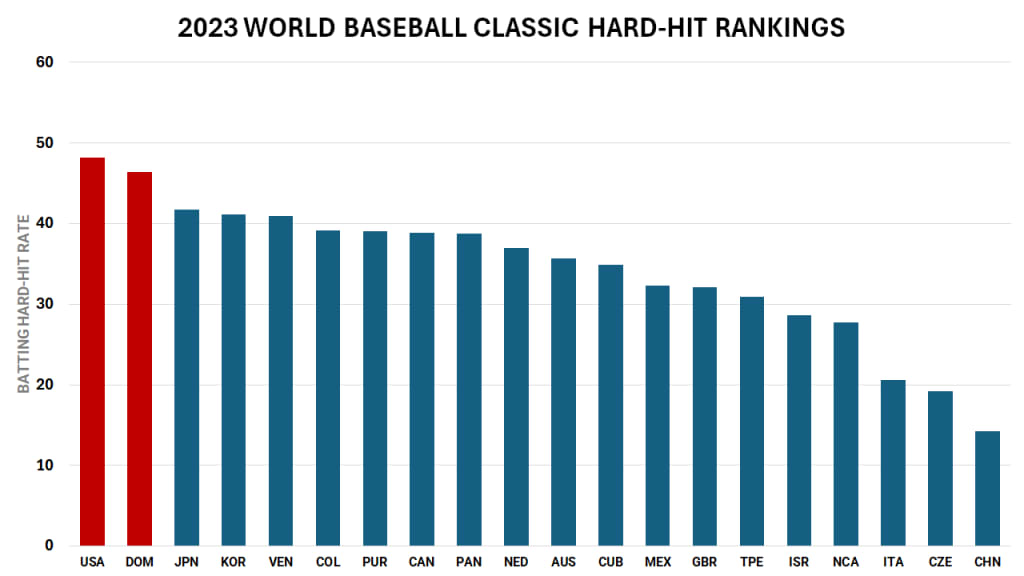
That was more about depth than outlier stars, because as it turns out, three of the four best hard-hitters (among those with 20 plate appearances) played for Team Japan, led by Kensuke Kondoh, new White Sox infielder Munetaka Murakami, and Ohtani, who merely hit .435/.606/.739 in the tournament. But while the bottom of the Japanese lineup trended more toward contact hitters with very little pop, America and the D.R. were loaded from top to bottom with batters who could crush baseballs.
That’s not likely to change in 2026, particularly if you look at it this way: The 14 American hitters had a 47.3% hard-hit rate in the 2025 regular season, while the Dominican hitters posted 47.2%. It’s essentially tied.
4. Team Japan really did show us all the splitters.
This was one of the biggest takeaways, watching the 2023 World Baseball Classic in real time: Look at all those nasty splitters.
Japan's pitchers threw approximately 62% of all splitters in the tournament themselves; more than half the teams didn’t throw a single one. Meanwhile, a dozen different Japanese arms showed a splitter, include names you already knew (Ohtani, Yu Darvish) or ones who have come to the Majors since (Shota Imanaga, Roki Sasaki, Yoshinobu Yamamoto, Yuki Matsui) or others who have stayed home (like Shosei Togo, Taisei Ota, and more.)
On the basis of run value per 100 pitches, Japanese splitters were a top-five value pitch in the tournament, and the showcase led to years of talk about how the splitter would find a resurgence in the Majors, which has largely been true. It wasn’t just splitters, though. Japan and the Dominican Republic tied for the hardest-thrown fastballs, too, at 95.5 mph. One great way to make a good splitter play up is to pair it with a hard fastball. Team Japan had both.
Speaking of splitters …
5. This was a real showcase for Sasaki and Yamamoto.
It’s not like Sasaki and Yamamoto were unknowns to seasoned ball-knowers; their names had been appearing in international circles for years. But for most viewers, seeing them on the international stage provided by the Classic was the first chance to see them in a high-pressure game and also to get an easily available look at what the metrics on their pitches might be.
Sasaki, as it turned out, had the hardest average fastball velocity (100.3 mph) of any pitcher in the entire tournament. As MLB.com’s David Adler wrote at the time, we learned that Sasaki was going to be a pitcher with elite velocity, more arm-side run than you’d expect, an otherworldly splitter, and maybe not all that much else. That, for better or worse, is about what we did end up seeing in his first year in the bigs.
Seeing Yamamoto in the same tournament allowed for the same analysis – it was noticeable that his curveballs had some of the highest spin rates of anyone in the tournament – and it also provided valuable looks at Imanaga and Matsui, who later joined Major League teams. As we also said above: Almost no one hit the ball harder, more often, than Murakami.
All of that is without even noting Nicaragua’s Duque Hebbert, who parlayed an inning where he struck out Rafael Devers, Julio Rodríguez, and Juan Soto into a contract with the Tigers. We probably can’t predict the next Hebbert, but given the ongoing NPB-to-MLB pipeline, keep an eye out for what we see out of pitcher Hiromi Itoh (the 2025 Sawamura Award winner) and Teruaki Sato (a 40-homer slugger who won the Central League MVP Award).
6. Team Italy might have added some real thump to its lineup.
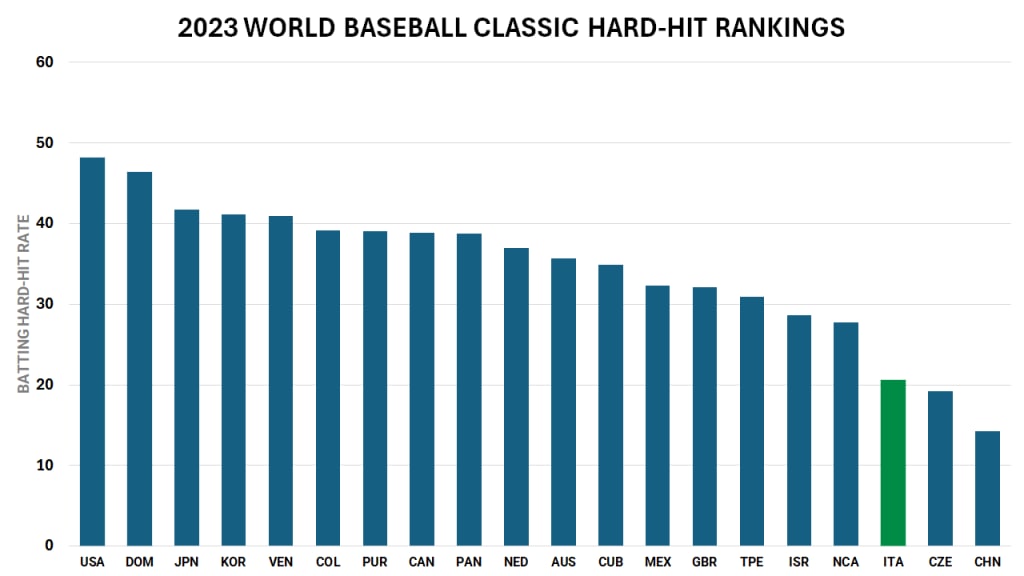
The Italians did OK in the 2023 Classic, but the Azzurri managed just a single home run in 195 plate appearances, and that’s simply not going to cut it. Their 20% hard-hit rate was third-weakest of the 20 teams, and was barely more than half the average rate of the overall tournament – a result of a lineup that had a lot of slick-fielding up-the-middle players without a ton of pop. No player in the tourney on any team, for example, had more plate appearances without a hard-hit ball than the 17 by former Cardinals outfielder Ben DeLuzio. Bring back that chart from above where we highlighted the United States and the Dominican bats, and you can really, really see it:
Since then, the leadership of the Federazione Italiana Baseball Softball has been largely turned over – long-time catcher Francisco Cervelli will manage, while former Dodgers general manager Ned Colletti takes the same role here – and the lineup looks a whole lot different this time around. While Royals first baseman Vinnie Pasquantino returns from 2023, now he’s joined by Mariners outfielder Dominic Canzone (who had a 142 OPS+ last year), Kansas City teammate Jac Caglianone (the No. 6 overall pick in the 2024 Draft), and a variety of up-and-comers like Kyle Teel, Zach Dezenzo, Jakob Marsee, and Thomas Saggese.
The nine big leaguers on this roster had a 43% hard-hit rate in the Majors last year. That doesn’t even include third baseman Andrew Fischer, Milwaukee’s first round pick last year, who slugged .760 for Tennessee last spring, is the top-rated third base prospect in the game, and wants to model his left-handed swing after Bryce Harper. It’s not the Dominican lineup, or the American one, and they won’t lead the tournament in homers. They should hit for considerably more pop than that this time around, though.