


When Trey Yesavage told the world "I’m built for this" prior to his stunning postseason debut against the Yankees, there was a long list of people who helped get him to that moment who simply nodded in agreement. And they can’t wait to see what he does with his next opportunity in the American League Championship Series.
Like with any success story, even one that seems as sudden as this one, there’s a large supporting cast and many key decisions that made it possible.
High school in Pennsylvania
In many ways, Yesavage’s road to shutting down the Yankees in Game 2 of the American League Division Series started back in the summer of 2019. Yesavage, a native of Boyertown, Pa., about 40 miles northwest of Philadelphia, showed up at an open identification showcase run by Prep Baseball Report. To that point, his baseball experience had extended only as far as the Boyertown Junior Legion team.
While his current delivery is rigid -- it's part of a unique setup that works for him -- it's silky smooth compared to the mechanics that Shaun Vernesoni saw then. Yesavage was “a little clueless” about what he was doing, according to Vernesoni, the co-owner of the Keystone State Bombers, the organization that hosted the showcase, but he was up to 85-86 mph and he was just turning 16 that summer. Vernesoni and his cohort from Keystone looked at each other with eyebrows raised.
“It was not a super clean delivery, but there was present arm strength,” Vernesoni recalled. “We saw a lot of potential and we agreed: ‘We can’t let him leave without getting him.’”
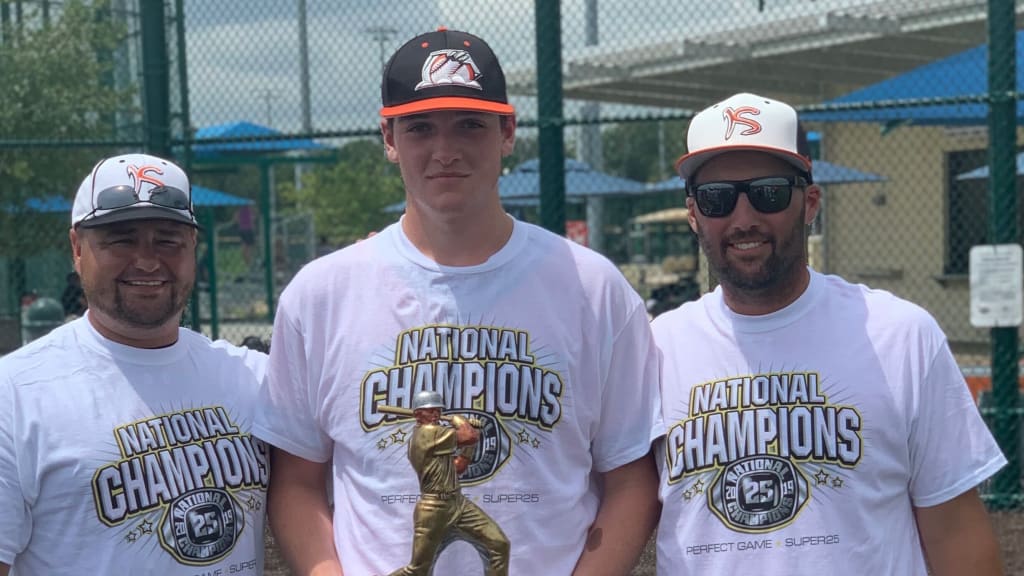
Trey brought his father, Dave, down to talk to the group. That was the first obstacle because, as Keystone co-owner Joe Hruska put it, “He’s a big guy and he’s pretty intimidating.”
The Yesavages decided that Trey would join the Keystone program, and despite the rough edges, he found his way to the center of some very talented travel ball team rotations. With his size and arm strength, he started getting a little attention from colleges, and after connecting with University of Pittsburgh pitching coach Jerry Oakes, he committed to head to the southwest part of the state for college.
Last-minute college plans change
The spring and summer of 2020 was a mess for baseball everywhere because of the pandemic. That was Yesavage’s junior year of high school, and things would take a drastic turn -- and not only because of the pandemic. In June, Oakes and Pitt parted ways, leaving Yesavage unsure of what to do.
On the one hand, it was very late in the game -- the summer before his senior year of high school -- to consider a switch. On the other, he is very much driven by relationships, according to all who know him. Losing his connection to the Panthers made him pause and ultimately led him to decommit at the last minute and try to find another home.
“I think all three of us had the conversation with him at some point, that it might be in his best interest to reconsider and remain with Pitt,” said Frank Cooney, Keystone’s director of recruiting. “But he was adamant.
“I told Trey I would work my hardest, but we are kind of stacked up against it. Guys aren’t going to be able to see you throw, there’s not going to be a lot of scholarship money out there. It was an uphill battle.”
The Draft wasn’t really an option at this point; Yesavage was too raw. He was seen by some teams during his senior year, but reports were about projection and rawness.
“He was a physical-looking kid,” one area scout recalled. “You thought in the future he could get stronger and the arm strength would come along. He was low 90s when I saw him. He could throw hard in spurts. He was rough around the edges in high school. His breaking ball needed to improve. You were betting on arm strength, and the offspeed stuff is a big reason why people probably weren’t on him.”
In other words, Yesavage needed college. So Cooney got to work reaching out to schools he had connections and relationships with. One of those people was Jeff Palumbo, the recruiting coordinator at East Carolina University.
This was an unusual time for college recruiters. Because of COVID, there was a fair amount of uncertainty, the equivalent of throwing darts in the dark. Many missed the mark, but Yesavage turned out to be a bullseye. Palumbo never saw Yesavage pitch in person, but a good video stream from an outing at Perfect Game’s LakePoint complex in Georgia, and the recommendations of Cooney and Oakes, led to ECU rolling the dice.
“We got the chance to sit and watch him,” Palumbo said. “He didn’t have an incredible outing, sprayed the ball a little bit, but there were things there. His makeup seemed good. And I trusted my sources. I owe Jerry a steak dinner. I tell him that every time I talk to him. Jerry knew our place and the kind of makeup we look for in our guys. Trey fit that mold.”
A transformation at ECU
When Yesavage got to campus, he arrived with that low-90s fastball and a spike curve that he largely couldn’t land for strikes. That spotty command Palumbo saw on the video stream came with him. He worked in relief during his freshman year with the Pirates, following a path that worked well for 2021 first-rounder Gavin Williams. Yesavage learned to start trusting his stuff, that it would get college hitters out, leading to a 15.6 K/9 rate in his freshman year, though that also came with a 6.6 BB/9 rate. Most importantly, there was progress.
“His demeanor and composure was evident as a freshman,” Palumbo said. “There was the strikeout stuff, and we did a good job bringing him along that freshman year, putting him in situations where he could have some success. By the time the year finished, he was coming into big situations. You could see the confidence growing.”
After getting some starts in the wood bat summer Valley League, Yesavage showed up in the fall of his sophomore year ready to take another leap forward. But he needed to tweak his secondary offerings. Pitching coach Austin Knight helped introduce both the cutter-like slider (or slider-like cutter) and the splitter that fall. The cutter helped right away; the devastating splitter took more time. But Yesavage went on to dominate in ECU’s rotation with a 2.61 ERA, a 1.00 WHIP, 12.4 K/9 and, perhaps most importantly, a walk rate of just 2.7 per nine. Blue Jays area scout Coulson Barbiche took notice very early on.
“It was a February outing of his sophomore year,” Barbiche said. “The operation was different, but at the same time, you see batters’ swings and you’re baffled by him with your own eyes.”
The scouting industry really doesn’t start to hone in on a player until the summer before his Draft year. Yesavage was on the map, then jumped even higher with a very strong turn pitching well for USA Baseball’s Collegiate National Team. That’s when the higher-ups on the Blue Jays' staff really took note, guys like former scouting director Shane Farrell and then-national crosschecker and current Jays director Marc Tramuta.
Barbiche initially had a second- or third-round follow on Yesavage until he saw him that fall back on campus. He elevated his evaluation to a first-round follow as a result.
“You start to put them under a finer microscope as you get to his eligible year,” Barbiche said. “It wasn’t until that fall that I started really locking in on the delivery. You can get wrapped up in it’s a little rigid and unique, but the rhythm and timing were all good and he threw strikes. I decided I wasn’t going to overthink it too much.”
His bosses didn’t disagree. During his junior year -- when Yesavage finished with a 2.02 ERA, a .154 batting average against and a 14.0 K/9 rate -- the Blue Jays saw him just about every start.
“We saw him so much,” Tramuta said. “Eleven of us reported on him, that includes all levels of scouts and analysts. Picking [at No.] 20, you never really have a great feel who will be there until you get closer. He separated himself in the middle of the year. Shane was on him early. Scouts and analysts, it’s great when those two lenses combine.
“The slot, the release, the uniqueness, the four-seam ride, the slider and the split, the tough angle, the steepness, the pitches tunnel really well. He does a good job with the four-seamer up and burying the split and throwing it for strikes.”
It took from the fall of Yesavage's sophomore year until the spring of his junior season to get comfortable with that splitter, and it elicited a miss rate of 55 percent, according to Synergy, during his final college season. That’s right. The pitch that made the Yankees' lineup look so uncomfortable in the ALDS? He’s only been throwing it effectively for two years.
More from MLB Pipeline:
• Top 100 prospects | Stats | Video | Podcast | Complete coverage
The Jays knew they wanted him. But they weren’t sure he’d last to pick No. 20. There was a lot of buzz he could go in the teens; the Mariners at No. 15 seemed particularly interested. He had a so-so start in May, where he walked four, with a lot of scouting eyes on him, that could have contributed. But it might have been the dry needling incident that got him to Toronto.
Yesavage suffered a collapsed lung before the conference tournament, believed to be caused by dry needling, a technique used to treat pain and muscle dysfunction. It caused him to miss the tournament and might have made teams pause just enough to go in another direction.
“It could’ve played a role,” Barbiche said. “I’ve heard other guys in the area say the same thing. We are all surprised that he was there for us.”
The Blue Jays saw the positive in all of it. They really liked Yesavage’s character, and he came back from the incident and outdueled No. 2 overall pick Chase Burns in a Regional matchup.
“The separator -- this isn’t just recency bias -- was the makeup,” Tramuta said. “Shane was blown away by him during the interview at the Draft Combine. We had a lot of good other sources. He had the punctured lung, came back and pitched well. You could ask anyone he played for, they’d say the same thing about the makeup. When you’re breaking ties, he definitely had that in his favor. To do what he’s been doing, I think that’s been on full display.”
Rapid ascent and development
The Blue Jays thought they had a pretty advanced arm joining their system, one who could move pretty fast. And even though no one could've possibly predicted he’d dominate in the MLB postseason in his debut season, no one -- from the Keystone State staff to ECU to the Jays’ scouting and player development departments -- was surprised. They knew he was "built for this.”
It wasn’t so much developing Yesavage, then, as it was handling his ascent well and putting him in a position to succeed. Farm director Joe Sclafani and the Jays decided to start him in Single-A Dunedin, knowing he’d dominate there, and also being aware of how often the High-A Vancouver club gets rained out in April. Yesavage went on to pitch at all four Minor League levels, never making more than eight appearances, typically struggling upon arrival, but quickly adjusting and dominating.
“I’m very proud of the group for the plan they put together,” Sclafani said. “We think he’s going to be a lynchpin in our rotation for a long time, and there’s something to be said for him playing with guys [at each stop] who will be his teammates for years. He showed a slow heartbeat, that he wants the ball all season. It was an incredibly special year for him.
“Now everyone knows how special he is.”