
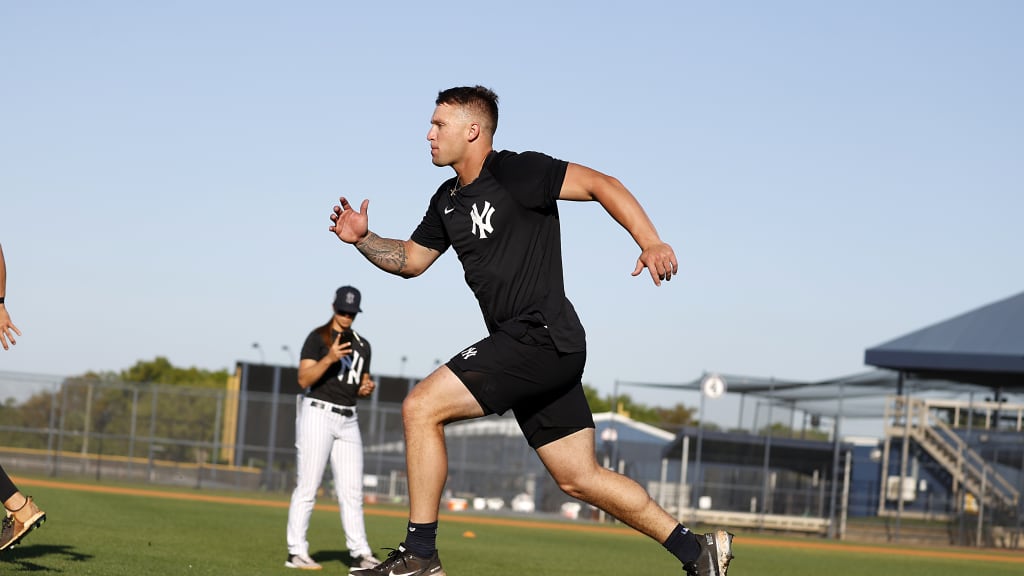
The Arizona Fall League is a great place to excel. Every year, the game’s most exciting prospects gather for about a six-week season, competing in a showcase that can fast-track a career. As such, Elijah Dunham’s performance on the Fall circuit in 2021 offered plenty of cause for optimism. In 23 games for the Surprise Saguaros, the outfielder batted .357 with a 1.037 OPS. He stole 11 bases and hit two longballs, while walking more than he struck out.
The outstanding output helped lead Surprise to the championship game and earned Dunham AFL Breakout Player of the Year honors. It was, in many ways, a dream, as good a display as any player could hope for, let alone an undrafted college signee coming off a debut year in pro ball that saw him earn a place on the organization’s top prospects list.
“A regular Minor League game might have four or five scouts. But at a Fall League game, it’s possibly 20 to 30,” says Yankees vice president of player development Kevin Reese. “There’s a bigger spotlight on you, and who’s going to show up?”
You can learn plenty about Dunham by scanning the box scores from Arizona, but despite all the accomplishments and successes, the cleanest demonstration of who the Indiana native is, and of how high he might someday ascend, actually came in his lowest moment, an afternoon in a natural and destructive spotlight. Or rather, it came in a short conversation the next day.
Dunham’s rise is built on reaction and response, meeting adversity where it lives. He embraces -- indeed, relishes -- the imperfections in a game (and a life) in which omnipresent failure makes accomplishment all the more sweet.
“I kind of have a system,” says Dunham, who has thrived at Double-A Somerset this season. “I get really mad if something bad happens. And then I take ownership of it, and I move on with it. And I can get back to neutral after that.”
Ironically, Dunham’s redemption arc took flight when he was barely a year old, as a man he wouldn’t meet for about two decades began a pro career in the Dodgers’ organization.
Hunter Bledsoe signed as a free agent in 1999 after his fifth year of college. Looking over his Minor League numbers on Baseball-Reference.com -- just about all the evidence that exists of a career that never saw Bledsoe rise above Double-A -- the professional stalemate is hard to figure.
Bledsoe barely produced any power, but the guy could clearly hit. He retired with a career average of .300, to go along with a .368 OBP and .766 OPS, numbers that seem good enough at least to offer him more time. Yet in addition to nagging back and hamstring problems, Bledsoe today notes two things that stalled his career. The first, he says, was that he didn’t have an advocate in the organization, no one looking beneath the raw numbers and pushing to give him a shot. But there was another, more practical, issue, and it can be found just to the left of the impressive stats on the Baseball Reference matrix. It’s the third column, labeled “AgeDif.” Bledsoe was just too old.
Compared to the weighted average for his league (with positive numbers rising with age and negative numbers going in reverse), the figures for Bledsoe’s various stops in affiliated ball read as follows: 0.7, 1.3, 2.2, 5.7, 2.0, 2.4, 4.3.
“That was my story,” Bledsoe says. “I signed as a 23-year-old. And I hit .300 in the Minor Leagues. I was a two-time All-Star. I could just never get past the fact that I was a tick beyond the age curve.”
Bledsoe’s journey would likely have little in common with Dunham’s but for a brutally unlucky accident of timing. Drafted by Pittsburgh in the 40th round in 2019, Dunham opted to return to Indiana University, certain he could improve his status with a strong 2020 campaign. “And he came out on fire that season,” says his father, Paul. “He was just annihilating the ball.”
Fifteen games into his junior season, Dunham was racing up draft boards. His OPS on the year was 1.052, and he was the Big Ten Player of the Week for the period ending Feb. 24.
“I was always under the impression going into that 2020 season that if I had a good year, it could have been top five rounds, like three to five,” Dunham says now, and he had every reason to believe as he prepped for a few last months in Bloomington that his situation was playing out in the best way possible.
And fortunately, nothing bad happened on the planet in 2020 that could have derailed any plans.
Just two weeks after MLB suspended spring training in 2020 on account of the raging COVID-19 pandemic, the league and the Players Association reached an agreement that allowed for, among other things, potentially shortening the 2020 First-Year Player Draft to just five rounds. Two months later came an announcement that players not taken in the draft’s five rounds would be eligible to sign for a maximum bonus of $20,000.
Dunham, once on a rocket path to professional riches, was once again a college kid without any way to keep improving his stock. Universities -- and their athletic facilities -- shut down, games were canceled, and the scouting process moved online. And although it was tough to stomach, the whole Dunham family was grateful for their agent, a guy by the name of Hunter Bledsoe, who leveled with them: Absent the chance to keep impressing scouts over the rest of his college season, Elijah might end up falling off the board. “Had the whole year played out, it would have been a no-brainer,” Bledsoe says. “In my mind, looking at the early part of his season, I thought he was going to go on and be the Big Ten Player of the Year. And then, he would have gone in the top five rounds, and smooth sailing from there.”
Instead, Dunham had to go it alone. His efforts impressed -- but didn’t surprise -- those who knew him best. “That was the thing that struck me about Elijah that was different than a lot of the other guys,” says Indiana head coach Jeff Mercer. “Guys were upset, and Elijah was upset -- obviously, we’re all upset the season was canceled. But Elijah was immediately like, ‘Let’s put a plan together. How do I maximize the time? How can I use this to my advantage? How do I prepare myself for what’s coming next?’”
For a normal 20-round draft, Yankees vice president of domestic amateur scouting Damon Oppenheimer oversees an operation that has reports on some 550 to 600 players, with about 350 of them ending up on the team’s draft board. That number dropped down to 100 in 2020, and to make matters worse, the Yankees had just three picks in the five rounds. With their final turn, in the fourth round, the team went with Beck Way, a college pitcher that they had above Dunham on their board.
Over at the Dunham house in Indiana, the family watched name after name be selected. At one point, the phone rang, with it the life-changing offer they had been awaiting. A team threw out a number and asked if Dunham would take it. “And Elijah said, ‘Yes!’” Paul Dunham recounts. “And we’re all excited, and then 20 minutes later, they called another name. It was the last round. That’s kind of devastating.”
Bledsoe recalls that the other player ended up signing for about $300,000. Had the draft continued, and had Elijah been picked somewhere between the sixth and seventh rounds, he might have been looking at a signing bonus in the neighborhood of $250,000. Instead, he was left with two choices: Take a $20,000 bonus from a team and get to work (albeit in an atmosphere without a Minor League season, and with facilities still closed); or go back to Indiana for his senior year and try again in 2021.
“My first thought was, ‘If I don’t get drafted, I’m going back to college,’” Dunham says. That option had a lot going for it. Dunham was a popular star on the Hoosiers’ team, and the whole family loved the support that Elijah got from the Indiana staff, including Mercer, who believed that it should be a simple choice to return. The whole landscape of Minor League ball was in flux, with no real sense of when anything might return to normal. Signing a bare-bones pro contract could put the player into an unenviable limbo -- and an unnecessary one, Mercer felt, considering Dunham still had college eligibility.
Bledsoe viewed things from the opposite side. For one thing, there wasn’t much more that Elijah could glean from his college experience. But more importantly, there was the lesson that he, himself, learned the hard way. As a senior, Dunham -- who turned 22 in May of 2020 -- would be delaying his professional development by a year, which would force him to spend his entire career climbing uphill against the age curve. “The draft is the entry point,” Bledsoe says. “It’s not the destination.” Another year at Indiana would hurt his chances at making the Majors, and beyond that, teams just don’t offer massive bonuses to seniors without any leverage. Instead of the figure that Bledsoe says he could have been looking at had the 2020 Draft extended beyond five rounds, the agent assumed that he would get, at most, about $100,000 if he went back.
Both arguments had their merits, and they came from people who were certain that they were looking out for the player’s best interests. In the end, Dunham chose the option that made more sense for his future, rather than his present. “We had a Zoom call with Mercer, and Mercer couldn’t understand it,” Paul Dunham says. “And it was hard, because Elijah loved Mercer. Elijah just felt like, ‘My goal is not to play college baseball. My goal is to make it to the Majors.’”
Knowing that he had only himself to rely on, and feeling put upon by situations out of his control, Dunham attacked the situation. He created his own training facility at his house, working with his three siblings on a daily training regimen. (Paul jokes that his daughter, Moriah -- a soccer player -- ended up in the best shape of her life.) No one could make the pandemic go away, or make the draft last a few more rounds, but Dunham could assert more control over his destiny than your typical elite college baseball player, having suddenly been gifted with a financially unfortunate but competitively lucrative opportunity: free agency.
Able to sign with any team willing to pay him the max $20,000, Dunham restarted the courtship process, only this time, spared the whims of a draft order, he was in control. He spoke with organizations across the league, but the Yankees’ pitch came with an added bonus: Casey Dykes.
Dykes -- whom Dunham calls his favorite coach ever -- had been part of Mercer’s staff at Indiana before taking a player development job with the Yankees. Now the team’s assistant hitting coach, but at the time slated to be an instructor in the Minors, Dykes chatted with Dunham about life in equal proportion to baseball, and he offered a friendly face during a difficult time. Dykes was that second piece that Bledsoe recalled himself never having. He was able to sing the Yankees’ praises to Dunham -- and to be a booster for him with Yankees brass. Suddenly, despite the disappointment of draft day, Elijah had bought back a year of professional development, and he would be joining an organization in which he already had an advocate.
“They have the best coaches, they’ve got the best development system, and they do a great in-between of old school and new school,” Dunham says of the Yankees organization. All he had to do was figure out how to use the down time that 2020 demanded. Not a problem.
“I’ve never worked so hard in my entire life,” he says. “It just motivated me because I didn’t want to have that be a point in my career where I feel like a lot of guys might get discouraged. I didn’t want that to happen to me.”
***
The Golden State Warriors’ Draymond Green plays with a sometimes-manic intensity, filling up some of the less-glamorous box score columns while accumulating technical fouls. Part of his die-trying effort, the four-time NBA champ has said, comes from memories of draft night 2012, when the Michigan State star watched 34 names get called before his own.
In a performance suited for the Umbrage Hall of Fame, Green can list the 34 players from memory. Perhaps unsurprisingly, the potential actual NBA Hall of Famer offers inspiration to a certain Yankees prospect. “I love Draymond Green,” Dunham says. “If I played basketball, I’d want to be like Draymond Green -- the facilitator, the enforcer, the technicals. He’s the guy everyone looks to to bring the energy and bring it every single day. I kind of take my baseball game like that.
“That whole year off where I wasn’t doing anything, that was all I thought about. I thought I was a top five–round guy. I ended up not being viewed by everyone else that way. … I still play with that. And a lot of my teammates make fun of me for it. They’re like, ‘Dude, you can stop with all that. You don’t need to.’ But why am I going to? It still happened. It’s still a fact. It didn’t change anything just because I had a good year, a good Fall League.”
Since signing with the Yankees and beginning his journey, Dunham has evolved on the field in ways that have boosted his star. Never much of a running threat at Indiana, he has become a reliable base stealer, intelligent on the paths. His arm in the outfield has improved, and he has excellent bat-to-ball skills with the promise of a developing power bat. In 2021, Dunham put up an OPS of .825 between Low-A and High-A. He stole 28 bases and was caught just five times. And at Double-A this year, he has continued to impress. His coaches and teammates certainly talk about the ways that he has improved his game, but without nearly the joyful intensity that fills their faces as they discuss the type of teammate and competitor Dunham is.
“He plays with his hair on fire,” says Yankees hitting coach Dillon Lawson, who worked with Dunham last year while serving as the team’s Minor League hitting coordinator. “He maxes everything out. And you have to appreciate it; he plays like there’s no other option.
“He makes it easy for someone to bet on him.”
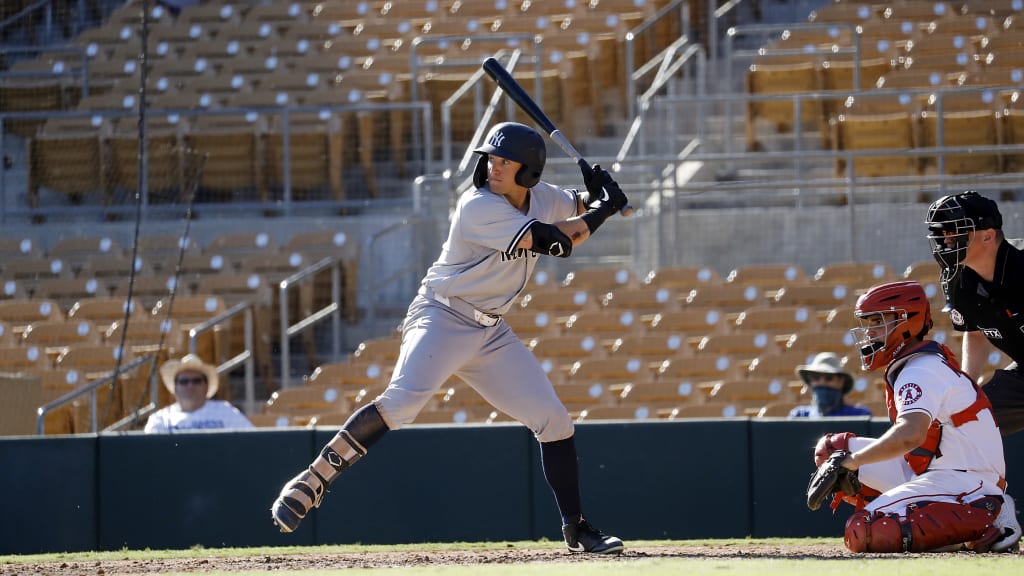
Back in Arizona, just about 16 months after betting on himself, Dunham raced toward the Saguaros dugout hoping to find a place to hide. The sun in Peoria that day was blazing directly into the left fielder’s line of sight, making it all but impossible to see balls off the bat. While he did make one diving catch running toward the foul line, Dunham flubbed three other plays (only one of which he even got close enough to so as to be charged with an error) as scouts scattered throughout the ballpark jotted notes in their books and iPads.
Chatting near the dugout the next day, Dunham easily shrugged off his own scouting demerits. Much more upsetting, he said, was that it was a fellow Yankees prospect -- Clay Aguilar -- on the mound, and the defensive issues hurt his stat line. It was the emotional response of a sure-thing prospect comfortable in his standing, not that of an overachiever scraping for any footing. It also perfectly aligned with the Dunham the Yankees are thrilled to have in their system.
“In that moment, I’m like, ‘There’s going to be another play. It’s going to come to me.’ That’s just how baseball works,” Dunham says, noting that he still sometimes randomly apologizes to Aguilar. “When I’m going through that, as much as it hurts, I’m still trying to keep myself confident and keep myself right because a play is going to happen where you do have a chance on it. And if you’re still worried about the couple balls you missed in the sun, I don’t make that play down the line. The whole time, it’s almost like mental warfare. You’re fighting your inner guy.”
That fight has served Dunham well. He faces adversity, he responds, and he improves. He’s a talented player, but so is everyone around him. So, he unleashes his inner Draymond Green and deploys some strategic resentment. “He still plays with a chip on his shoulder because he feels like he’s got millionaires all around him, especially when he went to Arizona,” Paul Dunham says. “And it’s like, ‘Man, I’m just as good as these guys, if not better.’ I think if he looked back now, he would be thankful that the process happened because it made him work even harder.”
Having signed as a college junior, Dunham’s first steps in the low Minors inevitably had him playing against kids a bit younger than he was. But as the 24-year-old works this year in Somerset, his own AgeDif metric on Baseball Reference tells the tale of a well-placed bet: 0.0. He’s still a $20,000 signing, and his agent knows that teams understandably offer more rope to a prospect in whom they have invested more money. He lived it. But Bledsoe also knows that for a player such as Dunham, with his specific and unfortunate situation, that bet was the only hope. “Most likely all the difference in him having a chance,” Bledsoe says.
That chance is all Dunham can hope for. Appearing on MLB Pipeline’s list of the Yankees’ top 30 prospects is nice, but it’s not a big-league contract. There’s still plenty he has to work on, much more development ahead of him. But the one benefit Dunham claimed -- the one he never could have gotten back had he chosen otherwise -- was time. He was always going to work harder than almost anyone around him, and he was always going to do what it took to max out his talent. But without the counsel of an agent whose story resembled his own, and without a friendly face to advocate for him in the most decorated baseball organization in history, there’s no telling where Dunham would be right now, a point that everyone in his orbit can acknowledge.
“He made the right decision for himself,” Mercer says, without even a hint of resentment. “Obviously, I loved him in the moment, and I love him now, I supported him all the way through and always will, and I’m so happy. It’s worked out as the best-case scenario.”