
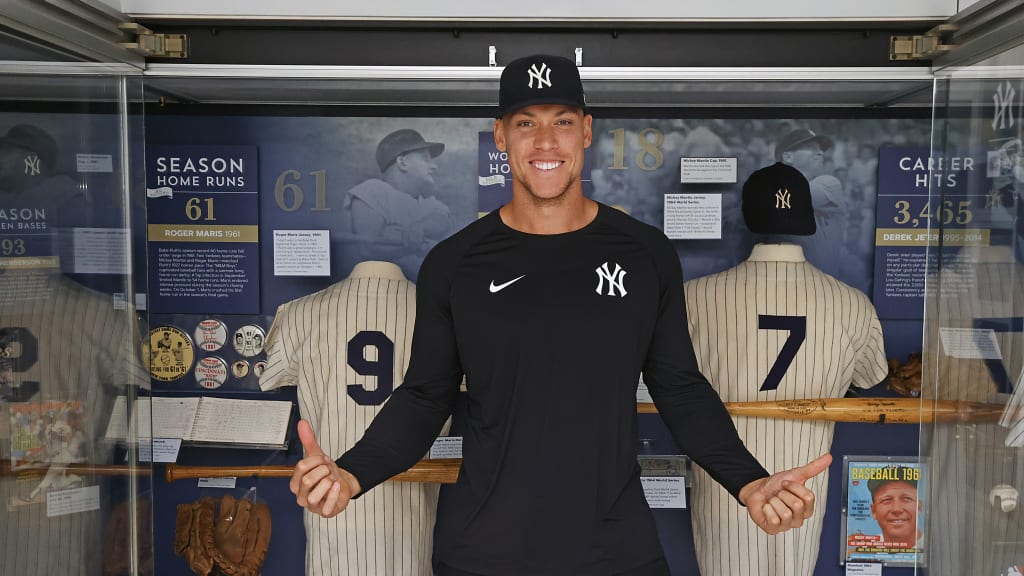
It’s easy to understand why so many people hold Aaron Judge in such high regard. The Yankees’ slugging outfielder is perhaps baseball’s biggest star. His eye-popping numbers speak for themselves, and his ability to connect with fans at Yankee Stadium and ballparks throughout the country has earned him countless admirers.
What’s refreshing, though, is that despite his celebrity status and the pressures that come with playing in New York, the 30-year-old hasn’t lost his enthusiasm for the game one bit. Sure, he’ll take advantage of the Yankees’ scheduled off day on July 4 to chill out with his wife, Samantha. But generally speaking, he’d prefer to have a game, especially when the Yanks are having a season like this one. Winning is fun, and you can tell from the constant smile on Judge’s face that there have been plenty of victories lately.
It has been a total team effort. From Gerrit Cole on down to the video replay coordinator, everyone in uniform has had a hand in the Yankees’ great start. But Judge’s first half has been on a whole other level. On a nearly nightly basis, the statisticians and researchers who cover Major League Baseball pump out facts and figures about Judge’s feats that place him alongside some of the game’s immortals.
Judge doesn’t even want to go there. He believes he has much to accomplish before claiming any sort of spot in the pantheon of Yankees legends. “Let’s not even compare to what those guys did,” he says. What he does have is a respect for the bar that was set, and his love for the game and its history is on par with anyone’s. Plus, he just likes to have fun. So, when Yankees Magazine invited Judge to spend some time in the New York Yankees Museum presented by Bank of America, where he could peruse Yankees artifacts while discussing his own experiences in pinstripes, he jumped at the opportunity.
“That sounds great,” he said. “I’m looking forward to it.”
***
It’s a Wednesday afternoon in the middle of June, nearly five hours before first pitch, and on the basement level concourse at Yankee Stadium, two small dachshunds are happily racing toward the door outside the home clubhouse. Their respective owners, Judge and Anthony Rizzo, follow close behind, having just been told that, sorry, dogs are not allowed out on the field to play. It’s all good. Judge bids his pooch farewell and makes his way into a nearby elevator.
Several floors up, the doors open, and the present-day superstar is suddenly surrounded by Yankees history. The jersey Babe Ruth wore when he called his shot in the 1932 World Series, the “ball wall” filled with nearly 900 autographed baseballs, Thurman Munson’s preserved locker -- they’re all right in front of Judge, and as senior museum curator Brian Richards opens the glass doors to the exhibit containing items once belonging to Ruth and Lou Gehrig, Judge’s eyes twinkle with anticipation.
“Can I touch anything, or no?” he asks. “Because I want to pick up these bats that these guys were swinging.”
All in good time, Aaron. We’ve only just begun.
Ruth, of course, is synonymous with home runs, blasting them farther and more frequently than just about anyone who has ever picked up a bat. He remains baseball’s all-time leader in career slugging percentage (.690) and OPS (1.164). Soon after he joined the Yankees, the section of seats beyond the outfield wall in right field became known as “Ruthville,” not only because of the balls Ruth regularly deposited out there but due to the rapport he developed with the fans who came to cheer him on when he played in right.
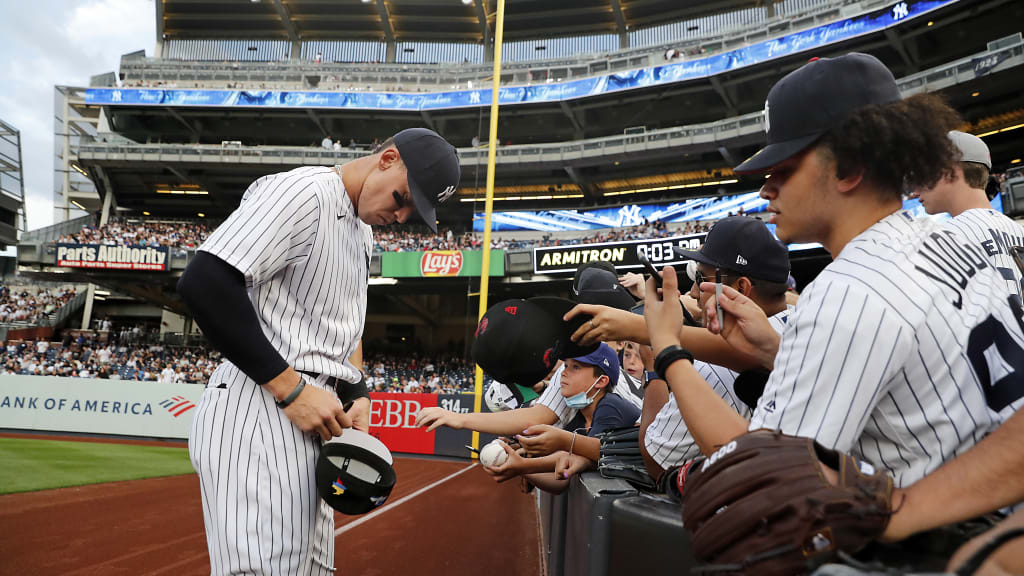
A century later, Judge carries on that same tradition, bantering back and forth and sometimes even playing catch with the fans out in right field. Although this season has seen Judge start more games in center than in right, he maintains a close bond with the fans seated in front of “The Judge’s Chambers,” whose voices and faces become familiar over the course of a season.
“That’s what makes it so much fun playing here at home,” he says. “The fans are what brings this Stadium to life, and right field is kind of intimate, short; it’s a real tight spot out there. So, I look forward to it every single time I get a chance to go out there and play in right. I kind of miss them in center! In center, I get the left-field bleachers, too, but I’ve just got Monument Park behind me. I’ve got nobody out there. I’ve got some old ghosts. But in right field, you’ve got the fans, you’ve got the little kids running up for foul balls, The Judge’s Chambers. It’s all pretty exciting.”
As most fans are aware, Ruth was also a superb pitcher at the beginning of his career. From 1916 to 1917, he won 47 games -- one fewer than Walter Johnson over that two-year span -- and in three World Series starts for Boston, Ruth went 3-0 with an 0.87 ERA. Could Judge toe the slab in a pinch?
“I could do it, but I don’t know if I’m getting three outs! It might take me a while,” he says. “In college, they had me pitch a little bit in fall ball. But every time the [spring] season would start up, they were like, ‘Hey, let’s just stick to hitting. I don’t think the pitching is going to work out this year.’ So, I think I made the right choice.”
Displayed next to Ruth’s No. 3 jersey is Lou Gehrig’s similarly iconic No. 4 jersey -- the first number retired in baseball history. This past June 2, Lou Gehrig Day was held throughout the league for the second time, and Judge wore a pair of custom cleats with a quote from Gehrig’s “Luckiest Man” speech printed on them. The message that Gehrig conveyed while in the early stages of amyotrophic lateral sclerosis (ALS) resonates deeply with the Yankees’ slugger, just as it has for countless others since it was delivered on July 4, 1939.
“The situation he was put in, he didn’t look at the negatives, he looked to the positives,” Judge says. “He got a chance to wear the pinstripes, play here with the Yankees, do a lot of great things. He really hit on that side of it, instead of talking about a disease that’s basically going to cripple him. It’s just amazing, the type of courage he showed at a time where very few people would probably show strength like he did.”
Ruth and Gehrig. The two men most responsible for putting the Yankees franchise on the map. One was a larger-than-life figure who lived it up everywhere he went, the other a quiet homebody whose idea of a good night was a home-cooked meal. So which one is Judge most similar to, personality wise?
“I’d probably go Gehrig,” he says. “I like spending family time, hanging out at the house with the missus and family, having friends over the house.
“But,” Judge adds with a grin, “there’s parts of Ruth that come out at times, that’s for sure.”
***
The exhibit is called “Yankees by the Numbers,” and several of the figures displayed catch Judge’s attention. Gehrig’s 23 grand slams jump out -- Judge currently has two -- as does the Iron Horse’s single-season franchise record for runs batted in, set in 1931.
But no number stands out quite like 56.
In 1941, Joltin’ Joe DiMaggio became an international sensation by hitting safely in 56 consecutive games, a feat that no one has really come close to matching.
“I think that’s one of the records in baseball that will never, ever be broken,” says Judge, whose career-long hitting streak so far was a 13-game stretch at the end of 2017; 14 games if you include Opening Day 2018. “Knowing how hard this game is, and how you can do absolutely everything right …
“Like, last night, I hit three balls hard, but they were right at somebody, and all of a sudden, you’re walking home, and you’re 0-for-4, and you’re like, ‘I feel like I didn’t have a bad day. But I didn’t do anything.’ So, it’s just impressive. It speaks to the skill he had, the little bit of luck that gets sprinkled in there for a couple of those games, and ... wow. I’d take half that.”
The tear that Judge has been on to open the 2022 season all but ensures he will be at Dodger Stadium in mid-July to take part in the All-Star Game, which would be his fourth career nod -- still 14 shy of Yogi Berra, who was the very definition of a perennial All-Star. No matter how many Midsummer Classics he gets invited to, Judge says it is always “an honor and a pleasure,” and he relishes the opportunity to meet other players he admires and interact with fans from all over the country.
“I never want to take it for granted,” he says. “I can look around the league, and there’s a lot of great players that have been playing the game for seven, eight, nine years and still haven’t made it to one All-Star Game. So, any time you get a chance to go there and represent, for me, the New York Yankees and represent the sport of baseball, you’ve got to enjoy those moments because I don’t think there’s going to be very many people who have 18 All-Star [selections] like Yogi.”
Just as the reporters covering the ’41 Midsummer Classic in Detroit were fixated on DiMaggio and his hit streak -- which had already reached a Major League–record 48 games -- writers traveling to Dodger Stadium will surely want to ask Judge about the American League home run record. It was 61 years ago, in 1961, that Yankees right fielder Roger Maris set a new single-season mark with 61 home runs. Through mid-June, Judge was hitting home runs at a pace that would have him flirting with Maris’ benchmark should he keep it up.
“Not at all,” Judge says when asked if he thinks about that number. “Not at all.”
But he does acknowledge that, just as Maris had with Mantle, he’ll have all the support he could ask for from a teammate who understands better than anyone what it takes to hit for such power -- and the pressure that can come with approaching a hallowed number.
Giancarlo Stanton was traded to New York on Dec. 11, 2017, 58 years to the day after Maris was traded from the A’s to the Yankees. An extraordinary power hitter in his own right -- Stanton’s career rate of one home run roughly every 14 at-bats is fifth best in baseball history -- the Marlins’ franchise leader in longballs was coming off an MVP season in which he crushed 59 dingers. Many wondered how the two towering sluggers would mesh. As was the case with the M&M Boys, any reports of discord would have to be fabricated.
“It’s been nothing but love between both of us. We’re really good friends,” says the 6-foot-7 Judge, noting how beneficial it has been to be able to pick the brain of a 6-foot-6 right-handed hitter. “We just continue to push each other. I think we’re both of each other’s biggest fans. If he does well, then I’m going to do well, and that’s going to help everybody. So, he’s always been one of my biggest supporters.”
As Judge goes on to laud Stanton’s leadership in the clubhouse, Richards unlocks the glass doors and removes a tan glove from its display. The curator explains that it is a Rawlings XPG-6, an experimental model worn by The Mick as he patrolled center field at the old Yankee Stadium in 1963.
“Would you like to hold it?” Richards asks.
“You sure?” Judge responds.
Like Indiana Jones about to grab the Golden Idol, Judge keeps his eyes fixed on the prized item. His initial hesitancy gives way to wonder as he takes the glove in his large hands, turning it over and over as he inspects it from all angles.
“Wow. Can I open it up, or no?”
Given the OK, Judge unfolds the glove and runs his fingers across the pocket, but trying it on is a bridge too far. It probably wouldn’t fit, anyway.
“To be honest, this is like an infield glove,” Judge says. “Isn’t that crazy? This is … unreal.”
Playing center field for the New York Yankees is one of the most prestigious jobs in sports, thanks in large part to the bar set by players such as DiMaggio, Mantle and Bernie Williams. Judge has welcomed the opportunity to play there more often this season, and he has proven to be just as capable of dazzling fans with his defense in center -- see his theft of Shohei Ohtani’s would-be longball on May 31 -- as he is in right.
“I love robbing homers,” he says. “Center field, I feel like you’re the captain of that outfield. You’ve got the best seat in the house. You’re seeing how everything’s going. You can kind of position your guys around you, like, ‘Hey, I’m seeing this, let’s move this way,’ or ‘Hey, I need you to scoot in, or scoot back.’ It’s just a special place to be, and I’ve had a lot of fun playing it the past couple games.”
The Yankees haven’t had an official captain since Derek Jeter retired in 2014, and should Yankees managing general partner Hal Steinbrenner decide to bestow that honor on Judge someday, no one would argue. Judge carries himself in much the same manner as Jeter, maintaining a consistent professionalism and dedication to his craft that never takes a day off. And just as Jeter had his own daily rituals -- touching the sign with the DiMaggio quote, “I want to thank the Good Lord for making me a Yankee,” on his way to the dugout; spending a moment of private reflection at shortstop before each game -- Judge has his routines. He, too, takes a moment to himself out near his position a few minutes before the game starts. When he trots around third after a home run, he always points to the sky to give thanks to the big man upstairs. And after he touches home, he’ll tap his helmet and point to the stands.
“I used to do that back in the Minor Leagues, just because I like knowing where my family’s at, or where Sam, my girlfriend at the time, where she was at,” Judge says. “They would always kind of give me a little head tap so I would know [where they are] because when you try looking for people in the stands, you’re like, ‘Is that them? Is that them?’ If I saw someone do this [head tap], I’d know it was them. So, I kind of give that back to them.”
Giving back to kids is a Yankees tradition that predates both Judge and Jeter, but both have carried on the practice in extraordinary ways. Just as Jeter did with his Turn 2 Foundation, Judge got his family involved in launching the Aaron Judge All Rise Foundation, which in a few short years has had a big impact on both coasts.
“You know what? I try to keep it simple: I think our youth is our future,” says the Linden, California, native. “With the All Rise Foundation, we’re just trying to get kids in different programs, whether it’s after-school programs, different camps in the summer, different things just to keep them out of trouble, one, but also help make them better citizens and maybe try to give them a better life than what they have. They’re going to be the ones running this world when we’re all old and need somebody to take care of us. So, if I can impact one kid’s life and help him get the courage to do better at school and maybe go to college and help out his family, that’s ultimately all I’m looking to do.”
***
Practically swimming in baseball nostalgia, Judge feels like a kid again. As he walks across the museum floor, he shares his recollections of collecting baseball cards in his youth and sitting down the third-base line in San Francisco, pestering Pedro Feliz to sign his hat. (The Giants’ third baseman eventually obliged.) Judge was, and still is, a huge fan of the national pastime.
Which is why he can hardly believe what he sees along the far wall of the museum, near windows that overlook 161st Street and the site where The House That Ruth Built stood from 1923 to 2008. There is an exhibit called “Bronx Bombers” that celebrates some of the team’s most famous home run hitters. Displayed from left to right are the jerseys of five players for whom having no name on the back was never any issue: No. 3, No. 7, No. 9, No. 44 … and No. 99.
“What’s that last one doing in there?” Judge says.
While he doesn’t yet have the gaudy career numbers of Ruth or Mantle, or the type of legendary performance that begets a nickname such as “Mr. October,” Judge has authored enough moonshot moments to warrant inclusion -- starting with his very first plate appearance. Just as our grandfathers pointed to the light tower that Mantle hit, and our fathers talked of Reggie Jackson’s third home run into the black, we’ll be telling our kids and grandkids about the day Judge got called up and blasted the fourth pitch he saw 446 feet to dead center -- the first Yankee to reach the black glass panels above Monument Park.
“I was blacked out; I don’t even know how I did it,” Judge says. “I don’t even remember it happening. That was just a funny day, watching Tyler Austin, a buddy of mine, hit a home run right before me, and I’m celebrating in the on-deck circle like he just hit a walk-off, and then it’s like, ‘Oh, man, I’ve got to go out there. Don’t make a fool of yourself, just put the ball in play, and get on to the next one.’
“I hit it, and all of a sudden, you just start jogging, and you’re like, ‘Wait. What do I do now, I just keep running? No one’s stopping me, I guess.’ It was a pretty surreal moment, and I was happy my family and my (now) wife were there.”
It was the first of many surreal moments for No. 99. But unlike Jackson, who brought his star with him to New York, or Maris, or even Ruth, Judge had been part of the Yankees organization long before that astonishing debut. Drafted 32nd overall in 2013, the Fresno State product spent nearly three full seasons working his way up through the Minors before officially putting on the pinstripes for the first time on Aug. 13, 2016. Those experiences, Judge says, helped prepare him to succeed at the Major League level.
“You learn how to play this game the right way and never take it for granted,” he says. “Even when I was in Charleston, even when I was in Trenton, even when I was in Scranton, all my at-bats, all my preparation, I was preparing myself as if I was in Yankee Stadium. Because when you’re in the Minor Leagues, and you just got done traveling for 12 hours on a bus, doubled up next to somebody the same size as you, and now you’ve got to play a game, it’s pretty tough to get motivated. But then when you think, ‘Hey, I’m not in Charleston, South Carolina, I’m in the Bronx in Yankee Stadium, playing in front of 50,000 people,’ once I get my mind and headspace in that sort of thought process, that kind of gets you going.
“It’s been an honor.”
We attempt to avoid the elephant in the museum -- the fact that, of all the players we’ve talked about so far, Judge is the only one who hasn’t tasted October glory. There’s no need to bring it up. Everyone has seen how hard he works toward that goal, every day of every season. But when we try to breeze past the circular case displaying each of the team’s 27 championship prizes, Judge has other ideas, stopping to gaze at the array of diamond-encrusted rings and admiring how they have evolved over the years.
“What’s the 2022 ring going to look like?” he wonders aloud with a wide grin.
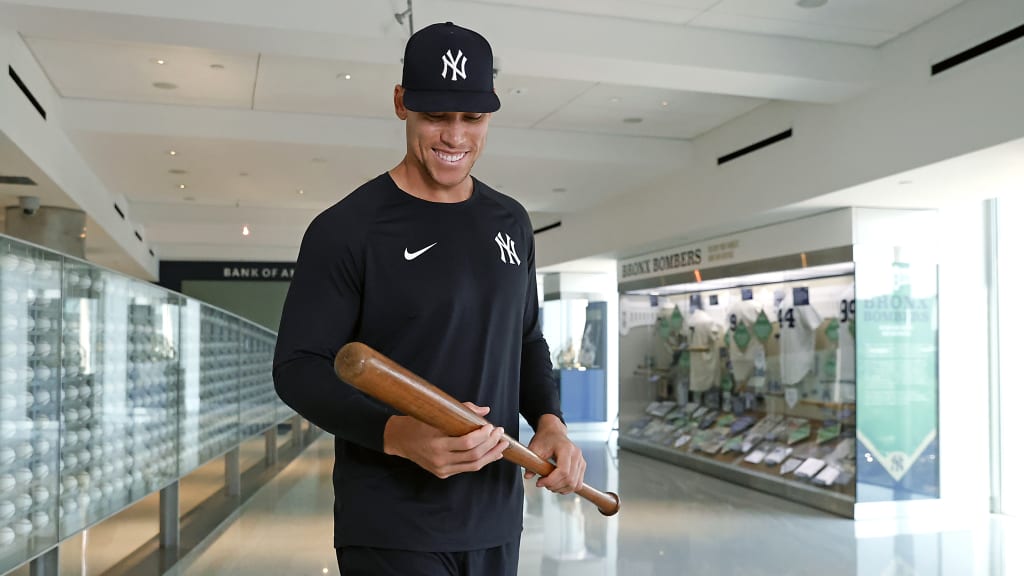
We could spend all day chatting with the Yankees’ slugger supreme, but there is a game to prepare for. Before heading back down to the clubhouse, though, there’s one last item Judge needs to see. Richards emerges from a storage vault holding an impressive piece of lumber: a 45-ounce Louisville Slugger used by the Great Bambino 100 years ago at the Polo Grounds. The curator approaches Judge, who looks unsure for a moment as Richards extends the bat toward him.
“I can touch it?” Judge asks.
“You can hold it,” Richards tells him. “You can put your hands right where Babe Ruth did a century ago.”
Despite it being 12 ounces heavier than the 35-inch, 33-ounce bat Judge uses, Ruth’s thick-handled club feels surprisingly comfortable and well balanced in his hands.
“Oh, this feels great,” he says. “I might take this out there tonight if you guys don’t mind. There’s definitely some magic still left in this.”
Judge poses for a few photos with Ruth’s bat, and there’s no need for Yankees chief photographer Ariele Goldman Hecht to ask him to smile. He has clearly enjoyed this little trip back through Yankees history. While he might not be comfortable hearing his name mentioned in the same breath as some of the team’s all-time greats, he has a true appreciation for the tangible legacies left by those legends.
“Incredible stuff,” he says. “Thanks for allowing me to come up here.”
Judge does not try to pull a David Wells and take Ruth’s gear into that night’s game. But he does do something to quickly assuage any fears we might have had about interfering with his game-day preparation. In his first at-bat that night, Judge deposits a full-count curveball from Rays left-hander Shane McClanahan over the wall in right-center field -- his Major League-leading 25th home run of the season. The Yankees go on to win, 4-3, improving to 46-16 and extending their division lead to nine games.
The only other Yankees to hit 25 home runs in the team’s first 62 games?
Two guys named Ruth and Mantle.