


Justin Verlander will make his 557th and final Major League start on Saturday. It’ll be only his second time throwing to Dillon Dingler, the 30th and final catcher to work with him. Of all the current and former players with stories and memories of Verlander, none have them quite like his catchers, who have been on the receiving end of his nastiest pitches. It’s a big job, but it’s also a career-shaping experience for some.
We talked to two who worked with Verlander extensively over his Tigers tenure to get their memories and insights as he calls it career.
Thanks to colleague Steve Gilbert for talking with James McCann.
What’s your first memory of catching Verlander?
Alex Avila, 124 Verlander starts caught, 2010-17:
“It was early, the beginning of my career, and really I was new to catching. I had only been catching for maybe a year, not just professionally, but ever. And I remember just how difficult it was to judge his curveball out of his hand, because his 12-6 curveball that he threw back then was so hard and had so much depth to it. I mean, he threw it 84-85 mph, which you wouldn't see from a true 12-6 curveball. There was so much break to it, I had a hard time deciphering which one I could catch and which one I had to get down to block. That's how much break it had, and that's my first recollection of the physical part about catching him.
“But then the biggest part was just being able to keep up with him from a preparation and focus standpoint when it came to the game plan and game calling. He made me a better catcher because I had to elevate my game to match his preparation and intensity, because if you didn't, as his catcher, you weren't going to last long, not like he wouldn't want you back there. You just wouldn't be able to keep up, because he was so intense, so focused on what he had to do to be successful. You needed to be able to elevate your game to that same standard.”
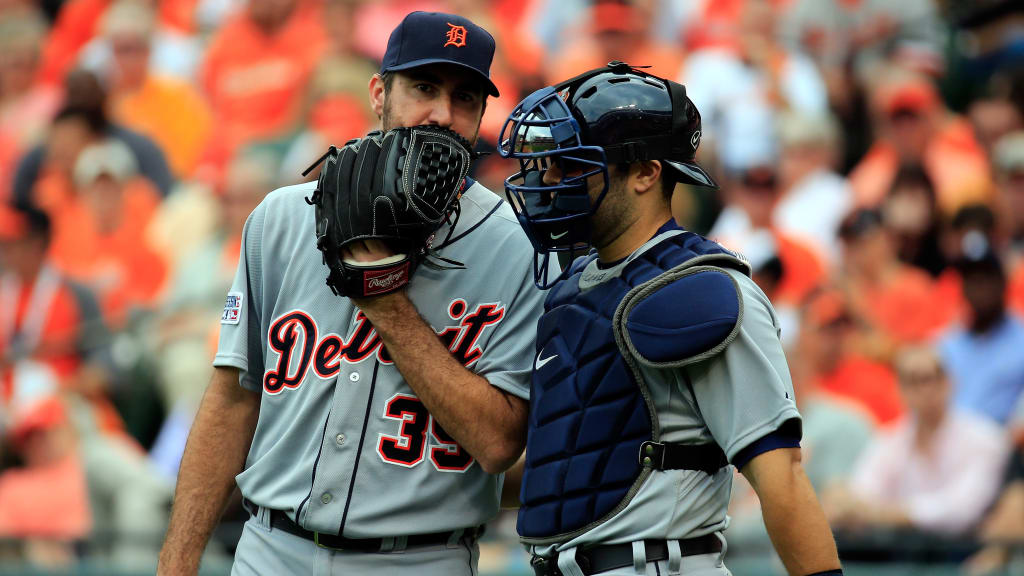
James McCann, 57 Verlander starts caught, 2014-17:
“The first time I caught him in the big leagues was in Kansas City in September 2014. We had a one-game lead in the division over Kansas City. I remember Avila kind of coaching me up on how to handle the pregame meeting and just the things that Verlander liked to do, the things that he was having success with at the time, the things he wasn't having success with. It's kind of one of those things where you just try not to make the guy mad, try to make things as smooth as possible. Being the first time I'm catching him in the heat of a playoff race, the other thing that sticks out to me is the pregame meeting. He had one of the most in-depth-like pregame meetings I've ever had. Like, he knows the ins and outs of every hitter, where his stuff is going to play compared to that hitter, and I was amazed. I'm just sitting there like, man, this guy, his attention to detail is absurd.
“Well, then we got to Billy Butler in the lineup, and he looked at me and said, ‘Whatever you call, I'll throw.’ And he moved on to the next hitter, and I'm like, ‘OK.’ Well, after he left, the pitching coach informed me that Billy had always handled Verlander well for whatever reason. He kind of laughed and he said, ‘Good luck.’ Oh man, I think that night Billy struck out [he flew out the other at-bat]. So, it went well. We won the game, but I just remember his attention to detail on every hitter, except for Billy.
”We got a win, and actually, [Verlander] signed a jersey for me. I don't remember the exact wording, but being a part of my first win, it's awesome.”
What’s your favorite memory of working with Verlander?
Avila:
“Me hitting a couple of homers off him [in 2016 with White Sox]. Yeah, that's a great moment.”
McCann:
”I'll say two things: One, he was always the guy that would grab the young players and say, ‘You're coming to dinner with me.’ He would pick up the tab, take guys out to nice meals and buy guys suits. He was that true professional veteran that took care of the young players financially where he could. The other thing that stands out is when we lost a no-hitter in the ninth inning [in 2016], and to this day, he'll tell me that Chris Iannetta owes me a Rolex because he was the one that broke it up. We got deep into some games with no-hitters, but I think that's the furthest we went, against Anaheim.”
Avila:
“I was talking a week or so ago when I was in Toronto about the no-hitter there [in 2011]. The question was, ‘Was that some of the best stuff you had seen him pitch with that year?’ Now, obviously, that year he won Cy Young and the MVP, and I was like, ‘No, actually.’ It wasn't the worst stuff I'd seen from him, but it certainly wasn't his A-game. I think he had only four strikeouts in that game, and so there was a lot of contact. There was a little bit of luck in there, mixed in with a really good pitching performance. But over the course of that year, I remember several other games where he just had much better stuff and we came close to no-hitters, but they ended up getting a hit. One of the games that I remember is when we were facing the Diamondbacks in Detroit. He struck out a -- at the time -- career-high 14 batters, and he struck out the side in the eighth inning with two guys on and nobody out. He had like 110 pitches or something like that. The video shows Jim Leyland in the dugout with Joaquin Benoit warming up in the bullpen, and you could tell the gears are turning as if [Leyland] should take him out or not. He leaves him in there at around 110 pitches, and when he needs it, he steps on the gas, throwing 99-100 [mph] with a hammer, and nobody can touch him. It was just on a whole different level, not just from an ability standpoint, but just pure will.”
What made Verlander so great to work with?
Avila:
“The No. 1 thing was just his God-given ability of being able to throw as hard as he did for as long as he did, being able to step on the gas, pull back on the gas a little bit, step back on it. That was the eye-popping thing about Justin. His stuff was incredible. But I think what set him apart was that he found a routine, because that's something for every starting pitcher that's extremely important. They need to have some sort of routine on not just that day, but even in between their starts, to put them in a position to succeed on that fifth day. And Justin, on days he started, treated them like it was the last day on Earth. I think that's what separated him from being a good Major League pitcher to an All-Star pitcher to one of the best to ever do it. And when the game would be on the line, there was no difference in the way he prepared, because he prepared for every game like it's a must-win game.”
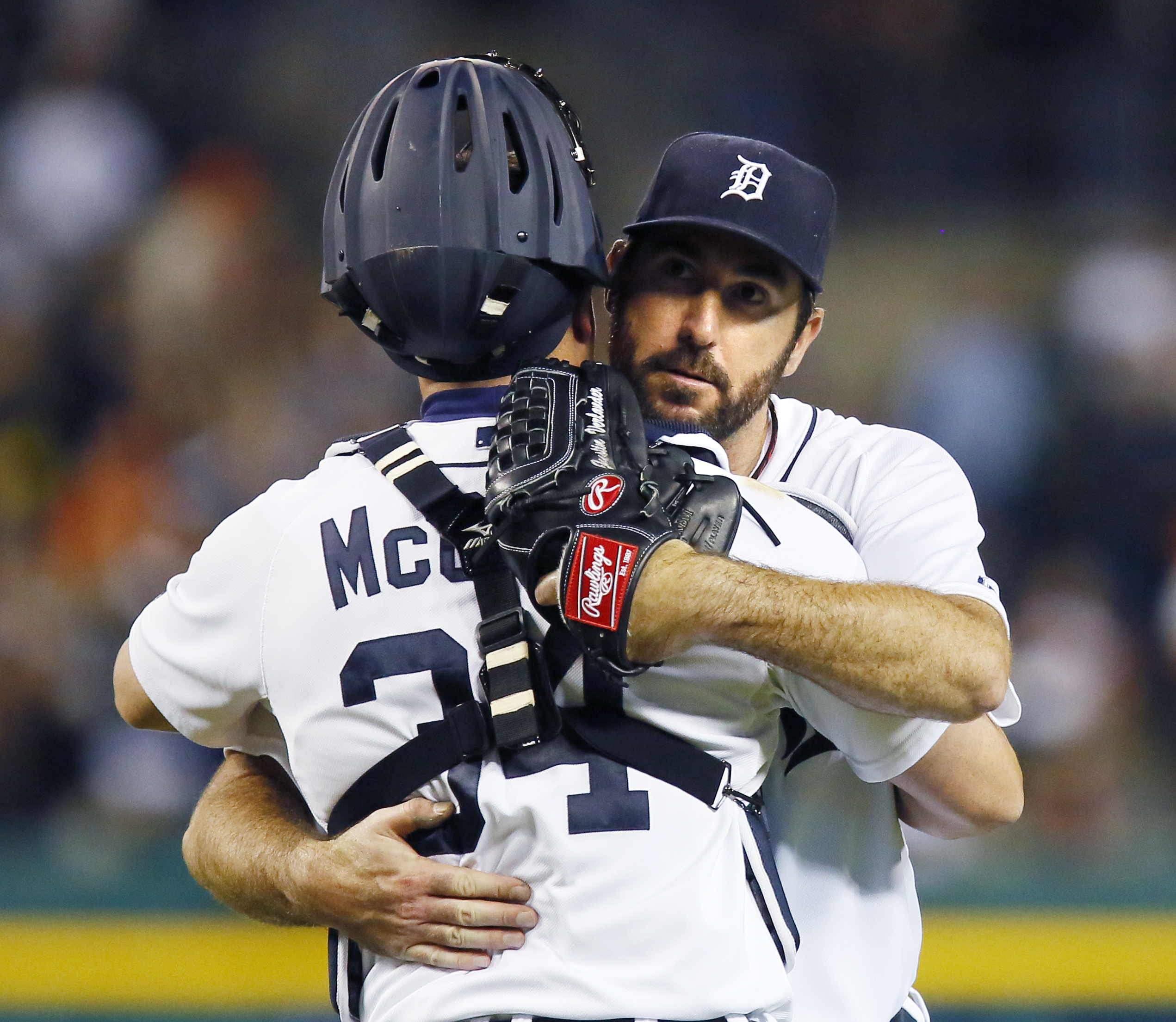
McCann:
“I mean, first off, the talent, right? There was a point in time in his career, and it lasted a lot longer than other people's windows like this, where he was just better than the hitter in the box. The combination of his four-seam, his sliders, curveballs, changeup -- he was just better than anyone that stepped in the box, and he knew it, and he used that confidence, and he dominated the game for a long stretch of time. But the little things that people don't necessarily see: Like I said, his attention to detail is some of the best I've ever seen. His preparation is some of the best I've ever seen. His desire to be great, I would put up there with anyone that I've ever been around. He didn't just want to beat people, he wanted to embarrass people when he stepped on the mound. And his goal wasn't to win one Cy Young. His goal wasn't to be an All-Star one time. His goal was to be the best to ever do it. And he's definitely put himself in the conversation to be one of the best that's ever done it.”
What were mound visits like?
Avila:
“See, that's the thing with Justin. I mean, you didn't need to motivate him, right? A lot of it, I would say 99% of it, was always game-plan-related. A lot of times, whether you were in a tough spot or if I went out there to give them a breather, our discussions were always about how we were attacking the hitter, whether it was that hitter coming up, or if we were trying to plan out the next two or three hitters. You know, if we got this guy out, what was going to be the first pitch to this guy? If he gets on, maybe we're going to go there. Because there was really nothing I could say to him when it came to a mechanical cue or fix. He was pretty good at being able to diagnose that himself.”
McCann:
“Honestly, it depended on the day, on the situation. I think early in my career, I was always … not nervous, but I was always like, ‘OK, I want to make sure I say the right thing here.’ And then after I got to know him, I started to understand that he did want my opinion. He wanted to know what I was seeing, what I was feeling, and we got to a point where we had a pretty darn good working relationship. But yeah, early in my career was like, ‘Don't make the guy mad. I want him to like me.’ And then over time, when that relationship evolved and that trust evolved, you know, he could tell me exactly what he was feeling.”