

The three best left-handed hitters on the free-agent market all have something in common.
Cody Bellinger, Kyle Schwarber, and Kyle Tucker are all in line for nine-figure contracts. They’re all ex-Cubs, too, and multi-time All-Stars. But the real similarity is their ability to crush left-handed pitching.
It’s an exceedingly rare skill for a left-handed hitter – let alone a slugger. In 2025, lefties hit just .231 with a .365 SLG and a 24.0% strikeout rate against southpaws. As a whole, left-handed pitching is as dominant as it’s been in quite some time: Lefties combined to allow a .240 batting average last season, the lowest mark since the Year of the Pitcher in 1968, which prompted MLB to lower the mound.
And yet, for Bellinger, Schwarber, and Tucker, this is an unquestioned strength -- an asset that should boost their markets this offseason. Let’s assess a hitter’s overall offensive production by Weighted On-Base Average (wOBA), a metric similar to On-Base Percentage, except it weighs extra-base hits. Last season, 86 left-handed hitters drew at least 75 plate appearances against left-handed pitchers. Few, if any, fared better than the free-agent trio.
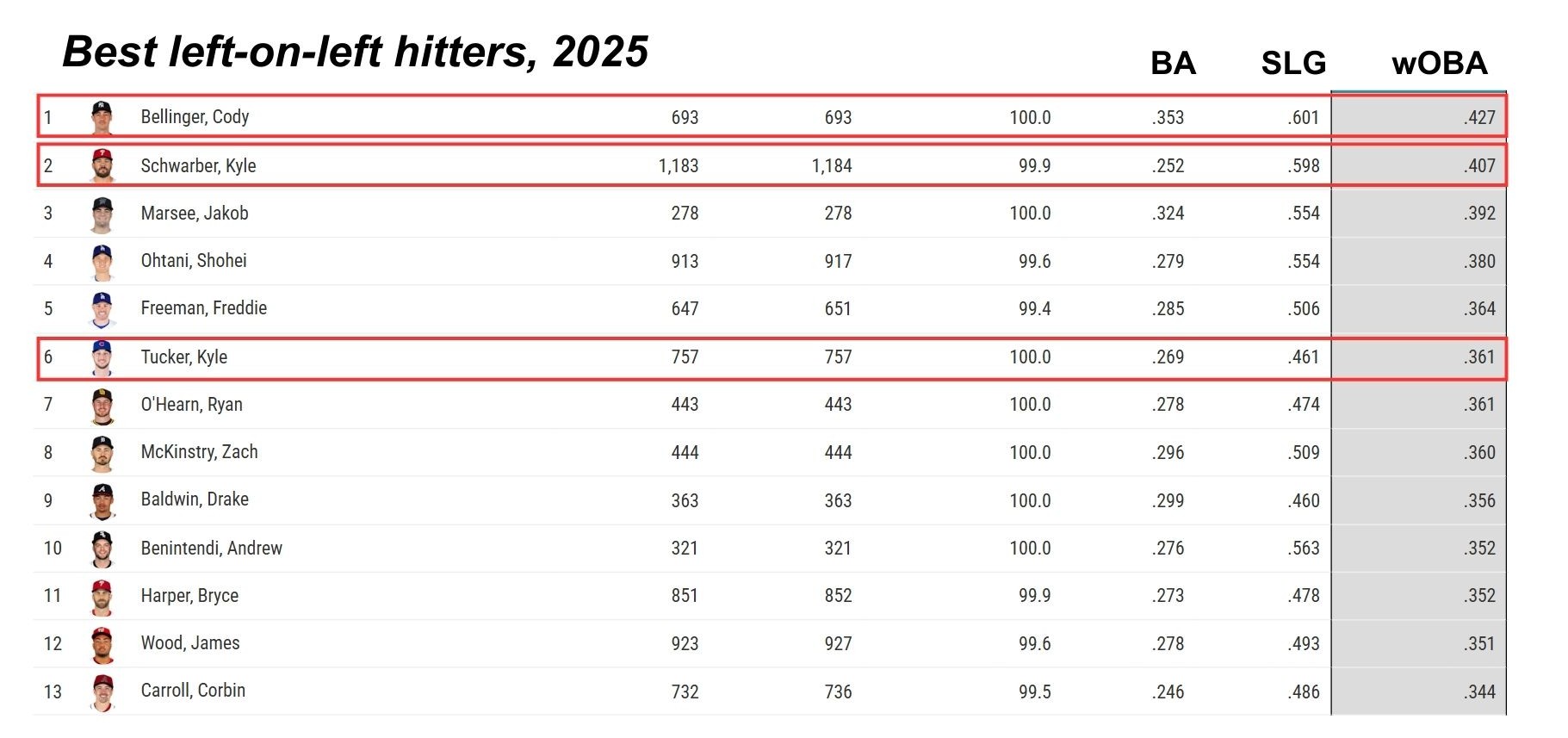
That's a .427 wOBA in left-on-left situations for Bellinger, a .407 wOBA for Schwarber, and a .361 wOBA for Tucker.
So, how do they do it? Let’s dive in.
Cody Bellinger
No left-handed hitter handled left-handed pitching like Bellinger did last season. The former Yankees outfielder led the group in left-on-left batting average (.353), slugging percentage (.601), and wOBA (.427).
This isn’t anything new for Bellinger, who has mashed against left-handed pitching before. In 2019, when Bellinger won NL MVP with the Dodgers, he posted a .398 wOBA against southpaws. His career OPS against lefties (.806) isn’t far below his career mark against righties (.822).
In September, Bellinger told NJ.com that left-on-left is “overblown.”
“A lot of it is approach,” Bellinger said later that month, after winning an epic battle with Aroldis Chapman. “I’m just trying to stay right here and stay within myself, and ultimately just put my best swing on the ball as consistently as I can. I kind of control what I can control.”
That sounds a lot like controlling the strike zone, and discipline is fundamental to Bellinger’s success. His chase rate against lefties fell from 35.9% in 2024 to 26.2% in 2025 -- nearly a 10% drop-off. Yankees hitting coach James Rowson told FanGraphs that Bellinger is as good at recognizing pitch shapes as anyone he's ever seen. That helps explain why only eight left-handed hitters ran a lower whiff rate than Bellinger against southpaws (16.6%).
But Bellinger didn’t just make contact against lefties -- he punished them. That’s what sets him apart. The eight hitters who had a lower whiff rate in left-on-left matchups didn’t hit for power; Nolan Schanuel of the Angels had the highest slugging percentage against lefties of the group, at .368. Bellinger nearly doubled that mark.
“He can shorten up and go the other way, or he can take you deep pull-side,” said Bellinger’s teammate with the Yankees, Max Fried. “So he’s two different types of hitters, and you’ve just got to make pitches and hope he gets himself out.”
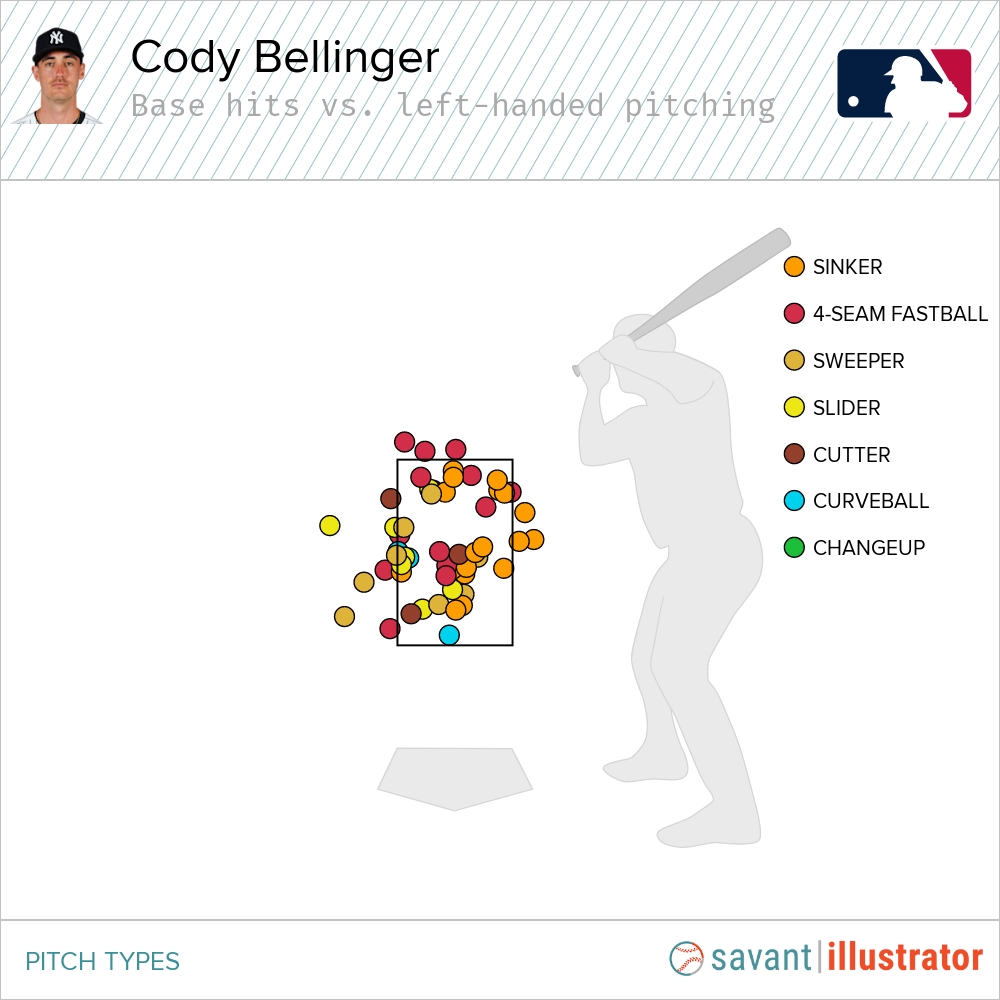
That didn’t happen often. Bellinger hit .365 against left-on-left fastballs, and .353 off left-on-left breaking balls. He covered every area of the strike zone, which you can see in the chart below. As Fried alluded to, Bellinger flicked pitches on the outer half to the opposite field and yanked middle-middle pitches into the right-field seats. That’s hard to beat.
Kyle Schwarber
Just two years ago, Schwarber ran a .188/.430 BA/SLG against left-handers, with a .331 wOBA. Kevin Long, Schwarber’s hitting coach with the Nationals (2021) and Phillies (2022-25), recalled that the slugger was “inept” at hitting lefties.
Fast forward two years and Schwarber is in line for a deserving nine-figure contract because, among other reasons, he cracked the riddle of left-handed pitching. Last season, he bashed 23 left-on-left homers. That’s the most by a left-handed batter against left-handed pitching in a single season in MLB history.
Schwarber’s renaissance has a lot to do with a new mindset.
“You don’t really view it as left-on-left or a right-handed pitcher,” Schwarber told The Athletic in May. “You just view yourself as hitting. You kind of want to take the stigma away from that.”
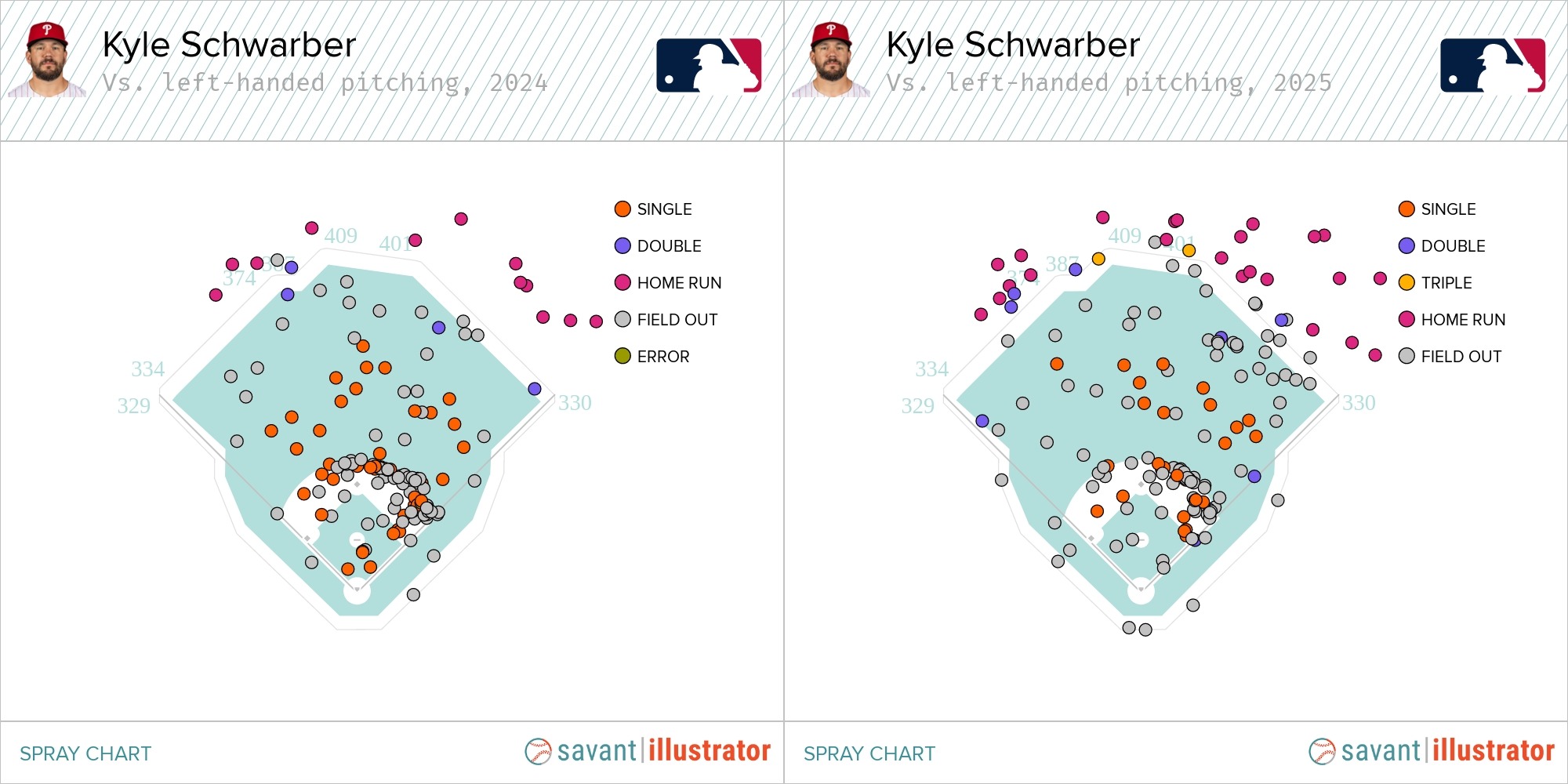
To do so, Schwarber sticks to his strengths, like hitting the ball in the air. His pulled airball rate against lefties -- 33.8% -- was fifth highest in MLB, and actually better than his mark against righties (29.5%). Even for a prototypical slugger like Schwarber, pulling balls in the air is the best sort of contact. The spray charts below show Schwarber’s batted balls against lefties in 2024 and in 2025. It’s easy to see the difference in production.
There’s more to this story than Schwarber’s new mindset. He worked closely with Long to get comfortable facing the odd crossfire angles that left-handed pitchers create for left-handed sluggers. He started wearing a protective C-flap helmet, too, which helped him stay home on pitches running in on him. With fast hands and little fear, he learned to turn on pitches at a high frequency.
It’s not a surprise that Schwarber crushes left-on-left fastballs. His .833 SLG against four-seamers/sinkers last season is over 150 points above the next closest player, Miami’s Jakob Marsee (.657).
Kyle Tucker
Tucker falls into the Bellinger camp, in the sense that he’s always hit left-handers, touting a career .842 OPS against southpaws. Since 2019 -- Tucker's official rookie season -- only Yordan Alvarez, Bryce Harper, Shohei Ohtani, and Juan Soto have a higher OPS in left-on-left matchups (min. 100 PA).
Tucker's success against lefties predates the start of his professional career. He grew up facing his brother, Preston -- a left-hander -- in Wiffle ball matchups in the backyard. He’s been comfortable facing lefties ever since.
Tucker’s best skills -- a rare blend of exceptional contact ability with plus power -- translate against lefties. In 2025, he posted a 19.1% swing-and-miss rate against left-handers, as well as a 16.7% chase rate. No one chased less often in left-on-left matchups than Tucker, and good swing decisions paved the way for success.
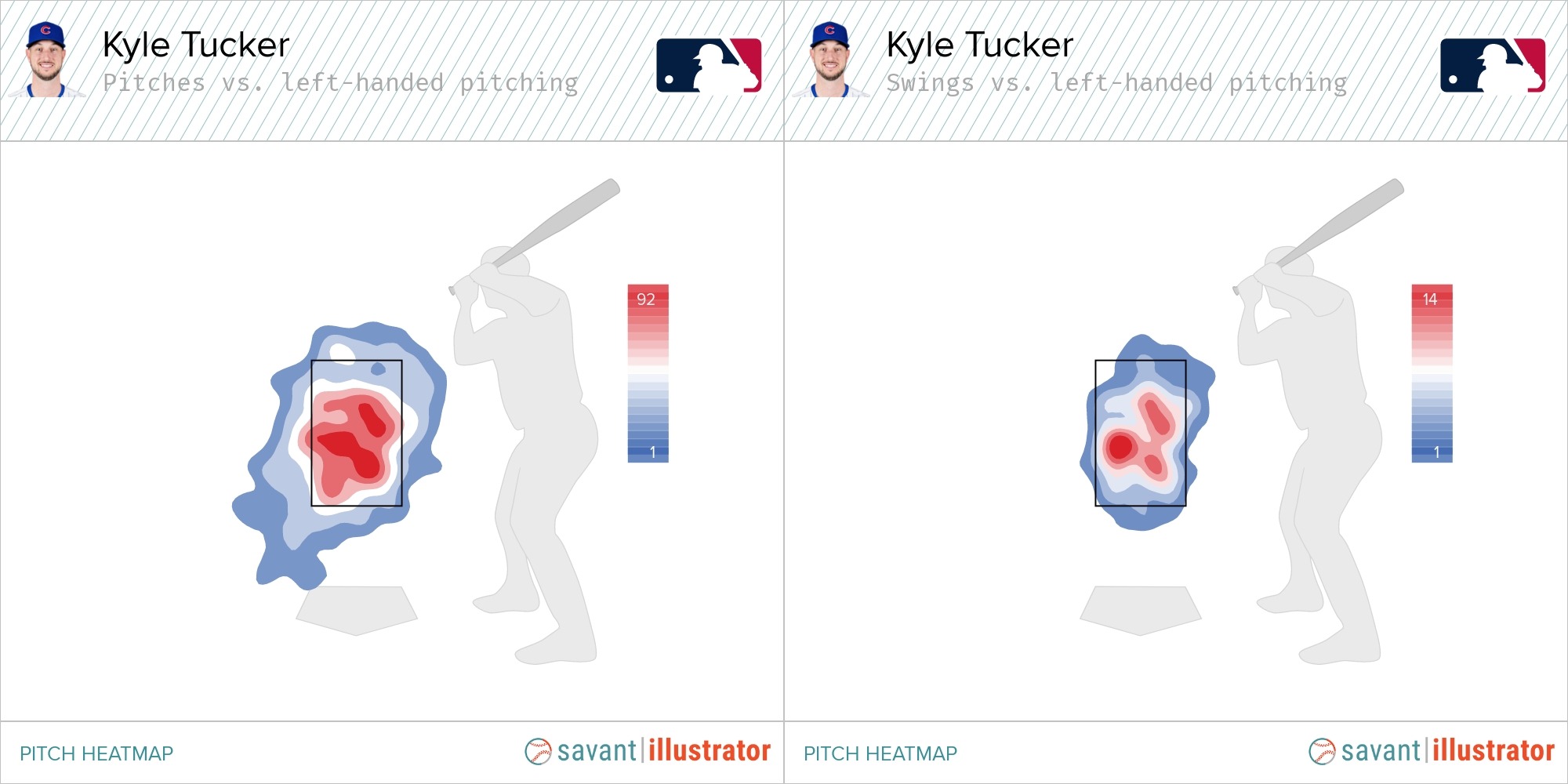
Any conversation of Tucker’s 2025 season would be incomplete without mentioning the hairline fracture in his right hand, which he sustained at the beginning of June. To some degree, his on-field production was impacted as he played through the injury. That sure looks to be the case against left-handers.
Tucker's contact quality vs. LHP
- Through June 1: 14.5% barrel rate / 51.6% hard-hit rate
- From June 2 on: 4.1% barrel rate / 28.1% hard-hit rate
We don’t really know the degree to which the hand fracture bothered Tucker. But, in April and May, Tucker posted two of the best months against left-handed pitching in his entire career; he followed that up with three of his worst.
The eight-year veteran owns a career .505 SLG against lefties that mirrors his .508 SLG against righties. It wouldn’t be a surprise if a fully-healthy Tucker gets right back to that elite level.