


No one loves a good debate quite like baseball fans, and with that in mind, we asked each of our beat reporters to rank the top five players by position in the history of their franchise, based on their career while playing for that club. These rankings are for fun and debate purposes only, and are updated through the end of the 2025 season.
Here is Adam McCalvy’s ranking of the top general managers in Brewers history.
1. Harry Dalton, 1977-91
Key fact: Inducted into Brewers Walk of Fame in 2003.
Dalton built powerhouse teams for the Baltimore Orioles from 1966-71 that went to four World Series in a six-year span -- winning two of them. But he had less success out west running the California Angels, and then-Brewers owner Bud Selig was able to hire Dalton away in the fall of 1977 after cleaning house in Milwaukee’s front office. Selig thought Dalton had the experience to capitalize on a recent infusion of promising talent to Milwaukee’s system, including that year’s first-round Draft pick, Paul Molitor. Dalton’s first move was to hire another former Oriole, bombastic pitching coach George Bamberger, to be the Brewers’ manager.
Even before the arrival of Dalton and Bamberger, it was a period of change for the franchise. Robin Yount, Jim Gantner and Molitor were already in the organization. The Brewers had signed former Oakland A’s captain Sal Bando the previous November and acquired Cecil Cooper from the Red Sox and left-hander Mike Caldwell from the Reds in trades.
Days before Selig hired Dalton, the Brewers signed the reigning American League RBI champion, Larry Hisle, to the biggest free agent contract in Major League Baseball that entire offseason. Dalton built around that core, trading for Ben Oglivie and re-acquiring Gorman Thomas mere weeks into his Milwaukee tenure, and later adding veterans like Rollie Fingers, Pete Vuckovich, Ted Simmons and Don Sutton to the club’s young homegrown players.
In Dalton’s first five seasons as GM from 1978-82, the Orioles were the only team in baseball with more regular-season victories than the Brewers, who made their first two postseason appearances in '81 and ‘82, including a trip to the ‘82 World Series. Dalton was the 1982 Executive of the Year and the Brewers won Baseball America's Organization of the Year honors in three straight seasons from '85-87. Dalton was Brewers' GM for 14 seasons from 1978-91, nine of them winning seasons.
“I always had a feeling from him in Baltimore, and even when he went out on the West Coast, that he really had a love for player development,” Selig said. “He had good people with him. He was everything I wanted and we had not had at that point, to be real blunt with you. We had some good baseball people, but Harry Dalton was the missing link all those years. So he came to Milwaukee and we had a huge press conference. The rest is history.”
Dalton gave future Brewers manager Ned Yost his first shot as a big leaguer, and Yost said of Dalton, "You always knew who was holding the hammer, and that was Harry."
"The type of players [Dalton] got were important," Hisle said. "They weren't just players that had good statistics; when you took the field you knew our sole purpose was to win. He assembled a wonderful, wonderful team. It's still difficult for me to believe that we went from 95 losses [in 1977] to 93 wins [in ‘78], especially in a division with the Yankees, Baltimore and Boston. Those teams were as good as any in baseball."

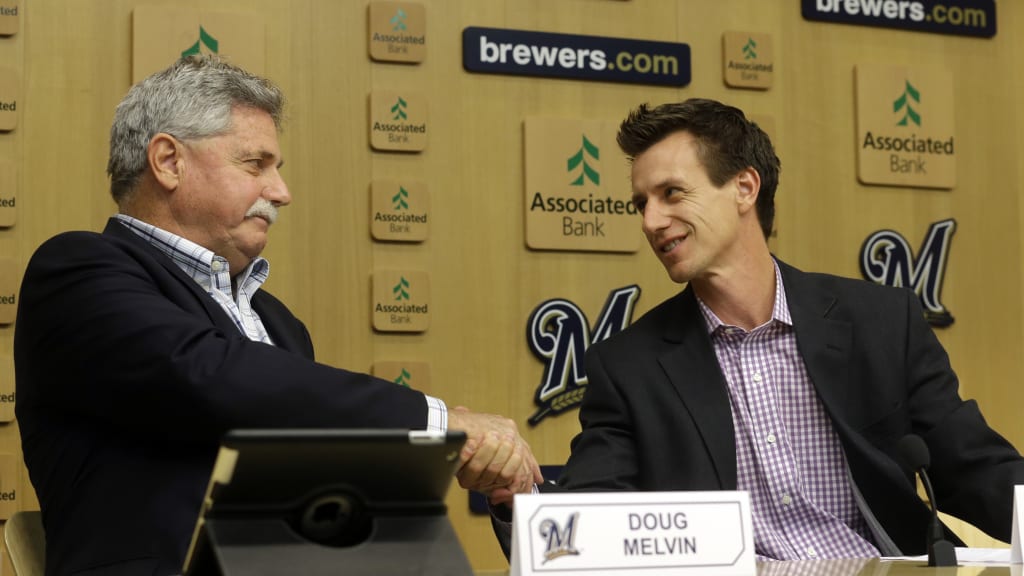
2. Doug Melvin, 2002-15
Key fact: As GM in Texas and Milwaukee, Melvin’s clubs made the postseason five times. Each time, it fell to the eventual World Series champion.
Melvin showed an early eye for baseball talent, starting with his own. In 1978, he was a 25-year-old right-hander in the Yankees system entering his sixth professional season. He expected to go to Triple-A Tacoma, but instead the Yankees sent Melvin back to Double-A West Haven, which turned out to be fortuitous because it reunited him with a girl named Ellen he’d met the previous summer. They married by the end of the year and had two children, a daughter Ashley and a son Cory, who later went into baseball himself. Purely from a baseball standpoint, however, it wasn’t an ideal assignment. So, at the end of that year, Melvin took a meeting with New York’s farm director, Jack Butterfield.
“Jack, I’m 26 years old now, and I don’t think I’m a Major League prospect,” he said. “Would you confirm that to me?”
“Yeah, I’ll confirm that,” Butterfield responded without a thought. “You’re not.”
Melvin blanched.
“I said, ‘Are you sure you don’t want to ask your scouts or go back and look at some reports?!’”
A front office career was born. Melvin came up in player development with the Yankees and Orioles before serving as GM of the Texas Rangers. The Brewers hired him at the end of 2002, and under Melvin’s watch, Milwaukee snapped a 12-year streak of losing seasons in '05, posted a winning season in '07, ended a 25-year postseason drought in 2008, and played to within two wins of the World Series in '11.
After hiring fellow Canadian Gord Ash to be his assistant GM, one of Melvin’s smartest decisions was to retain amateur scouting director Jack Zduriencik, who drafted many of the players -- mostly hitters -- who would lead the Brewers’ rise, from Prince Fielder, Corey Hart and J.J. Hardy before Melvin’s tenure to Rickie Weeks and Ryan Braun under Melvin’s watch. He heard the criticisms about the club’s record in drafting and developing pitchers, but trades for CC Sabathia in July 2008 and Zack Greinke and Shaun Marcum in December 2010 provided the finishing touches on the Brewers’ first postseason clubs in a generation. Melvin served as Brewers GM through the pivotal 2015 Trade Deadline before stepping down and moving into an advisory role with the club.
“Doug just had a great feel for people, and that served him well with a lot of his decisions,” said Brewers manager Craig Counsell. “He came in at a very good time, when the system was in a place that made it a very good time for a general manager to take over, and I think he actually left in a similar situation. With Doug, maybe the thing he won’t get credit for, is that a lot of times when GMs leave, the cabinet is bare. The cabinet wasn’t bare when he left. He left the franchise in a pretty good place.”
3. David Stearns, 2015-22
Key fact: His clubs qualified for postseason play four times in seven seasons.
Stearns was 30 years old, the youngest GM in baseball, when the Brewers hired him on Sept. 21, 2015. He had studied political science at Harvard and written for the school newspaper -- he was the football beat writer for two years and later wrote a sports column -- because those things are what most interested him.
But he always aimed to work in baseball. So, in the summer after his freshman year he took an internship with the Brooklyn Cyclones, a Class A affiliate of the Mets, doing what Minor League interns do: He pulled the tarp, fixed seats, painted fences, donned the mascot costume and power-washed bathrooms. More cerebral jobs followed; back-to-back summer internships with the Pirates in player development and baseball operations, then an administrative job with the Arizona Fall League. Later he worked for the Mets, for the Commissioner’s Office handling arbitration cases, then the Indians and Astros before the Brewers came calling.
“My goal getting into this thing was to get into a position where I had an impact on wins and losses on the field,” Stearns said. “I didn’t know exactly what direction that was going to take. Had my first job been as an area scout, it could have been a very different path.”
As GM, he executed a rapid rebuild -- Stearns preferred the terms “reset” or “retool” -- that paid dividends much earlier than expected. In 2017, the Brewers were not mathematically eliminated from the postseason until the final weekend of the regular season. The following January, Stearns acquired Lorenzo Cain via free agency and Christian Yelich via trade and saw both players blossom for a team that won the NL Central, starting a stretch of four consecutive postseason berths from 2018-21 before the Brewers missed the playoffs in the wake of the Josh Hader trade in ’22. Stearns stepped aside following that season, though he remained with the Brewers for one more year as an advisor.

4. Matt Arnold, 2023-present
Key fact: Two-time MLB Executive of the Year Award winner
Arnold’s tenure was off to a stellar start as of the 2025-26 offseason, when these rankings were last updated. A longtime Brewers executive who first came to Milwaukee in 2015 to be Stearns’ top assistant, Arnold took over leadership of the club’s baseball operations department when Stearns stepped aside following the 2022 season and managed to not only extend the longest stretch of regular-season success in franchise history, but even improve upon it. He won MLB’s Executive of the Year Award in 2024 after the Brewers defied expectations to win a second straight division title. Then he won the award again in 2025 after the Brewers led the Majors and set a franchise record with 97 victories before beating the rival Cubs in the NLDS.