

A bunch of electric pitchers who were free agents are already off the market, whether it's Dylan Cease or Edwin Díaz or Devin Williams. But there are still plenty out there for needy teams -- and those free-agent pitchers throw some nasty pitches.
Let's take a look at some of the best. These are the top individual pitches thrown by the current free-agent class, from overpowering fastballs to wipeout breaking balls to fall-off-the-table offspeed pitches.
We're picking one free agent pitcher for each of the main pitch types Statcast classifies, and we're not repeating any names -- so even if a guy has more than one nasty pitch, he'll only be on the list once.
Here are the nastiest pitches still available on the free-agent market.
4-seam fastball: Michael Kopech
With pitchers Cease, Díaz and Robert Suarez all signed, here's a dark horse for the best heater remaining. Kopech was only able to pitch in 14 games in 2025 as he dealt with various injuries, but the former Dodgers reliever still has a big-time fastball.
Kopech's four-seamer is still averaging right around 98 mph and touching triple digits -- when he returned to the Dodgers down the stretch last season he maxed out at 101. His fastball also has a very high spin rate (over 2,600 rpm) which allows him to generate strong rising movement (18 inches of induced vertical break) and get lots of swings-and-misses.
If Kopech is healthy in 2026, his fastball can still be one of the most dominant in the big leagues, like it was during the Dodgers' 2024 World Series run.
Sinker: Framber Valdez
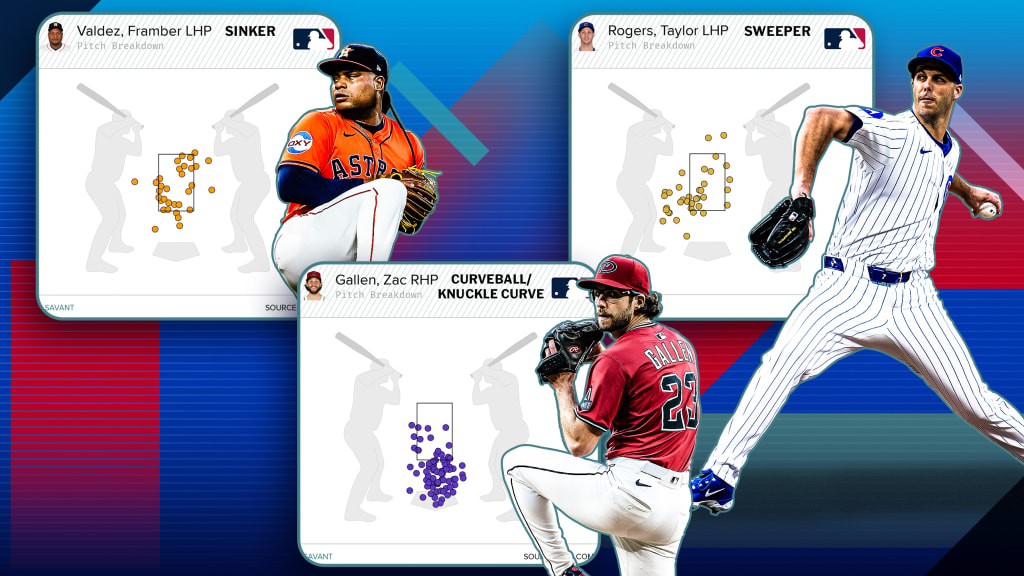
Valdez is the most consistent ground-ball pitcher in baseball, and the pitch at the center of it all is his sinker. The sinker is the pitch that has let Valdez generate a 62% ground ball rate since his breakout season in 2020, one of the very highest in the Majors over that time.
Over the last two seasons, no MLB starting pitcher has a sinker more valuable than Valdez's, which has been worth +25 runs prevented according to Statcast's run value metric (Valdez is tied with Giants ace Logan Webb at the top). The sinker is what makes him such an effective workhorse.
Cutter: Chris Bassitt
This would've gone to Kenley Jansen or Merrill Kelly if they hadn't signed already, but Bassitt's cutter is one of his most reliable pitches as the veteran continues to be a productive starter year after year.
Since 2022 -- a time period in which Bassitt has made 30-plus starts and thrown 170-plus innings every season -- Bassitt's 89 mph cutter has been his most-used pitch after his sinker, and it's been good for 40 strikeouts a year while holding hitters to a .222 batting average. Bassitt has one of the biggest pitch arsenals of anybody, throwing eight different pitch types, but the cutter helps hold everything together.
Slider: Tatsuya Imai
Two true elite sliders are off the market in Cease's and Díaz's, so let's go outside the box for this one -- to the Japanese ace Imai, who's coming to MLB from Nippon Professional Baseball's Saitama Seibu Lions.
Imai isn't like some other Japanese stars who feature the splitter as their signature pitch. Imai's best out pitch is his slider, which sits at 86 mph and generated a 46% swing-and-miss rate in NPB last season.
But the most intriguing thing about Imai's slider is that it has a "backwards" movement direction -- it breaks from left to right, toward his arm side, rather than the traditional right-to-left glove-side break for a right-hander's slider. That type of slider is rare in the Majors, thrown only by a few pitchers like Blue Jays rookie phenom Trey Yesavage, and can be baffling to hitters.
Sweeper: Taylor Rogers
There aren't a ton of nasty sweepers remaining on the free agent market now that Dustin May and Brad Keller have signed, but if you need a lefty specialist with a big side-to-side breaker to combat lefty sluggers, Rogers fits the bill.
Rogers is a two-pitch pitcher, sinker and sweeper, but his sweeper is the No. 1 pitch -- he threw it 51% of the time last season, vs. 49% for his sinker. It sits at just 78 mph, but with high spin (over 2,800 rpm), which allows it to break over 16 inches from side to side. Hitters whiffed on more than a third of their swings against Rogers' sweeper in 2025 and batted just .168 against it. Rogers collected 36 strikeouts on sweepers, second-most of any reliever.
Curveball/Knuckle Curve: Zac Gallen
This could also go to Valdez, whose curveball racked up 121 K's last season, but because we're already using him for his sinker, we're looking elsewhere for the curve. And Gallen's knuckle-curve has racked up plenty of K's too.
Gallen throws a "12-6" style of curveball -- his sits at 81 mph and drops over 53 inches while breaking less than five inches horizontally. For three seasons in a row entering 2026, he's notched over 75 strikeouts on that knuckle-curve, which makes Gallen one of just five pitchers with 200-plus total curveball K's over the last three years.
The others are Charlie Morton, Valdez, Aaron Nola and Blake Snell. That group is five of the best curveballers in the Majors.
Slurve: Sean Newcomb
Only a handful of Major League pitchers throw a "slurve" at all -- that's a slider/curveball hybrid -- but there are a couple available in free agency for teams looking for that in-between style of breaking ball, with more velocity than a curve but more looping movement than a slider.
Newcomb throws a particularly good one. The lefty reliever, who had a resurgent season with the A's in 2025, features an 82 mph slurve with a spin rate over 2,800 rpm and 17 inches of left-to-right horizontal break.
Newcomb got 45 of his 91 strikeouts on slurves, just about half, and the pitch generated a 32% swing-and-miss rate and 46% strikeout rate while holding hitters to a .172 batting average.
Changeup: Ranger Suárez
Williams' Airbender could've taken the title here, or Michael King's changeup with its Wiffle ball horizontal movement, but those two pitchers have new deals for 2026. So let's go with Suárez, whose changeup is a key to how he keeps hitters off balance.
The former Phillies southpaw isn't a hard thrower, but he mixes and matches his pitches to deceive opposing hitters, and his changeup might be his best weapon toward that end. Suárez's changeup sits at 80 mph, a 10 mph differential from his fastball, and has a ton of depth. It drops 40 inches from his hand to the plate, the fourth-most drop among pitchers who threw at least 250 changeups in 2025 and the most among lefties.
Suárez deploys a very balanced pitch mix and generated at least 10 strikeouts on all six of his pitch types last season, but it was his changeup that led the way with 36 K's.
Splitter: Seranthony Domínguez
The splitter just took center stage during the 2025 postseason, thanks to the two World Series teams, the Dodgers and Blue Jays, having several of the nastiest splitters in the Majors on their pitching staffs.
Domínguez had one of them, and the Blue Jays setup man is now a free agent. Domínguez had a case to be on this list for his four-seamer, which sits at 98 mph, or his sweeper, which also generated a 49% swing-and-miss rate, but we'll give him the split. For good reason.
Domínguez's splitter averages 87 mph with extremely low spin -- under 900 rpm -- which is what you want on a splitter, because low spin gives splitters their "tumbling" downward movement that makes them so hard to hit.
With that combination of high velocity (for an offspeed pitch) and low spin, Domínguez's splitter generated a 50% swing-and-miss rate and 49% strikeout rate in 2025 -- both among the highest in the Majors for that pitch type -- and held hitters to a .114 batting average.