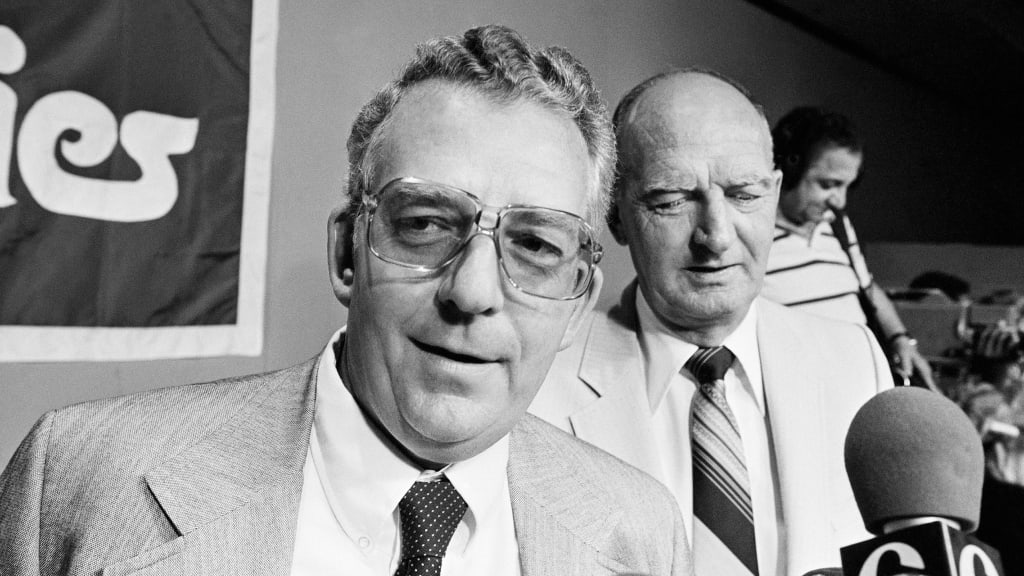
Bill Giles came to Philadelphia to entertain the masses. His legacy extends far beyond that.
Giles, once called the P.T. Barnum of baseball because he tried just about anything to get people to the ballpark, joined the Phillies to help them close Connie Mack Stadium and open Veterans Stadium in 1971. He quickly hired the legendary Harry Kalas from Houston to be one of the team's broadcasters. He later helped create the Phillie Phanatic, convinced free agent Pete Rose to come to Philadelphia, and in 1981 led a group that bought the Phillies from the Carpenter family. As team president from 1981-97, he led the Phillies as they won National League pennants in 1983 and '93.
Giles, who died on Friday at age 92, left a long-lasting mark on Philly.
“My only philosophy was to make people happy,” he told Main Line Today in 2008.
“The Phillies family lost an icon today,” John Middleton, the Phillies' managing partner and CEO said in a statement. “Bill helped to reshape our franchise from a traditional baseball club into a highly visible entertainment and business operation. His profound impact in overseeing one of the greatest eras in franchise history, both on and off the field, will forever be his legacy. Our hearts are heavy for the Giles family and all those who had the privilege of knowing Bill.”
“Sad news today as we learned of the passing of a dear friend of the Phillies family, Bill Giles,” Hall of Fame Phillie Mike Schmidt said in the statement. “Bill was the heart and soul of the organization for over two decades. He was a close personal friend to so many of us. He will always be a big part of Phillies history. Prayers go to the Giles family in this time of mourning.”
Born on Sept. 7, 1934, in Rochester, N.Y., William Yale Giles spent his entire life in and around baseball. His father, Warren C. Giles, was the Reds' president and general manager from 1946-51 and president of the National League from 1951-69. His godfather, Branch Rickey, brought Jackie Robinson to the big leagues in 1947.
Giles spent much of his childhood at Crosley Field in Cincinnati. He graduated from Denison University and spent three years in the Air Force as a navigator in Strategic Air Command before he returned to baseball as GM of the Nashville Vols in 1959. He joined the Houston Colt .45s as traveling secretary and publicist and helped open the Astrodome in 1965, some even claiming he helped nickname the place “The Eighth Wonder of the World.” The Carpenter family hired Giles after the ’69 season to be vice president of business operations. He later became executive vice president.
Giles had a knack for promotions. According to “The Big 50: The Men and Moments That Made the Philadelphia Phillies,” Giles held weekly staff meetings in the early years to find ways to get people to buy tickets to watch a bad baseball team.
“My goal was to do unusual things -- cash scrambles and giveaways and all that stuff,” he said. “If we could get them to the ballpark once, particularly when we opened the Vet, they hopefully will like it enough to where they would come back enough to become a mini-season-ticket holder for 10-15 games a year and then eventually a full season-ticket holder. It was that stepping stone of developing a fan base that started by doing a lot of nutty things.”
He had Karl Wallenda, originator of the The Flying Wallendas, walk a nearly 640-foot tightrope several hundred feet high across the Vet in 1973. There was no netting to save him if he fell. Wallenda did it, much to Giles’ relief. Wallenda repeated the feat in '76. Giles once tried to have “Kiteman” fly a hang glider from a ramp in the upper deck to the mound to deliver a ball to Philadelphia mayor Frank Rizzo on Opening Day 1972. “Kiteman” crashed into the upper deck, thankfully surviving.
“A dead body is not a good omen for the start of the baseball season,” Giles said at the time.
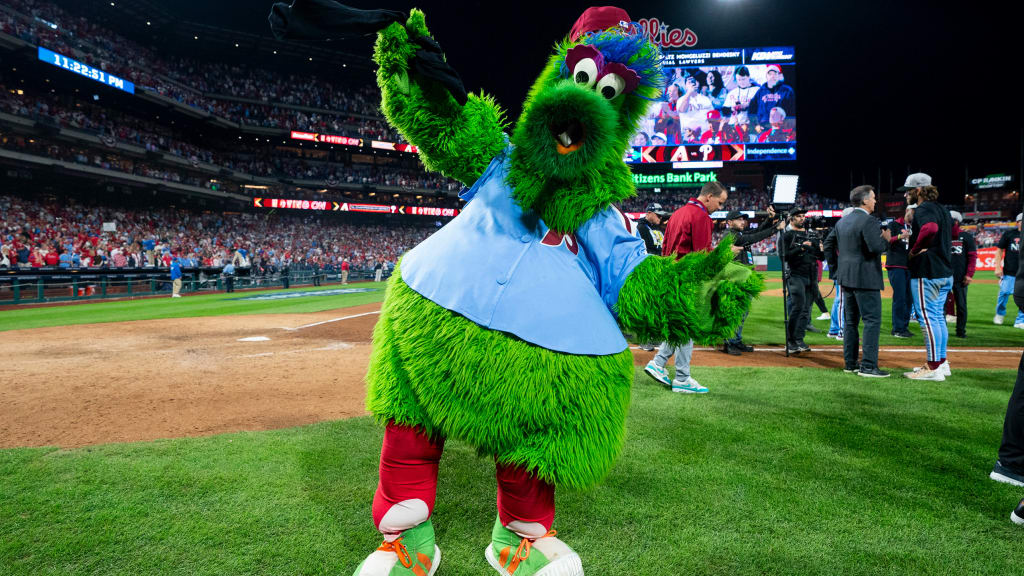
Former Phillies director of marketing Dennis Lehman and promotions director Frank Sullivan thought the Phillies could use a new mascot in the late ’70s. Giles told them to go for it. They asked Muppet creator Jim Henson for help, but he referred them to Bonnie Erickson and Wayde Harrison. Giles said he asked them to make the mascot fat, green, indistinguishable and loveable.
“I kind of wanted him cuddly, something like kids would like to hug,” Giles said. “I really don’t know why I said green.”
Different designs came to Giles’ desk. He asked them to make the mascot fatter. He wanted the nose bigger. He got it.
The Phillie Phanatic is now world famous and synonymous with the Phillies and Philadelphia.
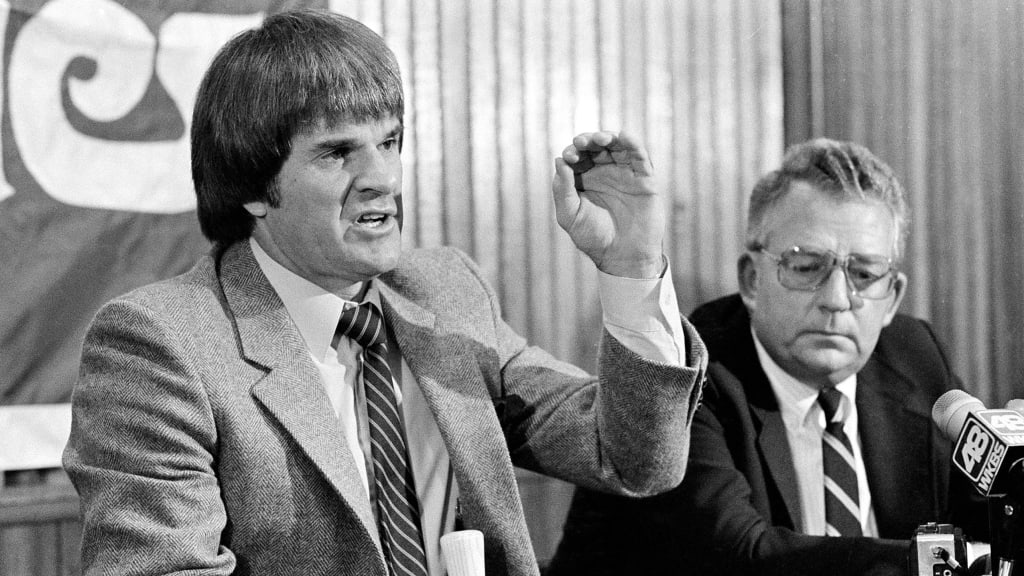
After the Phillies lost three consecutive National League Championship Series from 1976-78, they knew they needed to do something to push them over the top. Rose hit the market as a free agent following the ’78 season. The Royals, Braves, Cardinals and Pirates all made strong offers. The Phillies’ offer fell short, but on the drive to the airport, Giles pulled out the National League’s Green Book, the record book MLB once distributed to teams and media. Giles understood Rose’s massive ego and sense of history. He told Rose that if he signed with an American League team he would never hold the NL’s all-time hits record.
“All your kids and grandkids are going to see that you’re second and third,” Giles said. “Don’t you want to be first in all these categories?”
Giles then got WPHL-TV in Philadelphia to kick in an extra $200,000 per year in broadcasting rights to sweeten Rose’s contract offer. Rose signed. The Phillies won their first World Series in franchise history in 1980.
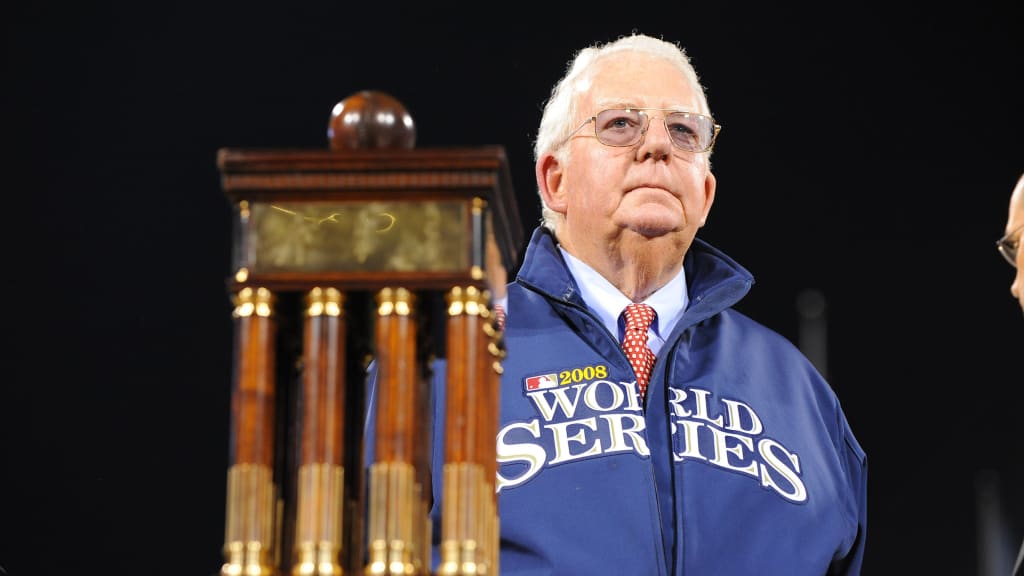
Giles later became team chairman after the ownership group moved to make David Montgomery president in 1997. MLB named Giles honorary NL president in 2001. He received the Bud Selig Executive Leadership Award in 2010 for lifetime achievement in baseball from the Professional Baseball Scouts Foundation. Giles also served as a member of the National Baseball Hall of Fame’s Veterans Committee. He worked with the Philadelphia Convention and Tourism Bureau. Philadelphia Chamber of Commerce, Philadelphia Sports Congress, Boy Scouts of America, Corporate Alliance for Drug Education, Pennsylvania Chamber of Commerce, Police Athletic League, Salvation Army, Union League, Temple University Medical School and Temple University Journalism School.
But those who remember the Phillies in the late ’60s and early ’70s marvel at Giles’ influence on the franchise. The Phillies were losing a lot of games and not very likeable. Giles helped changed how Philadelphians looked at them.
“To me," former Phillies vice president of public relations Larry Shenk said in “The Big 50,” "Bill saved the franchise.”