

Free agent Brandon Lowe was a finalist for an NL Gold Glove Award at second base for his work with the Pirates in 2026, along with winner Brice Turang and JJ Wetherholt, two of the more elite defenders in baseball.
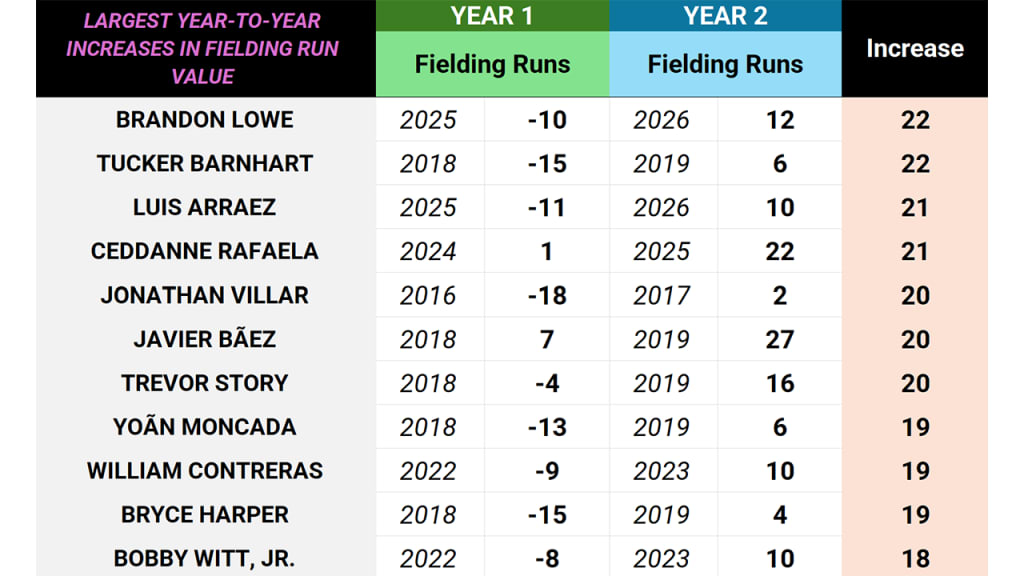
It almost doesn't matter that he didn't win. Simply to be nominated is an incredible victory for Lowe, who’d rated as (tied for) the weakest defensive second baseman in the Majors in 2025 (minus-10 by Statcast’s Fielding Run Value) before turning that all the way around to be the third-best second baseman this year (+12). For this one, you can toss out the sometimes confusing differences in defensive evaluation, because Defensive Runs Saved, an unrelated third-party metric, says almost exactly the same thing.
Lowe, by any way you choose to view such things, was simply a better second baseman this year than he was last year.
“The defense has been much, much better than anticipated,” noted Pirates manager Don Kelly in October, which might say as much about what was anticipated as it does what actually happened.
It’s not just a wild turnaround. It’s tied for the single largest year-to-year turnaround by a defender in a decade's worth of Statcast data, which is going to be more than a little important to Lowe now that he has entered free agency for the first time, at age 32.
Just like the baseball world always says: Players leave the Rays and then get better.
OK, maybe not. Still, it’s hard not to notice exactly when Lowe turned it around. If 2025 was a bit of an outlier in itself, as Lowe had generally been more of a below-average second baseman than a worst-in-baseball one, then it wasn’t until he got to Pittsburgh that he actually started playing it well.
How?
For one thing: We’re willing to give Lowe and his Rays mates more than a little credit here for the turmoil of their 2025 season, the one that forced them off the turf of Tropicana Field and into the heat, rain and sunlight of George M. Steinbrenner Field, the spring home of the Yankees, after Hurricane Milton rendered the Trop unplayable for a season. While the 98-64 American League champions outplayed everyone’s expectations this year, including likely their own, part of that was because the 2025 Rays checked in at 77-85, their worst record since 2016.
Maybe that's just how it was always going to go, because the 2024 Rays had been under .500, too. But whether due to unfamiliarity or anything else, Lowe’s defense had some pretty sizable splits, where he was (as a second baseman) atrocious at home (-11 Outs Above Average) as compared to mildly below-average on the road (-3 OAA). He also dealt with oblique and foot injuries, which surely didn’t help overall.
Still, even if things weren’t really as bad as they seemed in 2025, going from “mildly below-average,” to “something like truly elite, backed up by more than one metric,” is an incredible thing. As Lowe himself said, he credits the Pittsburgh coaching staff, particularly infield coach Chris Truby, who played parts of four Major League seasons earlier this century, including a brief stint in Tampa Bay himself.
“I’ve been pretty happy with how the defense has turned around for this year,” Lowe said in October. “It’s a testament to the coaching staff here that has helped me out.”
Truby and Lowe worked together on a change in his pre-pitch setup, adding in a slight bunny hop that Lowe used to speed up his reactions and footwork.
“He was just not playing as athletic as he can,” said Truby. “He was all ears [to a change].”
Truby said that in July, but it was apparent that there was a difference as soon as three weeks into the season. Just look at what Lowe told Yahoo! on April 21:
"There are some balls that I've gotten to this year that I don't know if I get to them last year," he said. "I feel like I'm getting better jumps and better reads on balls."
You can see it, comparing two somewhat similar grounders hit to his left over the last two seasons, hit by two somewhat similarly slow-footed backup catchers in Gary Sánchez, who was with Baltimore in 2025, and James McCann, a D-Back in 2026. While Sánchez hit his ball considerably harder, and so these are not of equal difficulty, the location and direction are enough to compare what we mean.
In the first play, Lowe gets close enough that the play was makeable, though it would have required a nice slide to do it, and he was unable to. In the second, coming this year against McCann, well, it looks boring. It looks like nothing. This is the entire point.
We can’t prove or disprove that the small hop pre-pitch is what improved his reactions, other than to show that yes, it was definitely there in 2026 in a way that it was not before. Previously, he'd started wide, then got moving. The "hop" is clearly visible now, using the Statcast tracking technology to compare the two plays viewed above.
Lowe turned 32 in August, and that’s not usually the age where a fielder’s defense starts to improve. It’s somewhat difficult to think that a team is willing to bet he can play above-average defense for many years to come, given his track record to date.
But he doesn't have to, either. A year ago, it would have been hard to think that any team would be even willing to employ him there, instead considering him a first baseman or designated hitter type. It’s safe to say that impression has changed.
For Lowe, heading into free agency, the timing couldn’t be better. Thirty-homer middle infielders simply aren’t that easy to find -- particularly ones who can capably field the position.