
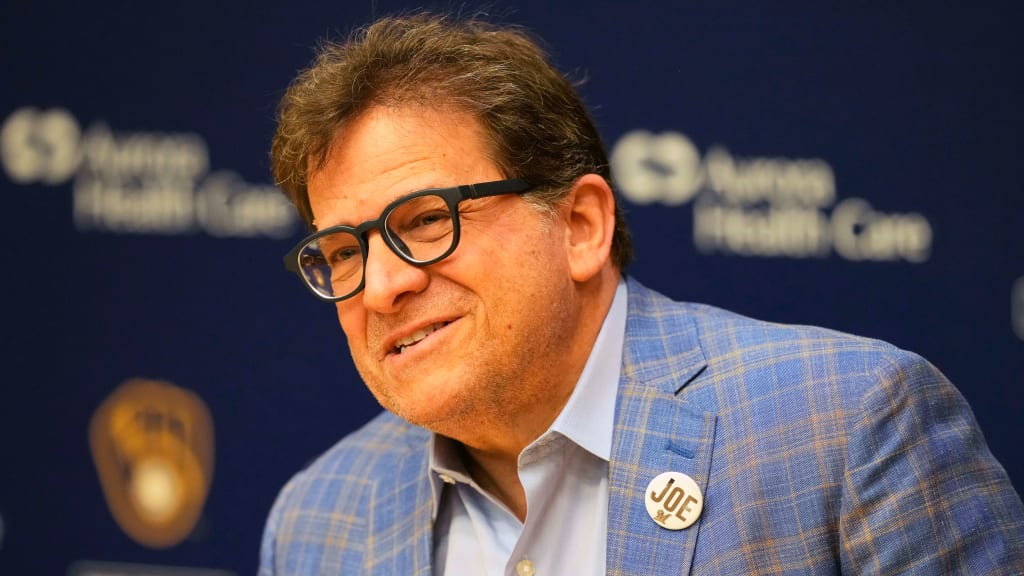
MILWAUKEE -- Brewers owner Mark Attanasio discussed memories of Opening Day past, the club’s financial position and World Series ambitions during a wide-ranging Q&A with reporters on Thursday.
Here are some highlights:
When you look back at Opening Day, what are some of the memories that stand out?
“It starts, I guess, with my dad [who traditionally sang the national anthem at the home opener before his passing in 2015]. It's always emotional, Opening Day. And it makes me think of the whole family, you know? This has become a gathering event for our family. And so that's special.
“And almost every season has been hopeful at this point, including this one. So I reflect on that. I came out for the workout yesterday, and it's really invigorating to come out and see the changes in the ballpark. You've got a few new sections and things and some new sponsors. Right before Opening Day and right before the playoffs, I like to just come and soak it all in. It was very quiet yesterday and peaceful, I got to reflect on 22 [years as principal owner]. This will be season 22.”
The last time you were coming off an NLCS in 2018, you went a little bigger on the payroll front. This year, not as much of a jump. What goes into that process, and what would it have taken to have a higher leap?
“There's definitely a correlation between money and success. That said, we were, I think, 23rd in payroll last year and had the most wins. So what we've done every year is looked at our roster and how things fit, and to my earlier comment about the youth and the team, and where everybody is in their arc or their career, there weren't really a lot of spots to fill. Matt Arnold and his group also looked at the next wave of folks coming up, and whether we have the No. 1, No. 2, No. 3 farm system -- depending on who you look at -- we have a lot of players that are going to be adding to this club very soon. If there's a hitch, it’s trying to bridge that gap. We have a couple of players to do that.
“We were very excited about bringing David Hamilton in to help out in the infield and Luis Rengifo. [During] the WBC, you see the growth of our players, our three Venezuelan players win the whole thing. Brice Turang was in the manager's office yesterday talking about what a valuable experience it was for him, and he performed at a very high level in the WBC. So we're very hopeful that we can bridge that gap. We'll see. That is the issue, year to year … and how quickly would the players in Double-A, Triple-A develop and be here to help?”
How did the TV situation impact payroll discussions this winter?
“It actually didn't for us this year. It probably shouldn't have been a surprise [the move to MLB producing and distributing Brewers telecasts], but it was late-breaking news. So we budgeted otherwise, but we were already in the process of doing things. We have a lot of flexibility in our balance sheet. We manage the club that way. Sometimes your greatest strength is your biggest weakness. Everybody is payroll, payroll, payroll, but we have a very strong financial position. And so when surprises come up like that -- and that was about a $20 million surprise [compared to the previous RSN model] -- it does not affect how we plan for the offseason.”
How much pressure do you feel as these years go on to bring a World Series to Milwaukee?
“It seems every seven years [the Brewers make it to the NLCS]. We don’t want to wait another seven years. It’s the one thing we really have left to do here, I think, in terms of success. And of course if we do get to a World Series, it’s going to be nice to win one. I feel -- it’s a goal. I can’t say I feel pressure, because the main pressure is to always be in the conversation every year. That doesn’t mean that you compete every year, that doesn’t mean that we’re satisfied with that. I can assure you nobody was happy about not making it [to the World Series] last year. …
“We are looking at how to build a championship team. So when you say, ‘Oh, you traded Freddy [Peralta],’ we are staying focused on how to best compete, to create as many runs as we can create and prevent as many runs as we can prevent. And we try to identify players who can perform in high-pressure situations. And we’re all with a goal of trying to get to the World Series. But if there’s 30 teams, I don’t know how many -- all 30 should be doing that, but there’s a lot who are doing that.”