

When baseball's best team takes the field this postseason, you're going to see heat, and lots of it.
Now, to some extent, you're going to see heat from every team, because the playoffs always bring out faster fastballs. The postseason velo bump is real. But it also brings out a cavalcade of pitchers' nastiest breaking and offspeed stuff.
But watch Milwaukee. The Brewers pride themselves on the good old fastball. They dominate with it, and they do it like no one else.
This is an age of faster fastballs but fewer fastballs. Teams don't throw the four-seamer like they used to. League-wide fastball usage is at its lowest point of the pitch-tracking era, which goes back to 2008. You might've seen some version of this chart before, but here's the recent trend:
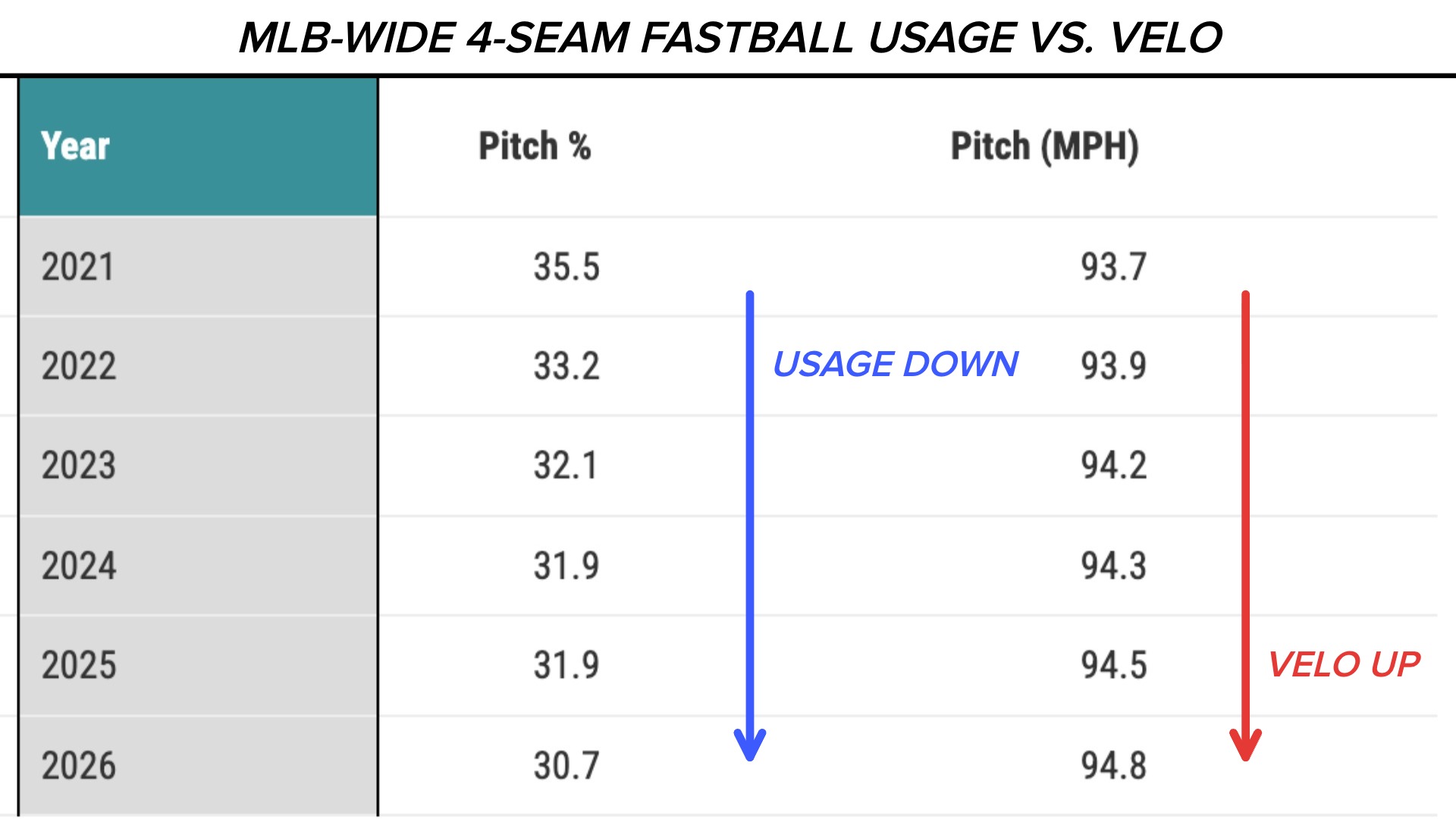
And that brings us to the 2026 Brew Crew, who just won 103 games and are the No. 1 seed in the playoffs. While lots of pitchers league-wide lean on their nasty breaking and offspeed stuff, Milwaukee's pitchers -- specifically, Milwaukee's starting pitchers -- embrace the heater.
"I have a different mindset with it," said Jacob Misiorowski. "I kind of just say ... [Screw it], good luck.'"
Behind Misiorowski, their ace and soon-to-be NL Cy Young Award winner, the Brewers' starting rotation set a record this season: In the age of fewer fastballs, they racked up more strikeouts on four-seamers than any starting rotation in the entire pitch-tracking era.
Team starting rotations with most 4-seam fastball K's in a season
Pitch-tracking era (since 2008)
- 2026 Brewers: 446
- 2017 Red Sox: 435
- 2023 Mariners: 398
- 2019 Astros: 389
- 2019 Guardians: 366
Check out some of those teams that Milwaukee blew past. The 2017 Red Sox, for starters, had Chris Sale as their ace, who struck out 308 batters that year … 142 of them on heaters. The 2019 Astros had two fastball kings at the peak of their powers -- Cy Young winner Justin Verlander and runner-up Gerrit Cole, who both had 300-strikeout seasons that year and combined for 282 K's on four-seamers.
The Brewers didn't just top those historic pitching staffs -- they also blew every other 2026 rotation out of the water. Brewers starters recorded almost 100 more strikeouts on four-seamers than the next-closest team. That was the Yankees (featuring Cole again, but also AL Cy Young favorite Cam Schlittler) with 348. The third-place team was the Dodgers, with their super rotation featuring, at various points, Yoshinobu Yamamoto, Tarik Skubal, Blake Snell, Tyler Glasnow and Shohei Ohtani, who all have great fastballs. Los Angeles had 337 four-seamer K's, over 100 behind Milwaukee.
This is not by accident. This is how the Brewers' stuff plays best, and the attitude they take to the mound is: Use it.
"If I want to dominate with my fastball, there's some fearlessness there," Brewers pitching coach Chris Hook said. "It's either, the pitcher's in charge, or the hitter's in charge. We want to be intentional: 'Hey man, I'm going to bully you.' That's that edge we're looking for. I don't think a fastball is always the answer. But I think that it should be the majority of the answers for us, for our group."
It's not just about finishing hitters off with fastballs, either. Milwaukee also uses heaters to establish the tone of an at-bat and create pitchers' counts. The Brewers rotation threw 41% four-seamers this season, the highest usage in the Majors. They throw four-seamers nearly twice as often as the starters on some of their fellow playoff teams, like the Rays (under 25%) and the Phillies (a league-low 22%).
"I think it drives everything," Hook said. "And I think everyone's kind of running away from that pitch. But we outline our advance scouting with fastball command, and [then add] where we can sprinkle other things. Because we have some unique fastballs. You can't do that with an ordinary fastball. We have some outlier fastballs on our team."
Obviously the No. 1 key to this brand of fastball dominance is "Having Jacob Misiorowski at the top of your rotation." We don't want to undersell the importance of having an ace with a true one-of-a-kind fastball. When you have the hardest-throwing starting pitcher we've ever tracked, the one and only pitcher who can literally throw thousands of 100 mph fastballs in one single season, it's not rocket science to have him let that heater rip.
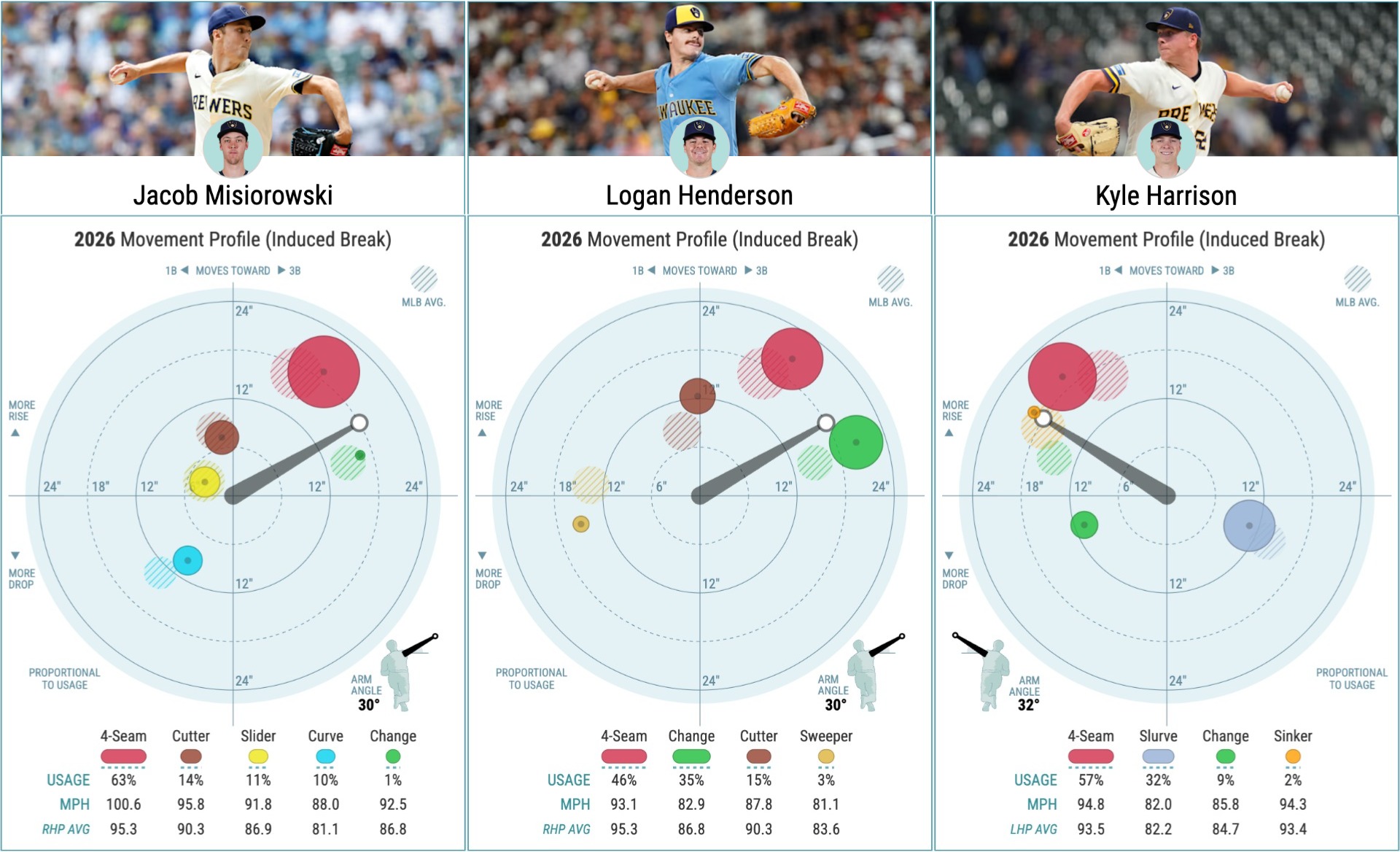
Misiorowski leads Major League starters in basically everything fastball-related: highest four-seam usage (63%), highest four-seam velo (100.6 mph), most four-seam whiffs (345), most four-seam strikeouts (166 of his MLB-best 252 K's).
"Hooky and [Major League pitching coordinator Jim Henderson] are awesome with it," Misiorowski said. "They’ve given us mindsets of, 'Let’s get ahead.' The key to getting ahead is just using the heater, trusting it. Obviously, you can get beat on it. It's a thing. But hitting is hard."
But even though he's the tone-setter, the Brewers' heat-heavy approach extends beyond just the Miz.
Logan Henderson threw 46% four-seamers and struck out 59 batters with them. Kyle Harrison threw 57% four-seamers and struck out 86. Even Robert Gasser and Shane Drohan kicked in 30-plus four-seamer K's each.
"You have to have special fastballs," Hook said. "You can't have 'dead-zone' fastballs [aka, fastballs with unexceptional movement profiles] -- that's not going to work. I don't think we do. And I think that we take advantage of what we have."
To take over the NL Central during the season, the Brewers rode their big three of Misiorowski, Henderson and Harrison -- three very different fastballs, all interesting in their own way. Only Miz has elite velocity. Sitting at 101 mph, his fastball is uniquely explosive, and it's very obvious what makes it good. But even Harrison, at "only" 95 (that's barely above average these days), and Henderson, at only 93 (that's slow these days), create unexpected amounts of rise and run from their low arm slots. They attack from a flat angle, Henderson from the right side and Harrison from the left, and their fastballs take off on the hitter.
"I think the fastball is the best pitch in baseball," Henderson said. "If you can execute it well, and late in the count, then you're going to have success with it, especially with some of the fastballs that we have. A lot of that falls on us -- knowing our strengths."
That's what it comes down to: The Brewers starters have strong fastballs, so they use them, and the organization encourages it. A lot of the time, if you see a smart team stop throwing four-seamers, it's not so simple as "Don't throw fastballs," it's that they don't want to throw BAD fastballs.
Harrison is the perfect example here because he's experienced both philosophies firsthand. A former top pitching prospect who wasn't able to tap into his potential with his original team, the Giants, he was first traded to a "no fastball" organization, the Red Sox, and then to a "yes fastball" organization, the Brewers … where he finally flourished.
"It’s funny, because I got traded to another organization and it was very 'other pitches'-focused," Harrison said. "They would protect your heater [by using secondary pitches]. Here it's like, 'We love your heater, we want you to use it. It's a good pitch.'
"It's weird how different orgs process it and have their approach. It was really refreshing to get here, and they love my fastball, and I get to pitch off it."
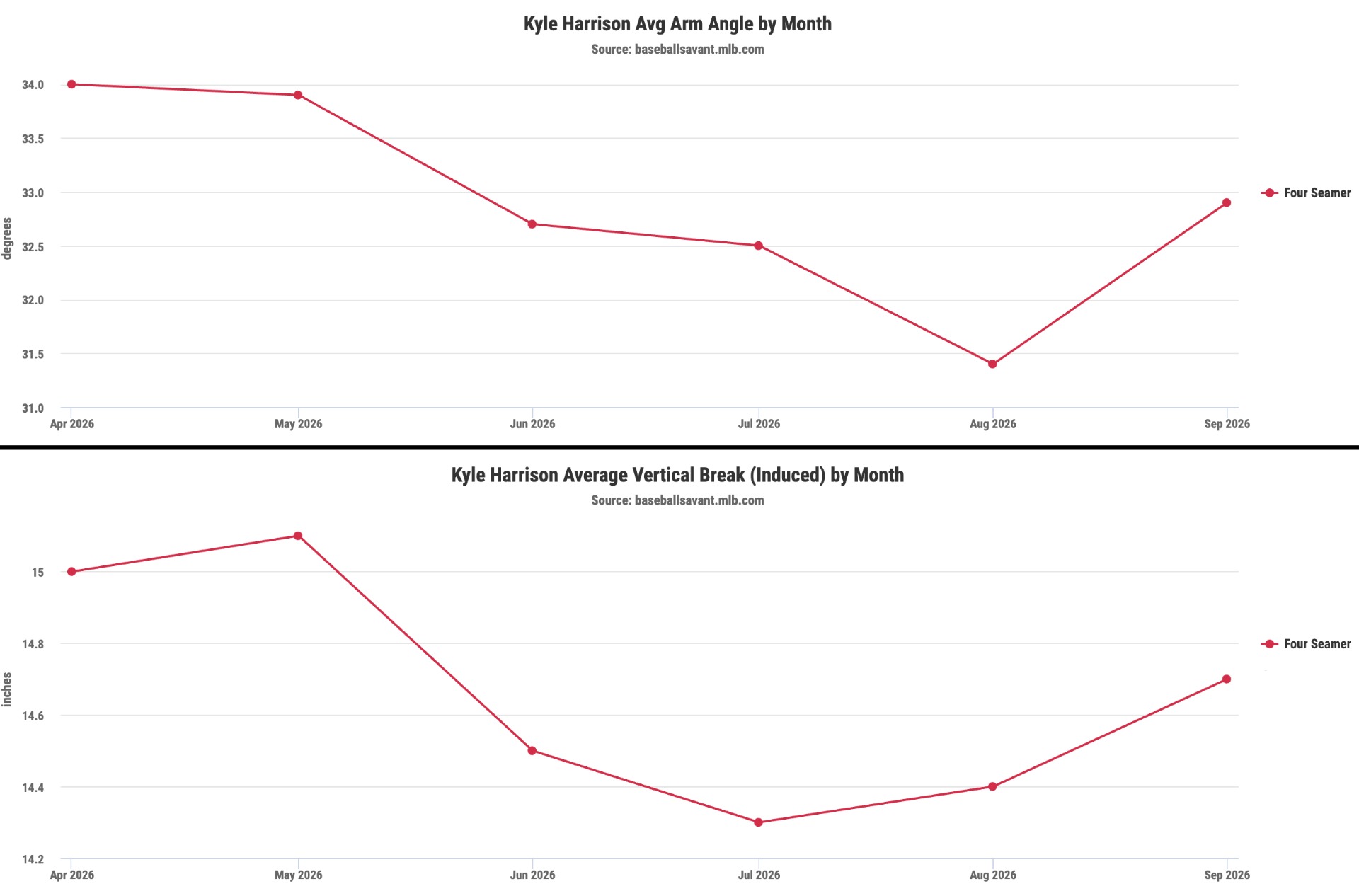
Now that we've reached the postseason, though, the uncertainty around Harrison is also the one thing throwing a wrench into this Milwaukee plan of attack. Harrison was awesome for most of the year, and looked like a lock for the playoff rotation ... until the stretch run, when he, well, lost his fastball. That's not a figure of speech.
As the season went on, a fatigued Harrison's arm angle dipped steadily, and he eventually lost both velocity and the rising action on his four-seamer that made it so effective early on. Harrison made a little bit of progress toward restoring his old arm slot and movement profile at the end of September, but it's gotten to the point that he might not even make the postseason roster, let alone the rotation.
But that still leaves the 1-2 punch of Misiorowski and Henderson at the top of Milwaukee's Division Series rotation -- and those fastballs aren't going anywhere.
"One is 102, 103, the other is 93, 94," Harrison said. "It's funny, one time Miz is like, 'I'm hanging a little bit,' and it's like, 'Yeah, you're still sitting 100 dude.' Must be nice."
Misiorowski and Henderson's fastballs are eight mph apart (or more), but they're both extremely effective. As overpowering as Misiorowski's four-seamer is, look at the numbers against Henderson's: Opponents hit just .156 against it, and it was a top-10 most valuable four-seamer in the Majors with +14 runs prevented (Miz was No. 1, unsurprisingly).
So the breakout rookie right-hander keeps firing it -- even though he also has a signature changeup that he could equally use as a putaway pitch. Henderson's funky high-spin changeup (sound familiar, Brewers fans?) generates almost 20 inches of horizontal movement and yields the highest whiff rate of any pitch in his arsenal.
But you know what helps a great changeup? A great fastball. Look at what happened to Paul Skenes this year -- he lost a bunch of fastball velocity, but the part of his arsenal that suffered as a result was his offspeed stuff. That was a ripple effect from the dip in his four-seamer.
Henderson has an opposite symbiotic effect going: His fastball is good, and his changeup is good, and they mutually help each other.
"Our whiffs come on fastballs," Hook said. "Everybody can go look and see where those fastballs are at, where we get our whiffs at. We get whiffs with our fastballs -- so that's what we should throw. And I think we get whiffs with our secondary stuff more often because we're doing that. It's not 'old school vs. new school,' it's just making sure that we're using our stuff in the best possible way."
The Brewers do, indeed, get whiffs with their fastballs. Milwaukee starters got 850 swings-and-misses on four-seamers this season, the most of any 2026 rotation and the second most of any rotation in the pitch tracking era, behind only the 2023 Mariners.
When we first approached Hook to ask about the Brewers' love of four-seamers, we broached the topic by referencing the league-wide fastball trend we started this story with: Teams are throwing fewer four-seamers these da—
Hook didn't even let us finish.
"Because all the numbers say not to throw it, right?" he asked. Rhetorically. Chidingly. For the Brewers, of course, this is wrong.
"Like, that's never an option. Like, the fastball is never the right pitch to throw."
Then he got serious.
"That's kind of crazy though, right?"
MLB.com writer/researcher Jared Greenspan contributed reporting to this story.