

Ryan Johnson missed by nearly a foot.
The Angels right-hander wanted to bury a cutter inside. Instead, he left the full-count pitch over the middle of the plate on Monday night.
A year ago, that mistake probably would've landed in the right-field seats at T-Mobile Park. Instead, Cal Raleigh swung underneath it, popping up harmlessly to third.
That single swing illustrates one of the biggest mysteries of Seattle's season. And Raleigh's historic 2025 season makes this year's first half all the more surprising.
After becoming the first primary catcher to hit 60 home runs while finishing second only to Yankees captain Aaron Judge in home runs, WAR and American League MVP voting last year, Raleigh entered the final day of June hitting .167 with a 70 wRC+. Among hitters to accumulate at least 200 plate appearances this season and last, Raleigh's suffered the greatest dropoff in offensive performance. (This and all stats below are up to date entering Tuesday night’s game against the Angels.)
Raleigh's struggles are a major reason the Mariners are 27th in run scoring over the past month and have hovered around .500 despite entering the season with postseason expectations.
For Raleigh, the issue is simple: It's been a disjointed season.
He sustained a right oblique injury on May 1 against the Royals. He took a few days off, returned on May 5, and tried to play through it for just more than a week. The team then shut him down when it was clear he wasn't right, and he missed a full month on the IL before his June 16 return.
"It's hard to swing when you're injured," Raleigh said. "Unfortunately, I had to take some time for that. You gotta get healthy, you know, feeling confident swinging ... and I think that's mostly the issue -- not anything related to mechanics."
But the injury alone doesn't explain everything.
Raleigh still owns an above-average 77th percentile bat speed (74.6 mph), just a tick down from last season (75.2 mph) but in line with his 2024 mark. He still owns an elite pulled air-ball rate (32.2%). It’s just that not as many of those balls have gone over the fence. (The rate is down six points from last season, but it still matches the second-best of his career.)
"I don't think he's very far off," Mariners GM Justin Hollander said. "I don't think anything underlying talent-wise has changed."
The engine is still there. Neither the Mariners nor our analysis found meaningful changes to Raleigh's swing path.
What's changed isn't Raleigh's swing. It's his timing and swing decisions.
"I think the big thing is he was playing through some stuff that affected the physical [swing], and the physical then affected the mental," Hollander said. "I think that's the last piece of the puzzle, honing in the strike zone a little more. When you don't see pitches at the Major League level for that long … there's a tendency for guys to expand the zone until they get locked in."
Hollander believes prep for the World Baseball Classic might have also contributed to Raleigh's slow start.
Whatever the case, Baseball Savant's new "Flawed Swing %" and "Perfect Swing %" metrics help explain what is happening. Rather than simply measuring whiffs, the metric identifies the quality of swings in terms of timing and contact quality.
In evaluating the new Statcast timing metrics for swings, Raleigh enjoyed a 19% "Perfect" swing rate last season from the left side, compared to 16% this season.
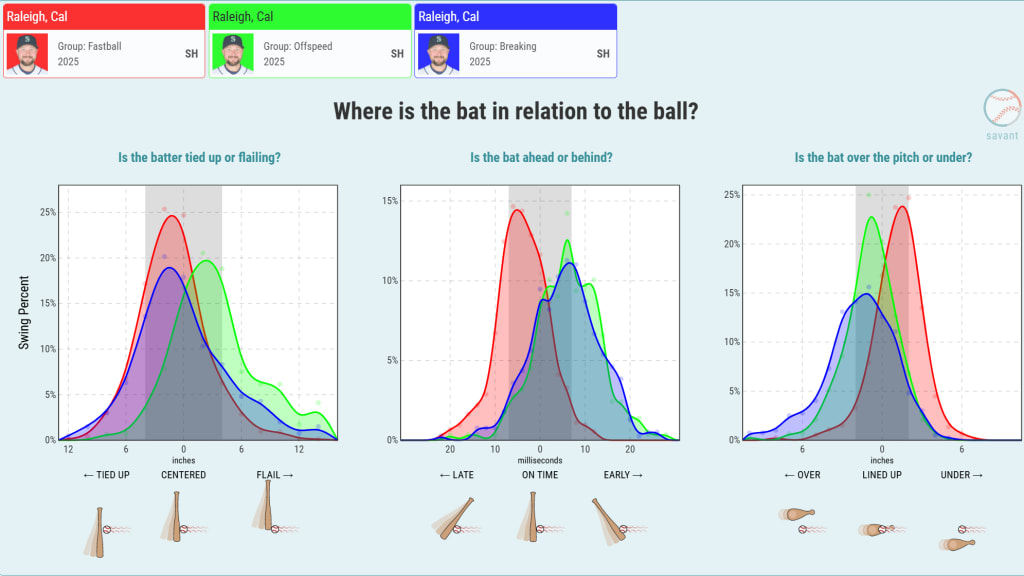
To dive deeper into the issue, I asked analysts at Driveline Baseball to compare Raleigh's swings from 2025 to '26. Driveline's analysis showed Raleigh's timing distribution has widened considerably.
Instead of clustering around ideal contact timing as it did in 2025, his swing distribution is spread, both early and late contact, a pattern that closely mirrors his doubling in Flawed Swing %.
Consider 2025:
And then 2026:
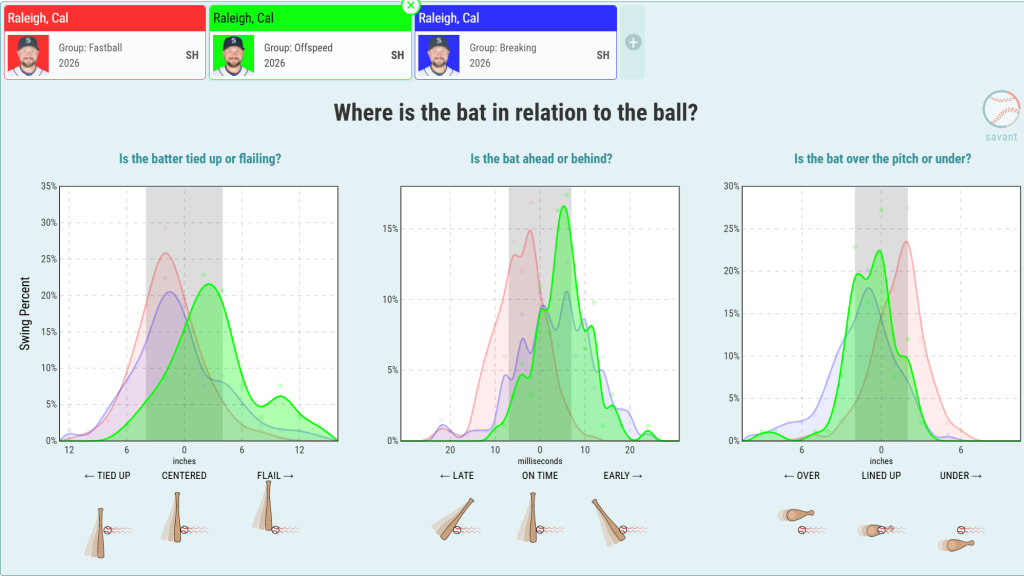
The distribution change is especially dramatic against fastballs. Last season, Raleigh posted positive run values against every fastball type, something he'd never done.
The fastball timing issue is most apparent against velocity. Raleigh has struggled for most of his career against fastballs that travel 95 mph-plus, but especially this season, posting the worst average (.170), slugging mark (.234), and wOBA (.218) of his career on such pitches.
While Raleigh’s swing path and bat speed are relatively stable year over year, timing issues are resulting in a depth-of-contact change as well. Consider that his depth of contact against fastballs is down from 5.2 inches in front of the plate last season to 1.9 inches this season.
Meeting the ball three inches deeper doesn't sound significant. But for a pull-side power hitter, it's often the difference between turning on a fastball for a home run or flying out harmlessly to medium-deep center.
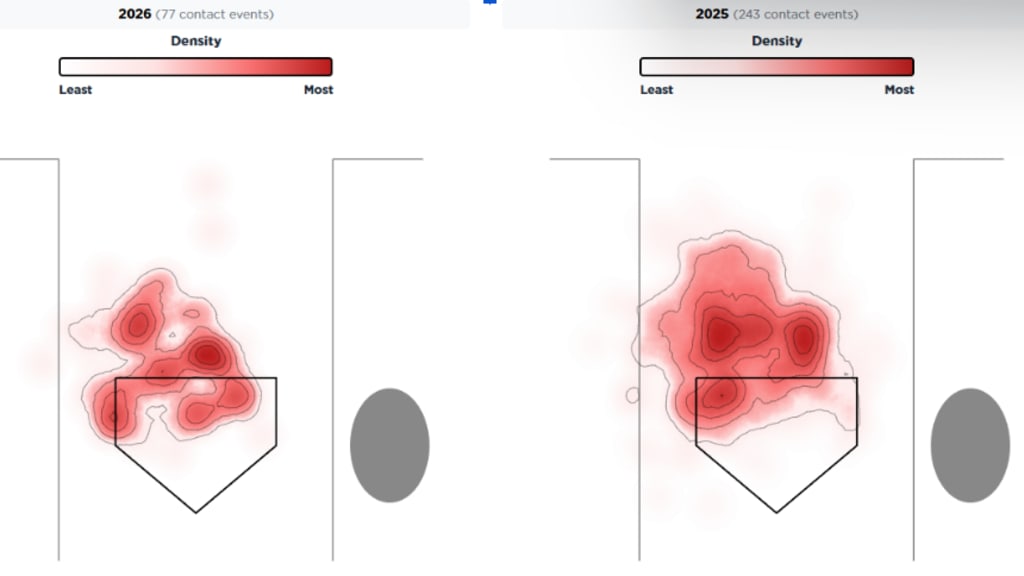
Raleigh’s opposite field fly-ball percentage sits at a career-high 20.3%, and is up nearly four percentage points from last season. Those are generally going to be outs, not home runs. That's the story of his season: Raleigh is not dramatically different, just slightly off.
One other big takeaway: His performance on balls outside the strike zone has cratered. Yes, he's chasing more than a season ago -- his 37% out-of-zone swing is the worst since his rookie year -- and when he does go outside the zone, he is doing far less damage.
Raleigh slugged a career-best .347 on pitches outside the zone last season, but is at a career-worst .063 this season.
What's key for Raleigh?
"Just trying to hunt pitches I can do damage on that I can hit," he said. "You don't want to hunt things you are not good at hitting."
Said Hollander: "I think what we saw last year is he was really on the fastball all year long, and he didn't chase pitcher's pitches."
That improvement really dated back to the second half of 2024, when Raleigh quietly broke out before his signature '25 season.
Raleigh dramatically cut his strikeout rate in the second half of 2024, including to a 22.4% level in September. That strikeout rate and chase decline largely carried over to the next season.
Raleigh credits then-teammate Justin Turner for helping him be more selective and offer at pitches he can best damage. That's what Raleigh believes he must get back to.
Said Hollander: "One of JT's gifts is he can speak the language of the hitter and make the complicated really, really simple. I think when guys go in the box, if you're thinking about a lot of different things, it's really hard."
Perhaps Raleigh's season is further complicated by trying to do too much.
The encouraging part for Seattle is that almost none of the underlying indicators suggest Raleigh lost the traits that produced one of the greatest offensive seasons ever by a catcher.
"What we are seeing right now is when he gets his pitch, he impacts the baseball just as hard as he ever has," Hollander said. "As the reps come, [the breakout] will come naturally, and hopefully soon."
As is so often the case in baseball, the difference between success and failure is measured in inches and milliseconds: a few inches deeper at contact, a fraction of a second later on fastballs, a few more swings at pitches he shouldn't chase.
Those are not the signs of a broken swing or player. They're the signs of a hitter who's just slightly out of sync.
And history suggests that's a much easier adjustment to make, and one a player like Raleigh -- who's never been a below-average hitter by wRC+ -- will make sooner rather than later.