
This story was excerpted from Anthony DiComo’s Mets Beat newsletter. To read the full newsletter, click here. And subscribe to get it regularly in your inbox.
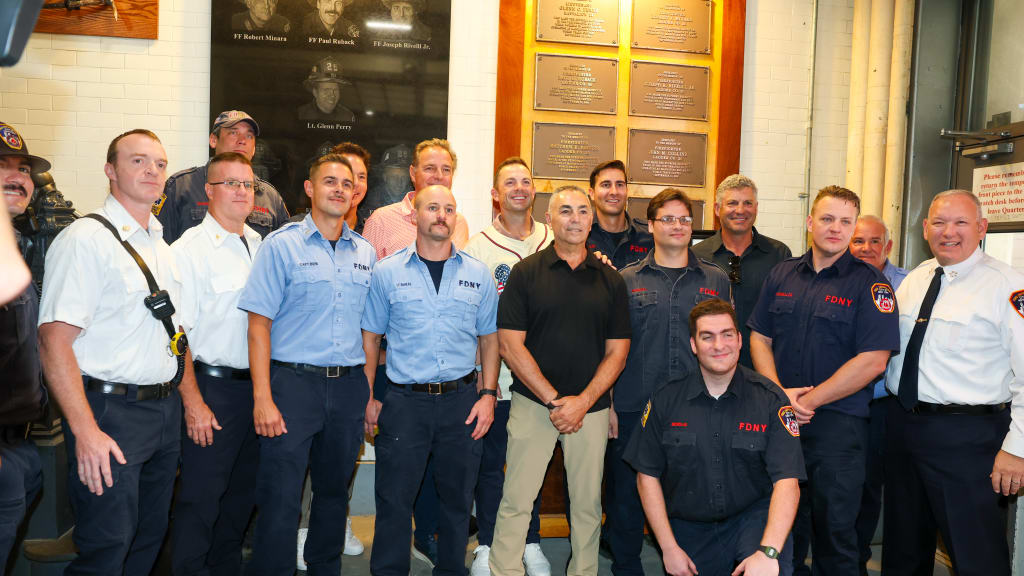
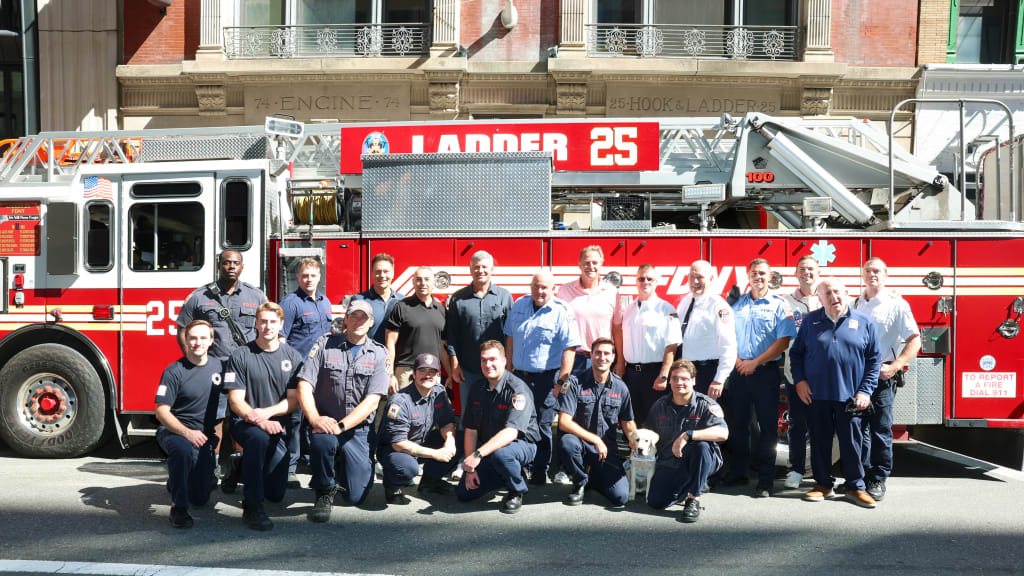
NEW YORK -- Earlier this week, a group of Mets traveled to Ladder 25 on the Upper West Side to spend time with the firefighters there, paying their respects to one of many firehouses around the city that lost members on Sept. 11, 2001.
Among those to make the pilgrimage were Todd Zeile, a veteran member of the 2001 Mets who is also the executive producer of a documentary, “When America Took the Field,” that will premiere on MLB Network on Thursday. There was John Franco, the Mets’ captain who played a massive role in their relief efforts. There were Al Leiter and Robin Ventura, a native son of the tri-state area and an adopted one, each of whom were 2001 Mets.
The final member of the group was David Wright, who was still a recently drafted teenager when the Sept. 11 attacks on the World Trade Center took place. Unlike Zeile, Franco, Leiter and Ventura, Wright did not spend any time working at the Shea Stadium staging area in the days following the attacks. He never visited New York City firehouses that summer. But he became an intrinsic part of the Mets’ remembrance efforts over the next quarter-century anyway, for the simple reason that Wright understands better than most what this all meant -- and continues to mean -- to New York City.
“Being a young player around Johnny Franco and Todd Zeile and Mike Piazza and Al Leiter, I think it taught me the importance of how high we hold our first responders in New York, the regard that we have for our first responders,” Wright said. “I saw that up close and personal being around those guys that were there for 9/11, that were there at Shea Stadium helping the first responders, that were so close to the devastation. I saw how much it meant to them and how important it was to them, and I think a lot of that rubbed off on me.”
Long before Wright became a Met, he was predisposed to this type of work. The son of a vice and narcotics police officer in Virginia, Wright grew up understanding that “there were a lot of police officers that didn’t come home to their dinner table.” From a young age, he held servicemen and women in high regard. Wright’s father used to instruct him to say thank you to any policemen or firefighters he passed by over the course of a day -- a small act of tribute he has since passed onto his own children.
So when Wright became a Met, growing up in a clubhouse alongside veteran players who lived in New York during the attacks, it was only natural for him to become a part of things, too. In the clubhouse, Wright would listen as Zeile and Piazza told stories about 9/11. Each September, he would accompany his older teammates on firehouse visits. Even in retirement, living across the country in California, Wright thinks little of flying back to New York to continue the tradition.
“Because of my dad being a police officer, maybe it hit me a little harder,” Wright said. “But I didn’t understand the full gravity of it until I finally got to New York and I saw the faces of Johnny and Todd and Mike and them being around the first responders and talking about 9/11. I think that’s when I finally understood it. And then being in New York for 15 years, you start realizing just how important first responders are to the community, and how they’re just built differently as far as their bravery and their willingness to help others.”
During his playing career, Wright used to preach the idea of remembrance to his younger teammates, stressing the importance of keeping first responders, victims and their families in their thoughts each September. In a sense, that’s what he’s still doing, even though Wright’s days in a baseball clubhouse have long since ended.
“Unfortunately at this point, it’s once a year where these men and women get celebrated, and I think it should be far more often,” Wright said. “That’s why I think it’s so important for me not just during 9/11, but whenever I was asked to come visit a firehouse or a police station, I tried to make it a point and do everything I could to do that, because I think a simple thank you goes a long way.”