

Baseball has never been more popular around the world, and following a sensational World Baseball Classic that set viewership records, the love of the game across the globe is more apparent than ever before.
There have been many milestones along the path to the current worldwide popularity of baseball, but there is one Major League team, in particular, that was a pioneer when it came to bringing international pitchers to its starting rotation three decades ago.
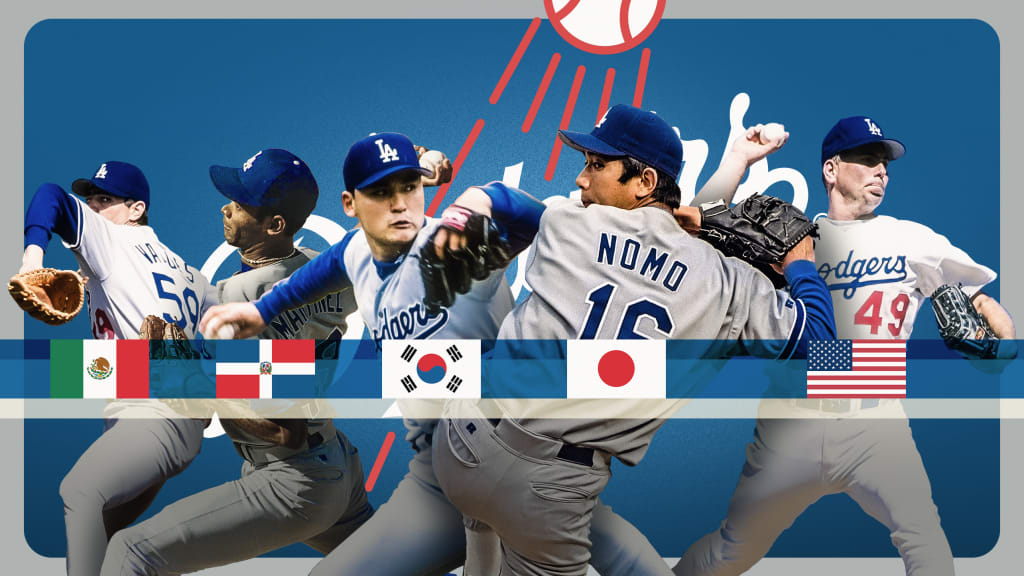
In the mid-1990s, the Dodgers did something no other club had done in MLB history by putting together a rotation featuring pitchers from five nations: the Dominican Republic, Japan, Korea, Mexico and the United States.
“It was a time when MLB growth was really expanding,” said veteran knuckleballer Tom Candiotti, who was a member of L.A.’s rotation from 1992-97. “The Dodgers were always at the forefront of all that stuff. It was amazing.”
It really began taking shape in 1994. The Dodgers, at this point, already had a pair of Dominican starters -- Pedro Astacio and Ramon Martinez. But in ’94, Los Angeles signed right-hander Chan Ho Park out of Korea and called up Mexican-born right-hander Ismael Valdez for his MLB debut.
In 1995, the phenomenon known as “Nomomania” swept across the Majors, with Japanese right-hander Hideo Nomo and his unorthodox “tornado” windup thrilling fans across the baseball world.
By 1996, it was all coming together: Nomo, Astacio, Martinez and Valdez were in the starting rotation along with Candiotti, and Park made the first 10 of what would be 181 career starts for the Dodgers. In ’97, Park joined the rotation as a full-time starter.
It was the most diverse rotation in Major League history, and it was a good one. In 1996, Dodgers starters collectively had a 3.51 ERA. In ’97, they posted a 3.73 ERA.
The rotation was also fun, particularly when it came to the variety of languages in the group. There wasn’t so much a language barrier as a “language exchange program.”
“I always tried to teach Nomo Spanish,” said Astacio, laughing. “And Nomo tried to teach me Japanese. We each learned a few words.”
Candiotti, whom manager Tommy Lasorda referred to as “the Italian,” would go out to lunch with Nomo regularly.
“Hideo was so funny,” Candiotti said. “I just cracked up. We could communicate fine. We knew enough [language-wise] to be able to have lunch or dinner together. That was fun.”
Candiotti also said that Nomo and Valdez were “very close.”
“I think they developed their own language that they had between them,” Candiotti said, laughing.
By the time Nomo arrived, Astacio was in his fourth Major League season. Astacio was helped in making the transition to the big leagues by Martinez, whom Candiotti called “the captain of all the Latin guys.”
Orel Hershiser, who was still pitching for the Dodgers when Astacio debuted in 1992, was a big help to him as well. Hershiser was also a mentor to Park, whom he was “assigned” by Lasorda, who knew that Hershiser had the right temperament and experience to help the young Korean right-hander.
“You just make sure to go out of your way to, you know, [say] ‘Hey, we’re going this way, big guy,’ or ‘stretch is in 15 minutes,’” Hershiser said.
“I think with Chan Ho, getting used to the style of MLB vs. Korea was a challenge. I think in Korea, his ability was good enough to get anybody out with any pitch eight out of nine hitters. And now all of a sudden, eight out of nine can hit you.”
It was surely challenging, but Park thrived upon arriving in the Majors. Over his first two seasons as a full-time starter, he had a 3.55 ERA. The same went for Valdez, whose ERA over his first three campaigns as a full-time starter was 3.02. Each was just 20 years old when making his MLB debut.
Nomo was in a league of his own over his first two MLB seasons. He started the 1995 All-Star Game and won the National League Rookie of the Year Award later that year before posting a 3.19 ERA over 228 1/3 innings -- including a no-hitter at Coors Field -- in ’96.
The Dominican duo of Astacio and Martinez were great in those years, as well. Astacio’s best season with the Dodgers came in 1996, when he finished with a 3.44 ERA over 211 2/3 frames. Meanwhile, Martinez posted a 3.34 ERA for L.A. from 1996-98.
It was an unprecedented starting rotation. And it was so good in so many ways. Just take it from the American -- er, “the Italian” -- of the bunch.
“That was a fun time,” Candiotti said. “It was really cool being a part of that.”