

In the regular season, no team's batters had a lower strikeout rate than the Blue Jays, and no team's pitchers struck out more batters than the Dodgers. Sometimes, the World Series narratives write themselves: Can the Blue Jays make enough contact against a pitching staff specifically designed to eliminate contact?
It’s an interesting story, and it will matter. It’s also not nearly the entirety of it, because the Jays have been pounding the ball all October, not just getting the bat to it. They are outslugging the Dodgers by nearly 100 points and everyone else by a lot more than that. That actually undersells it by more than a little; the Jays' offense has been one of the best-slugging playoff groups, well, ever.
Go back to 1969, more than a half-century ago, the first year when there were playoff games played prior to the World Series. Since then, nearly 200 teams have played at least seven games in a particular postseason. Look at where this year’s Toronto hitters rank among all of those teams:
- 2025 Jays batters had the sixth-highest OPS (.878) and fourth-highest slugging (.523) of any postseason team that played at least seven games, since 1969.
That’s truly incredible, and while it’s a lot about Vladimir Guerrero Jr. having something like the most dangerous postseason ever, it’s also about George Springer’s four homers, and Alejandro Kirk’s three, and Ernie Clement (!) slugging .619 (!!) while striking out just twice (!!!) and ultimately every single one of their eight regular hitters posting lines that are above-average. You can’t slug without contact, sure, but these also aren’t weak grounders to second base, either.
Excellent production, right? OK, well let’s just check on how the Dodgers pitching staff performed in their own run through the National League playoffs, again using the same timeframe as we just did for Toronto.
- 2025 Dodgers pitching had the third-lowest OPS (.531) and second-lowest slugging (.269) of any postseason team who played at least seven games, since 1969.
That’s pretty incredible too – and now you can see how this series is going to turn. It's not just about who allows or prevent contact; it's about who allows or prevents good contact.
For the Dodgers, it’s been clear this has been coming for weeks, ever since the late-season rotation all got healthy and productive at the same time – the September Dodgers had the second-highest strikeout rate in a month ever, and tied for the fourth-lowest slugging in the Divisional Era. Plus, the stunning re-emergence of Roki Sasaki took at least some of the pressure off a completely beleaguered bullpen.
It is something like the best strength-on-strength matchup you’re going to see, and while we’re certainly not ignoring how important the other side of it will be – do the Jays have good enough lefty relievers to handle Shohei Ohtani, Freddie Freeman and Max Muncy, for one thing, or how will rookie sensation Trey Yesavage’s magical speedrun through five levels of pro ball work in the World Series, for another – this is it. This is the most fascinating aspect.
To put it another way, it looks like this:
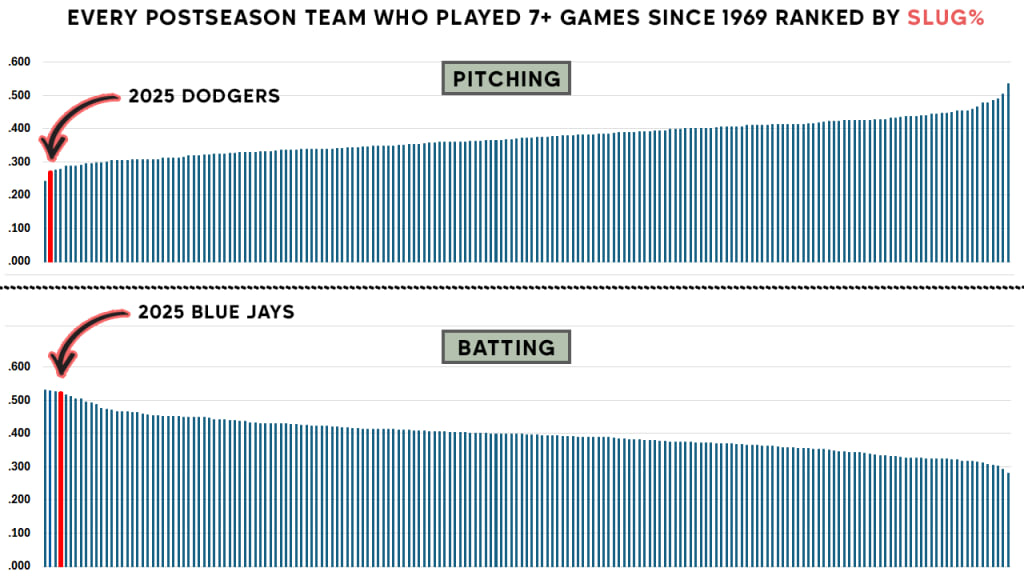
That’s loud, messy, and hard to read, right? That’s at least a little the point – there’s been so many playoff teams over the decades, and both of these teams, at the same time, are doing this one particular thing excellently, and almost better than anyone else we’ve seen.
Toronto’s ability not just to make contact but also to do damage is what really sets them apart from Milwaukee, which just got steamrolled by the Dodgers to the point that the .118/.191/.193 line the Brewers put up in a four-game sweep was one of the weakest lines in postseason history. While the contact-and-defense parallel is easy to draw between the two clubs, it’s not exactly right, because the second-half Blue Jays had the second-best strikeout rate in baseball, and as we dug into earlier in October, their biggest achievement this year was adding bat speed without sacrificing contact. That’s only increased in the playoffs.
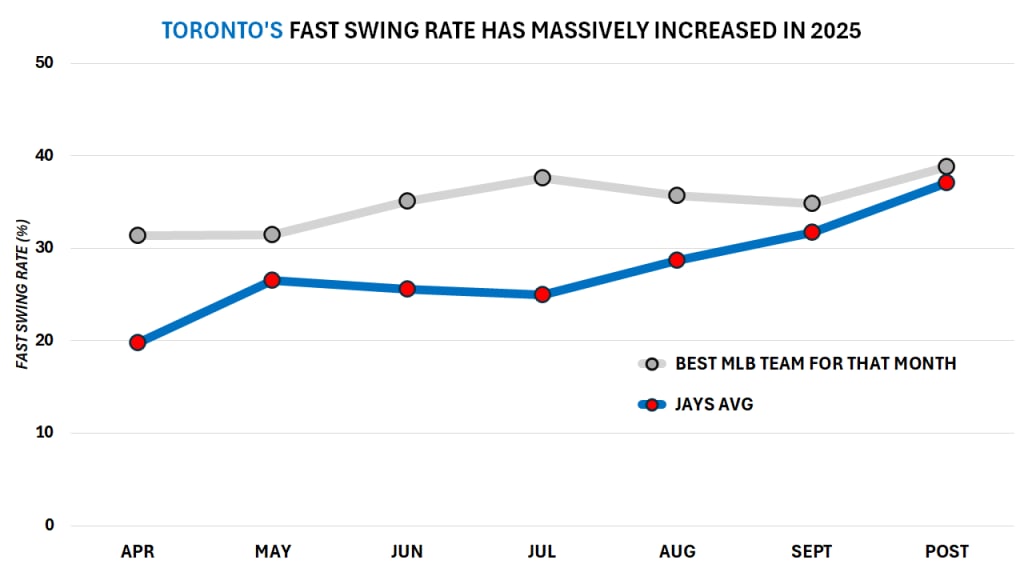
This is what Milwaukee couldn't do, and what Toronto has a better chance of achieving. So: Where will this battle be won and lost?
For all of their contact and power, the Blue Jays aren’t a terribly patient team. They like to swing, more than any other postseason club this year, following a second half when they had the third-highest swing rate – all of which is a huge difference from Milwaukee, which had the lowest swing rate in the regular season. The Jays are going to swing, and they’re going to get the bat on the ball when they do.
At the same time, there’s not a ton of chase, either. So far this postseason, both the Dodgers' pitching and Blue Jays' batting have seen chase outside the zone around 32% of the time, which is a little more than average (31%), but not excessively so. This also leads to relatively few walks, which is a potential boost for an L.A. staff that’s had some walk trouble all season.
That's the first step -- the Dodgers, knowing this, will try to force the chase, try to induce that weaker contact outside the zone. To some extent, though, this has just become a great bad-ball hitting team. Toronto is hitting .293 on pitches outside the zone, which is not only wildly above the 2025 (non-Jays) postseason average of .136, it’s the best any postseason team has had since data began in 2008. By a lot.
There’s also only so much you can do if Daulton Varsho is going to take a pitch like this and put it into the seats, anyway.
That said, the Dodgers are going to have a plan, and that plan is going to be about throwing as much nasty breaking and offspeed stuff as they can.
Consider what’s happened so far this month, so far as ‘throwing fastballs’ goes.
- No batting team has seen more fastballs this October than Toronto’s 65%
- Only one pitching team has thrown fewer fastballs this October than Los Angeles’ 48%
Part of the reason the Blue Jays have struck out so rarely this month is because they’ve seen so many fastballs, which they do an excellent job of hitting (at .297/.360/.500, they’re the best team at it this month). Part of the reason the Dodgers strike out so many batters is because they throw offspeed and breaking pitches so often – and yes, their .154/.211/.217 line is the best performance of any team in October.
It’s not going to be about velocity, at least by itself, either. If the regular-season Jays were decent at making contact on pitches 95 mph or higher, then the postseason Jays have been stellar, whiffing a baseball-best 17.5% of the time on those pitches. Nor is it that much about spin, as the Toronto lineup was also excellent making contact against postseason breaking balls.
None of which is to say that the Jays can’t also hit non-fastballs, because they can – it’s why they’re here. But after teeing off on Yankee offspeed pitches, Toronto hit just .190/.190/.238 against them from Seattle. The Dodgers, meanwhile, nearly doubled their regular-season offspeed usage in the NLCS. It is, after all, the Month of the Splitter.
It’s one thing to make a lot of contact, as the Jays do. It’s nice to have, yet not good enough by itself – the 2024 Jays made a lot of contact too, and they finished in last place. It’s another thing entirely to have a matchup like, well, this. The Dodgers' rotation is built to stop exactly what Toronto's lineup excels at. Which strength is stronger just might decide the entire World Series.