

LOS ANGELES -- The high-five is so deeply woven into sports culture that it feels like it has existed forever. But while former Dodgers outfielder Glenn Burke is known for creating that iconic gesture on Oct. 2, 1977, the celebratory moment stood in stark contrast to his daily reality.
As Burke was thrusting his hand into the air to greet teammate Dusty Baker -- inventing a symbol of public joy -- he was a gay man in a 1970s clubhouse who felt he couldn't openly share his truth until three years after his retirement.
On Friday afternoon, that pioneering history was permanently etched into the stadium fabric ahead of the franchise's 13th annual Pride Night, as the Dodgers officially unveiled a permanent display dedicated to Burke and Billy Bean -- the first two Major League Baseball players to openly identify as gay.
Set against a vibrant rainbow backdrop beneath the Left Field Pavilion near the Dodgers’ bullpen, the display features framed jerseys -- Burke’s No. 3 and Bean’s No. 40 -- alongside iconic career photographs and narrative placards. Created in collaboration with the Dodgers’ Pride Business Resource Group, the monument ensures that the stories of these two outfielders are an integral part of the daily fan experience.
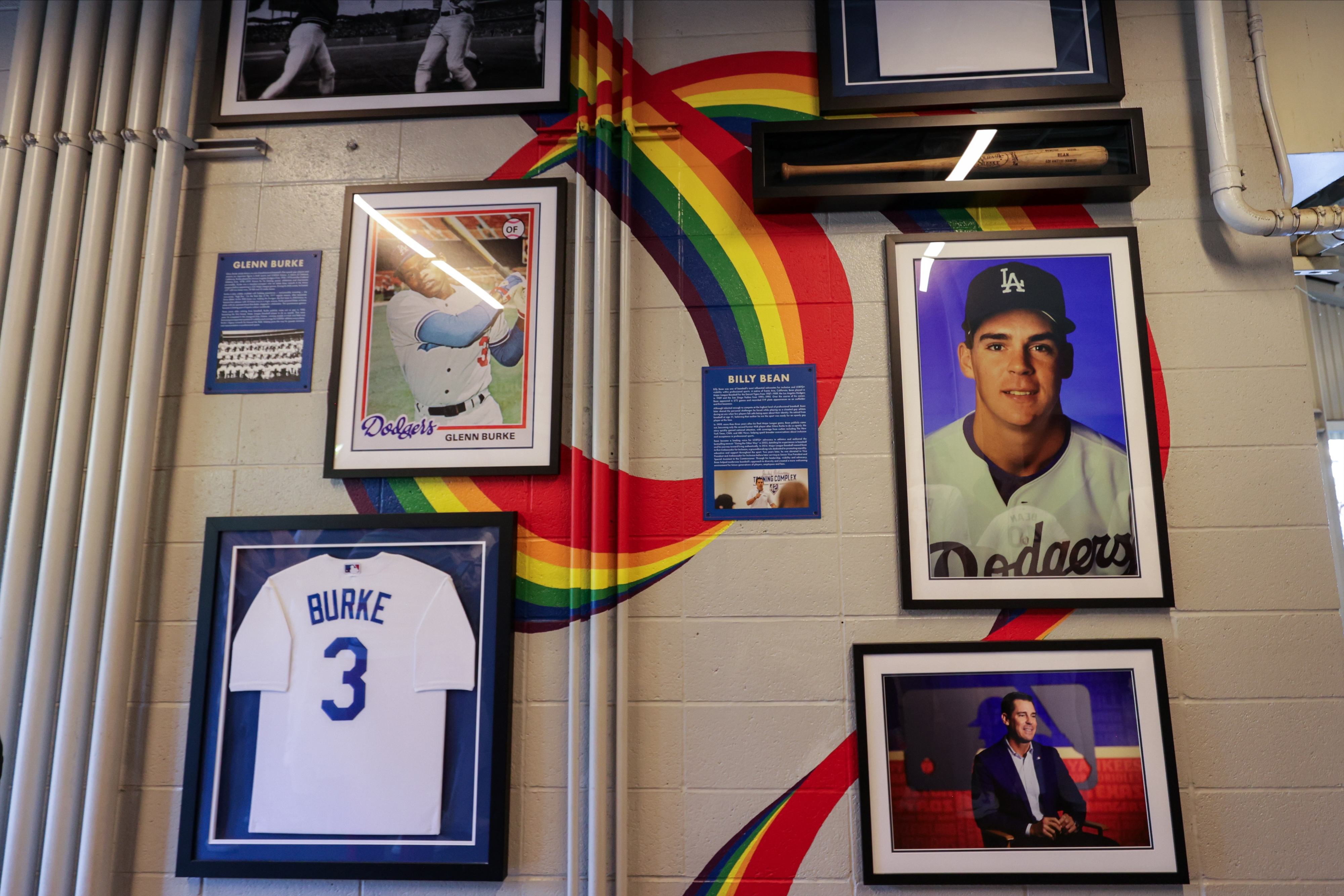
For an organization eternally tied to the legacy of social trailblazers like Jackie Robinson, Friday’s dedication provides recognition of a history that baseball has not always openly embraced.
Burke, who played for the Dodgers from 1976-78, became the first MLB player to come out publicly when he shared his story in 1982. Seventeen years later, Bean became the second.
Bean, who played parts of six big league seasons (including half of one with Los Angeles in 1989), retired in 1995 and publicly came out in ’99. He went on to channel his experiences into institutional advocacy, dedicating his post-playing career to ensuring future generations wouldn't have to harbor the secrets he did. In 2014, he was appointed MLB's first ambassador for inclusion, eventually rising to senior vice president for diversity, equity, and inclusion before his death in 2024.
For the families in attendance, the visual of the monument brought an overwhelming wave of validation.
"To see this, it just ... it fits," Greg Baker, Billy Bean's widower, said as he looked at the display. "It fits perfectly. It's exactly what you know, it's just beautiful. That's all I can say. It takes my breath away, you know, I have no words. I really don't."
Even though Bean was honored numerous times before his passing, Baker noted that witnessing his late husband's legacy recognized at Dodger Stadium brings a unique gravity.
"Each time it's a little bit different, but it's always so very special, and it never lacks," Baker said. "It never stops being emotional. He worked so hard and unselfishly put in all the work. I’m so proud of him. And the fact that this is happening [here], it's incredibly special to me and to his family. And so I want to thank the Dodgers organization. It's brave of them in this day and age to spotlight someone in our community when other organizations are trying to erase us."
A few feet away, Burke’s family looked at the framed jersey, remembering a brother who brought infectious laughter wherever he went.
"Oh, he would be smiling," said Joyce Henderson, Glenn Burke’s sister. "He would be so happy. He probably would be giving the high-five. He had always been the laughter in our family and he used to crack jokes all the time and be just laughing … so he would be overwhelmed."
For Henderson, seeing her brother honored by the very team that drafted him felt like a long-overdue moment of respect.
"About time," Henderson said with a laugh. "[When I found out] I said, 'Well, that's good, because that's the team that he was drafted in when he first went into baseball.' So we were honored that they did this. And we just thank them very, very much."
For Henderson, the years spent watching her brother protect his secret made his eventual decision to live openly all the more powerful.
"What he had to deal with and keep it hidden -- he didn't want anybody to know," Henderson said. "But as time went on, people did know. And then he came to the point where he just didn't care and he just told it like it was."
By bringing the stories of Burke and Bean into the heart of the stadium, the Dodgers have ensured their trailblazing legacies remain a permanent part of the franchise -- with the monument serving as a reminder to generations of fans that the legacy of Dodgers baseball isn't just measured in World Series trophies, but in the profound courage of the men who wore the uniform.