

Turn on the American League Division Series this weekend and spend a few innings watching the AL-best Rays, a 98-win machine, and you might notice something peculiar. In an era of baseball where it is exceedingly difficult -- and, seemingly, less of a priority -- to put the ball in play, Tampa Bay makes a ton of contact.
No team had a lower strikeout rate (18.8%) or swing-and-miss rate (20.7%) this season than the Rays. They play a stylistically refreshing brand of baseball. It is certainly fun to watch, but this only really matters because Tampa Bay has a good offense. The Rays ranked in the top half of the league in runs per game, and their 104 wRC+ was higher than all but four teams.
It is unquestionably unique, and undoubtedly working. Here’s something else interesting: This is all rather uncharted territory for the Rays, too.
“The added layer this year, the lack of strikeouts, is something probably a little bit new,” Rays manager Kevin Cash told MLB.com. “We felt like we had the potential of being a little bit more of a contact-oriented offense. To say that we thought that it was going to get to the point of leading things, I don’t know. I didn’t think that.”
Did anyone? Cash is in his 12th year as Tampa Bay’s skipper, and he’s seen plenty of his lineups sacrifice some degree of contact for power. He’s also had remarkable success. In a six-year span from 2018-23, the Rays made the postseason five times and posted the fourth best winning percentage in the Majors, only trailing the Dodgers, Astros and Braves. In that same period, Tampa Bay’s hitters combined for a 27.2% whiff rate that ranked second to none.
They were far from contact-oriented savants, and yet they were wildly successful anyway.
Along came 2026, and everything changed.
Comparing the Rays' offensive profile, 2025 vs. 2026
- 2025: 23.1% strikeout rate / 25.7% whiff rate
- 2026: 18.8% strikeout rate / 20.7% whiff rate
Tampa Bay finished each of the past 11 seasons in the bottom half of the Majors in hitter’s strikeout rate. Contact was not their thing. It is now. Only the 2024 Padres and 2017 Astros have had a lower swing-and-miss rate in the past decade. No team has cut its whiff rate this much (-5.0%) in a two-year span since the Guardians from 2021 to 2022.
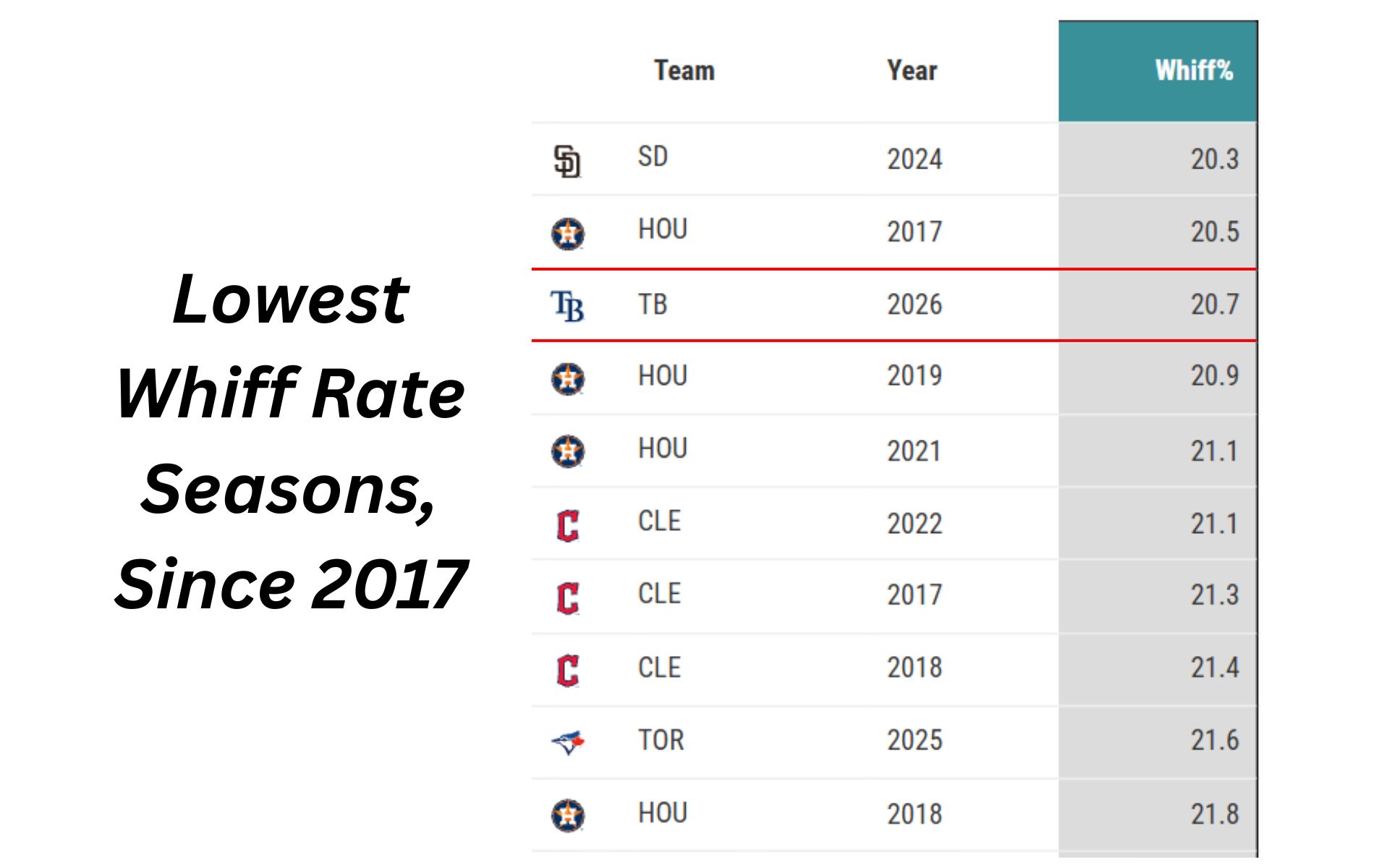
We have seen the Rays zig while everyone else zags many times before. They pioneered the opener, popularized infield shifts against hitters from both sides of the plate, and aggressively limited starting pitchers’ turns through the order. Those tactics were innovative; this one, in a way, is like going back in time. How did one of the game’s most forward-thinking and analytically-driven organizations come to embrace small ball?
“I think what we’ve always done is kind of coach or manage based off what we had on our team,” Rays hitting coach Chad Mottola told MLB.com.
Last year’s team was not a contact-oriented group. But by mid-January, the Rays had cut ties with the five players who had the highest swing-and-miss rates on their team in 2025 (min. 200 PA). Christopher Morel, Kameron Misner, Brandon Lowe, Josh Lowe and José Caballero combined to take 1,785 plate appearances for the Rays last year. Caballero had the lowest swing-and-miss rate of the bunch, at 27.4%.
This year, 12 different Rays have taken over 200 plate appearances; the highest whiff rate belongs to outfielder Victor Mesa Jr., at 25.5%. By the slimmest of margins, Mesa is the only player with a whiff rate above league average (25.1%).
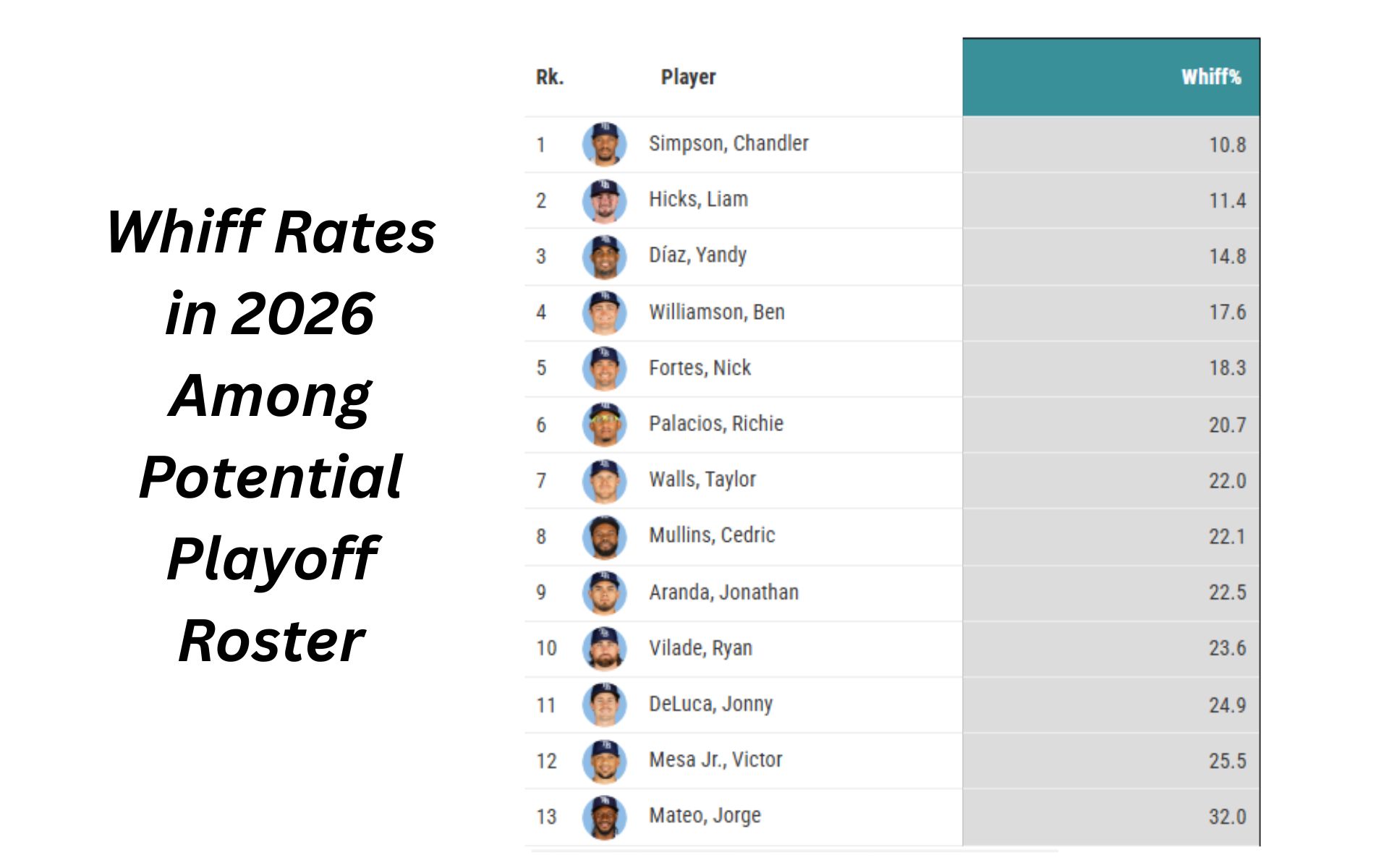
So, where did those nearly 1,800 plate appearances go? Some of this is Chandler Simpson, who makes more contact than all but two qualified hitters. But Simpson, the poster child for so much of what the Rays do, took just 141 more plate appearances in 2026 than he did in ‘25. There’s a lot more to this.
It’s center fielder Cedric Mullins (502 PA, 22.1% whiff rate) and infielder Ben Williamson (286 PA, 17.6%), who were each acquired in the offseason. It’s utility man Richie Palacios (20.7%), who took 399 plate appearances after injuries limited him to 17 games in 2025. Catchers Nick Fortes (323 PA, 18.3%) and Liam Hicks (145 PA and 12.9% whiff rate with Tampa Bay) are each contact-oriented hitters.
“Early on, it was kind of eye-opening to us,” said shortstop Taylor Walls, who was drafted by the organization in 2017. “I think to everybody. It’s a brand of baseball that has been lost for some years. And it’s kind of been our identity. We knew going into the season that these were skills and tools that we needed to try and maximize as much as possible.”
There is not really an exception here. The Rays returned five players from last year’s team who took at least 250 plate appearances in 2025. Four have trimmed their swing-and-miss rate from ‘25 to ‘26. That includes superstar third baseman Junior Caminero, whose skill set is in its own rarified air. The 24-year-old smashed 42 home runs while running a better-than average whiff rate of 24.1%. Twenty-two players hit 30+ home runs this season; only three members of that group swing and miss less frequently than Caminero.
“Watching these guys day in and day out, the way they compete in the at-bat, the way they make pitchers work, it makes a lot of sense that we’ve had success in leading that category,” Cash said.
Part of the way to avoid strikeouts is by putting the ball in play early in counts. The Rays see just 3.75 pitches per plate appearance, second fewest in the Majors. No team has seen fewer pitches in two-strike counts. And yet, that doesn’t tell a complete story of what’s happening here. This is about exceptional bat-to-ball skills, too. Tampa Bay’s swing-and-miss rate in two-strike counts (21.0%) was the lowest in the Majors.
So, what does this mean for October?
We’re overdue to address the elephant in the room, which is what this all actually means for the postseason.
You might remember the 2025 Blue Jays, whose dynamic lineup spurred an inspiring run to Game 7 of the World Series. Toronto, like Tampa Bay this year, had the lowest strikeout rate and lowest whiff rate in the Majors. This approach was embedded in the fabric of the organization’s DNA: The Jays led the Majors in both categories in 2024, too.
Contact doesn’t necessarily win playoff games. In recent history, the ability to hit the ball out of the ballpark is more important. Teams that out-homer their opponents went 30-5 in the 2025 postseason.
The sweet spot here is hitting for power and putting the ball in play, which is exceptionally difficult to do. That’s the formula that keyed the Jays, who added a significant amount of bat speed to turn all of that contact into a whole lot of slug.
Here’s the thing with the Rays: Homers matter for them, too. Tampa Bay went 48-2 when they outhomered the opposition this season, the best record in MLB history in such games. In 111 games before the Trade Deadline, the Rays hit 111 home runs, a bottom five total in the Majors. In 51 games to close the regular season, they hit 58 home runs, 12th most in MLB.
That’s not going to jump off the page, but it’s less of a glaring weakness, thanks to factors like the emergence of Mesa Jr. and the addition of Hicks. Their current lineup appears better constructed for postseason success now than on Opening Day.
The ‘25 Blue Jays aren’t a perfect comparison, either, because the ‘26 Rays do a lot of things that Toronto did not. Their pitching is far stingier, and their baserunning is far more impactful. Everything works in concert.
“The pitching has allowed us to play our style of baseball,” Mottola said. “It’s more the perfect storm of everything that has made us have the message that we have.”
That’s why when you watch the Rays in October, you’ll see a team that doesn’t look like anyone else. A new-age franchise has embraced an old-school approach. They are distinctly themselves, they’re proud of that, and it just may work.
MLB.com senior club reporter Adam Berry contributed to the reporting of this story.