

Velocity always goes up. At least, that's the way it seems in MLB.
Fastball velocity increases year after year. The average fastball -- four-seamer or sinker -- thrown by a Major League pitcher in 2025 was 94.3 mph, the highest of the pitch tracking era. Ten years ago, it was 92.8 mph. In 2008, the first year velocities were tracked league-wide, it was 91.4 mph.
Velocity is everywhere. Heat in the upper 90s used to be rare. Now it's routine.
But, interestingly, there's one place you won't find a lot of velo right now: the starting pitcher free-agent market.
Now that Dylan Cease has signed, there just aren't many free-agent starters this winter who throw hard -- at least not in the mid-to-upper levels of the market. That's pretty interesting.
Basically, the one big-name starting pitcher still out there with above-average fastball velocity for an MLB pitcher is Tatsuya Imai, who's coming over from Japan with a 95 mph fastball that could tick higher in the Majors if he throws with max-effort velocity more regularly.
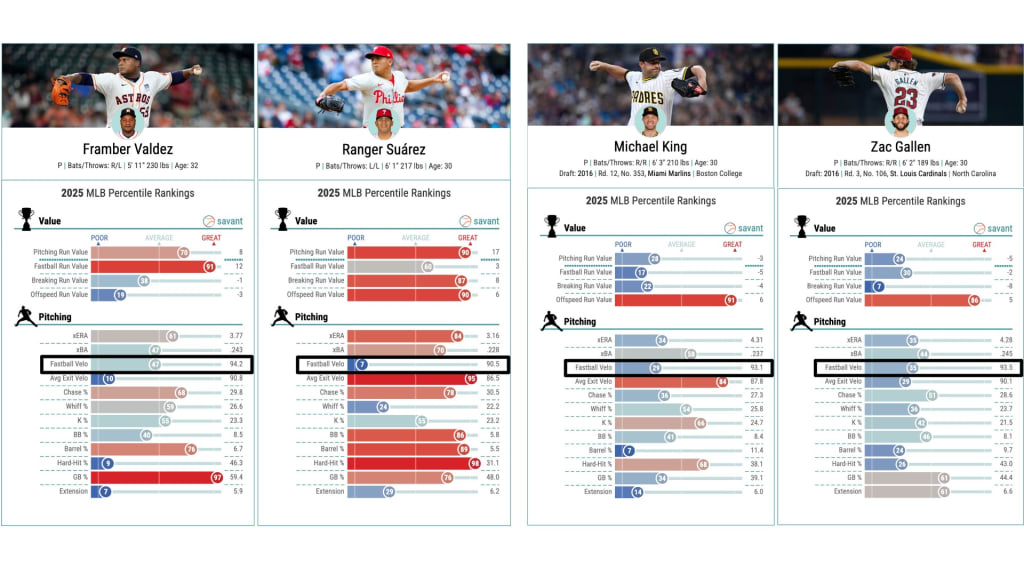
Or there's Framber Valdez, whose 94.2 mph average fastball velocity in 2025 was just a fraction below the overall MLB average, but was at least solidly higher than the left-handed pitcher average (93.1 mph).
But if you're a team looking for a big fastball to add to your starting rotation right now, there just aren't a ton of options out there. The top group of MLB starters still available -- Valdez, Ranger Suárez, Michael King and Zac Gallen -- all sit in the 90-to-94 mph range.
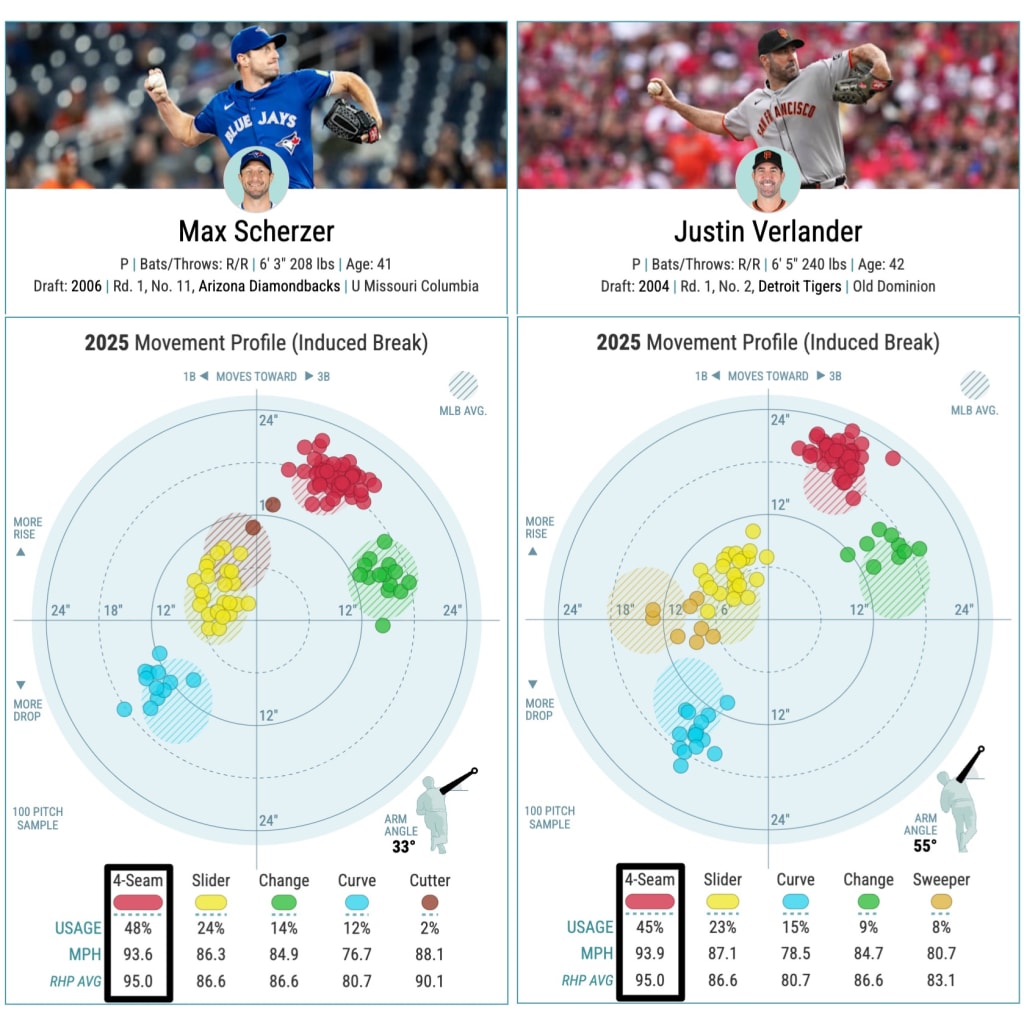
And once you get past Imai and Valdez, the fastest heaters you'll get are basically from 42-year-old Justin Verlander and 41-year-old Max Scherzer. Those future Hall of Famers had two of the most explosive fastballs of their generation, and they can still dial up the heat on occasion, but they're at the end of their careers.
Of the top remaining free-agent starting pitchers who pitched in MLB in 2025, basically none had a fastball velocity that ranked in the top half of the league.
Fastball velocity (4-seam/sinker) for notable remaining FA starters
With 2025 MLB percentile ranking
The top tier left
- Framber Valdez: 94.2 mph -- 47th percentile
- Zac Gallen: 93.5 mph -- 35th percentile
- Michael King: 93.1 mph -- 29th percentile
- Ranger Suárez: 90.5 mph -- 7th percentile
The next tier
- Walker Buehler: 93.9 mph -- 43rd percentile
- Nick Martinez: 92.6 mph -- 23rd percentile
- Lucas Giolito: 92.0 mph -- 16th percentile
- Tyler Mahle: 92.0 mph -- 16th percentile
- Zack Littell: 91.9 mph -- 15th percentile
- Zach Eflin: 91.8 mph -- 15th percentile
- Chris Bassitt: 91.5 mph -- 12th percentile
The "future Hall of Famer" tier
- Justin Verlander: 93.9 mph -- 43rd percentile
- Max Scherzer: 93.6 mph -- 37th percentile
The international tier
- Tatsuya Imai: 94.9 mph (in NPB) -- would be 60th percentile in MLB
- Kona Takahashi: 93.1 mph (in NPB) -- would be 29th percentile in MLB
There are still several pathways available to teams looking for an impact starter -- except the Blue Jays, who got an elite 97 mph heater with Cease and another likely above-average fastball with Cody Ponce, who returns to MLB after four seasons in Japan and Korea. Those pitchers just aren't centered on high-end velocity.
And that's OK. You can be an effective Major League starter without blowing hitters away.
Let's revisit the names on the list above. Those free-agent starters succeed with a variety of styles. Plenty fit into more than one category:
- Ground-ball specialty: Valdez, Suárez
- Command: Suárez, Gallen, Martinez
- Pitch movement: King, Valdez, Buehler, Martinez, Eflin
- Control: Eflin, Littell
- Large pitch arsenal: Bassitt, Buehler
- Balanced pitch mix: Suárez, King, Martinez, Eflin, Littell, Buehler
- Non-fastball signature pitch: Valdez (curveball), Gallen (knuckle-curve), Giolito (changeup), Mahle (splitter)
- Hall of Famers in their twilight: Verlander, Scherzer
The top-tier starters left on the market all have standout qualities other than heat. Valdez is a ground-ball machine. Suárez has elite command and an unpredictable pitch mix. King generates insane horizontal movement on his sinker, sweeper and changeup and uses that to freeze hitters in the box. Gallen, when at his best, owns every part of the strike zone.
Or say you don't need a front-end starter like Valdez, Suárez, King or Gallen. Teams looking for rotation depth have options too. In that middle tier, there are a lot of crafty veterans who get outs in other ways than by dialing up their fastballs.
MLB has always had room for pitchers with different profiles and different approaches. Even in the modern age of velocity, that remains true.
Those other types of pitchers are still quite valuable to have in a rotation. You've seen that in some of the starters who have come off the board already, like reliable veteran Merrill Kelly, who just returned to the D-backs with his 92.0 mph heater on a two-year, $40 million deal, or the two starters who accepted the $22.025 million qualifying offer for 2026, the Brewers' Brandon Woodruff and the Cubs' Shota Imanaga.
Woodruff had an average fastball velocity of 93.0 mph in 2025 but still generated a 32% strikeout rate and was one of the best pitchers in the Majors at suppressing opposing hitters' quality of contact, to the tune of a 2.20 expected ERA. Imanaga's rare lefty splitter keeps hitters off-balance, and even though his fastball is only 90.8 mph, it generates strong rising movement that lets him get plenty of strikeouts with it.
You'll see the rest of those "low" velocity starters -- not truly low, just in the sense of the direction the league has gone in recent seasons -- sign throughout the rest of the offseason. And you'll see many of them succeed in 2026 and beyond. They can still pitch without a fastball like Cease's.