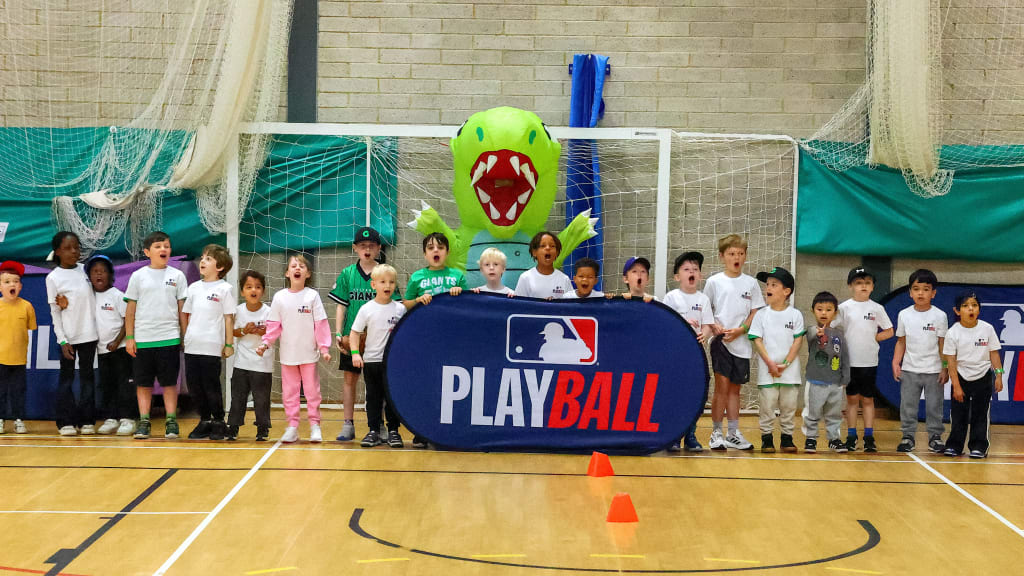

The creature lies in wait. He stands with short arms close to his body, running in fits and starts and letting out sporadic roars while trying to grab hold of his target.
No, he’s not a dinosaur. He’s an English child learning how to play baseball.
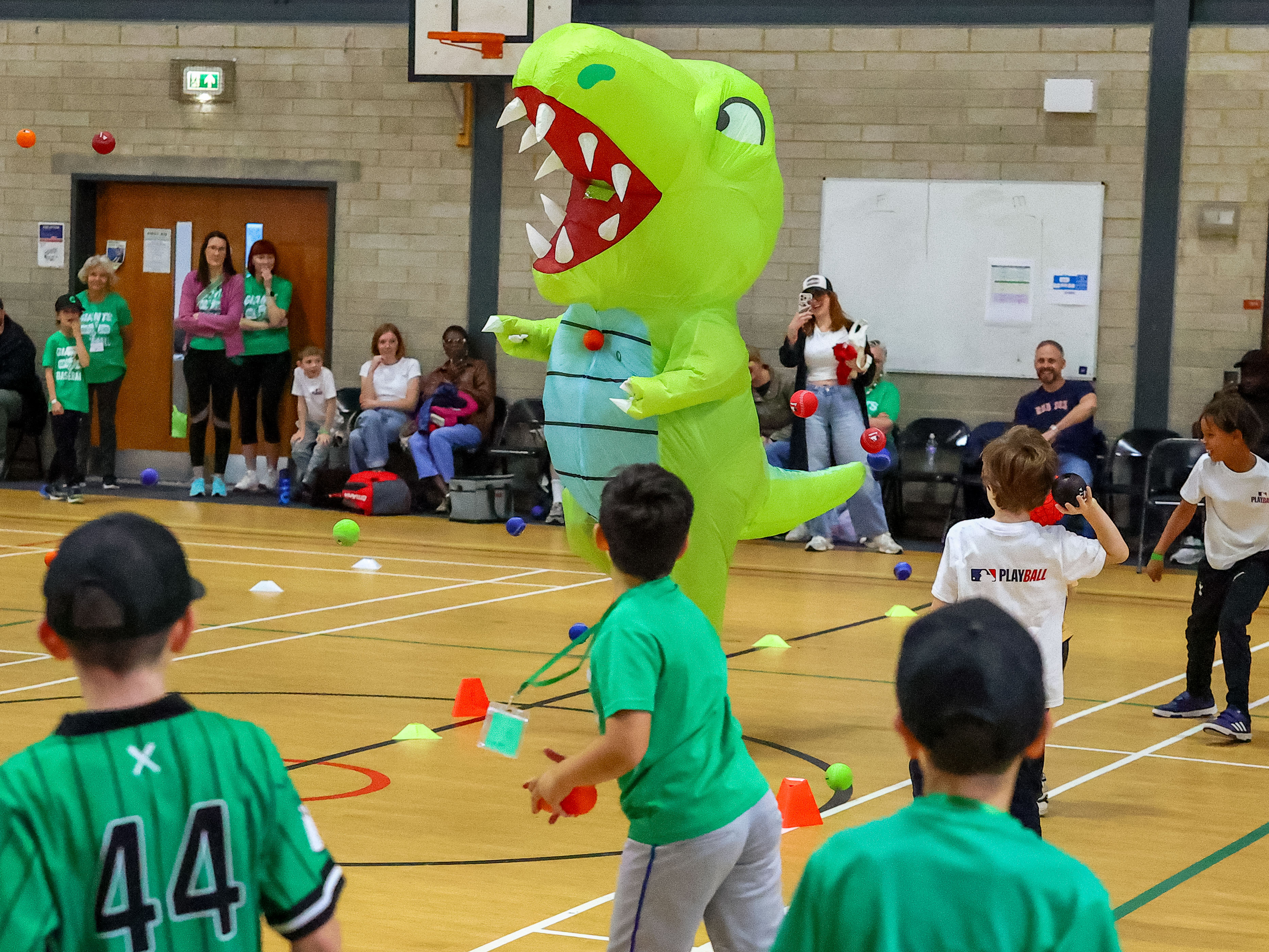
For the Greenwich Giants, a community baseball club in Southeast London, “T-Rex T-Ball” is a way of life. It’s how children aged 4 to 7 get introduced to the sport. Baseball concepts are boiled down to dinosaur comparisons, with kids pretending to be a T-Rex as they learn an athletic catching stance. In other drills, kids impersonate other dinosaurs while practicing proper running and jumping techniques in the field. For the older kids, “Raptor Dash” provides additional running training.
All of these methods were on display last Saturday at an MLB Play Ball Weekend event hosted by the Giants at the University of Greenwich. After the deputy mayor of Greenwich, Raja Zeeshan, opened with a ceremonial first pitch, over 150 children of all ages took part in a day full of baseball festivities. Some were members of the Giants, but for 122 kids, it was their first introduction to baseball. The Giants’ mascot, Gigi (who is technically a Giganotosaurus, slightly larger than a T-Rex) was on hand to play dinosaur-themed games with the younger children.
By the end of the day, after the official programming had ended, many of them were gleefully playing their own version of “sandlot” baseball.
“It was a sea of smiles,” said Will Lintern, founder and chair of the Greenwich Giants.
For Lintern, dinosaurs are synonymous with the club’s origins. He recalls when his son Alex was 4 and Lintern had been coaching with the British national team for several years. He wanted to get Alex involved in baseball, but there was only so much he could do if he was away all the time. Alex loved dinosaurs, and he had a birthday coming up. Thus, T-Rex T-ball was born.
At that time, Lintern shifted his focus from the national team into local kids baseball. As he describes it, the dinosaur-themed exercises and drills were a way to connect with both kids and parents unfamiliar with baseball. It’s hard, he said, to just tell a 4-year-old how to catch, but if you ask them to crouch like a dinosaur, their brain instantly knows what to do. These methods have proven successful; over the next several years, the initiative grew from just three kids in a field into the robust organization that the Greenwich Giants are today.
The Giants have partnered with MLB Europe before, namely surrounding the MLB First Pitch program and a schools festival supporting the 2026 World Baseball Classic, but this specific event has been in Lintern’s mind for about a year. Planning ramped up after the WBC, and for three weeks leading up to the event, Lintern was regularly pulling 12-hour days figuring out logistics.
As one might expect for a baseball event in England, the notoriously mercurial weather was one of the biggest challenges. Luckily, Saturday’s event was scheduled both outdoors on university grounds and in an indoor hall, so gray skies meant no break in the fun for the kids involved. Another challenge was making sure local baseball novices knew exactly what the event was. Branding it primarily as “Free Kids Baseball” seemed to do the trick.
Lintern credited over 40 people associated with the club for helping run the event, evenly split between coaches and volunteers. These included several “young leaders,” older kids who helped out with the drills for the younger folks.
One of these helpers was 9-year-old Alex, who assisted with drills related to knocking down cones and throwing bean bags through hoops. He’s aged out of T-Rex T-Ball, but he pops in to help the little kids with the programs he inspired. Alex’s school offers baseball in PE on Fridays, which he looks forward to every week, and his favorite baseball player is Shohei Ohtani.
His second favorite? One of Ohtani’s teammates. And there’s a good reason behind it.
“My age group, you can't pitch yet, whereas you can play in the field,” he said. “My second-favorite baseball player, Freddie Freeman, he is a first baseman. … Every time we play a game, I always like to get a chance to play first base.”
Alex is lucky he comes from a baseball-forward family who tries to watch Dodgers highlights every morning. But Lintern recognizes that for most UK families, this isn’t the norm. One of the biggest challenges to growing baseball there is overcoming the perception that baseball is “only” an American sport and making people aware of local baseball programming. The interest is there, he says. The task for people like him is to offer accessible, affordable baseball activities that keep parents coming back.
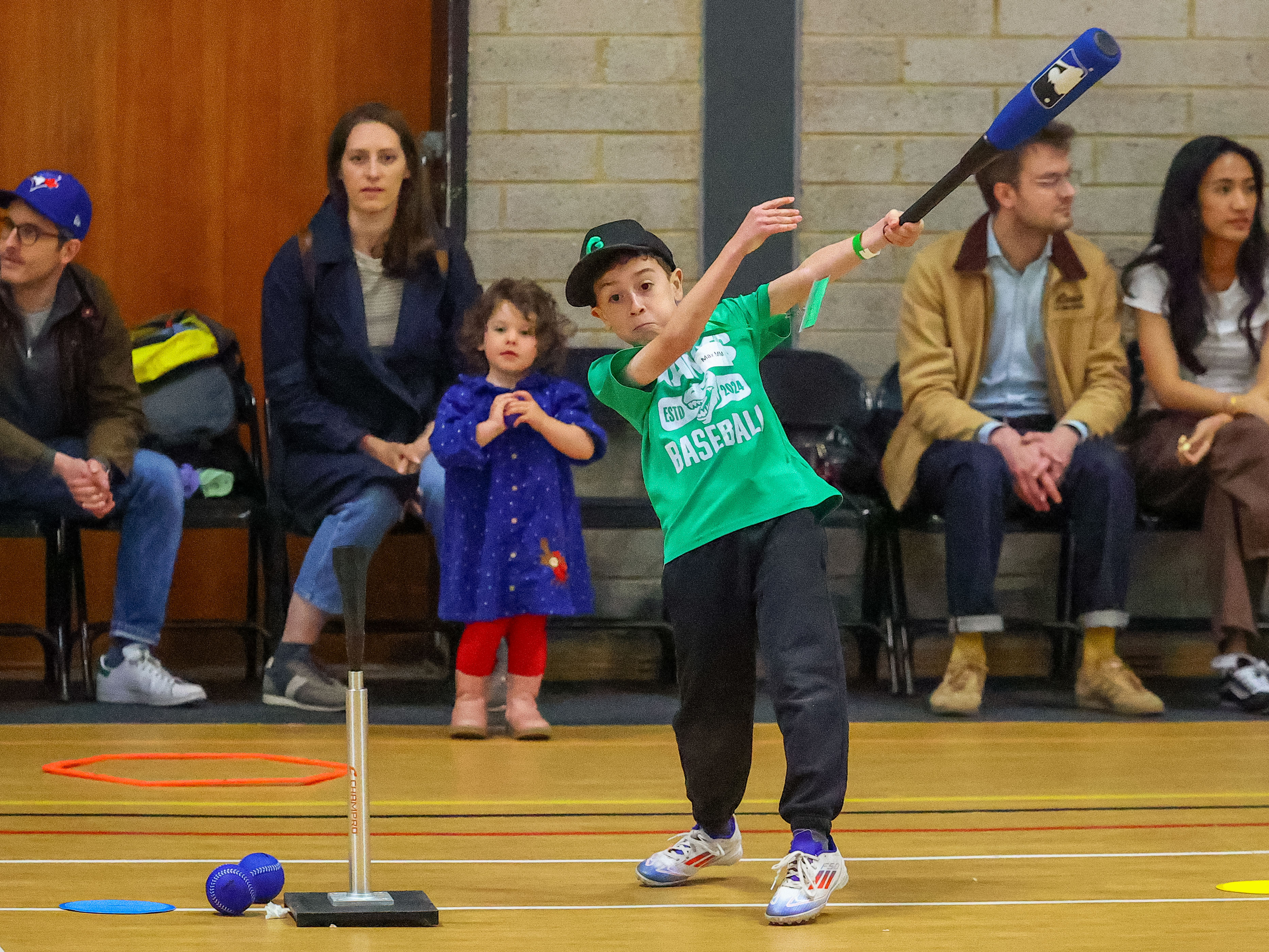
Saturday’s event certainly seems like it had a real impact. Lintern has received a flood of emails in the days since, from parents who attended the event and want their kids to join the Giants, to parents who missed it but want to know when the next one will be.
“It blew me away, because it was a validation of the things that I believed were true, that there was more interest out there than we had yet discovered, and we’re still just scratching the surface,” Lintern said.
And it seems like no matter how the Greenwich Giants expand in the future, dinosaurs will remain at the heart of their mission. Which begs the question: which actual dinosaur would be the best at baseball?
When asked this all-important query, Alex thought about it, then gave his verdict.
“Probably Spinosaurus,” he said. “Because of his big jaws to catch.”