
Baseball is the national pastime for a reason, and each pocket of the country has its own unique connection to the sport. To celebrate the 250th anniversary of this nation, we’re taking you on a summer road trip across the U.S. with Baseball in America, presented by Booking.com, 50 stories from all 50 states. Follow along here.
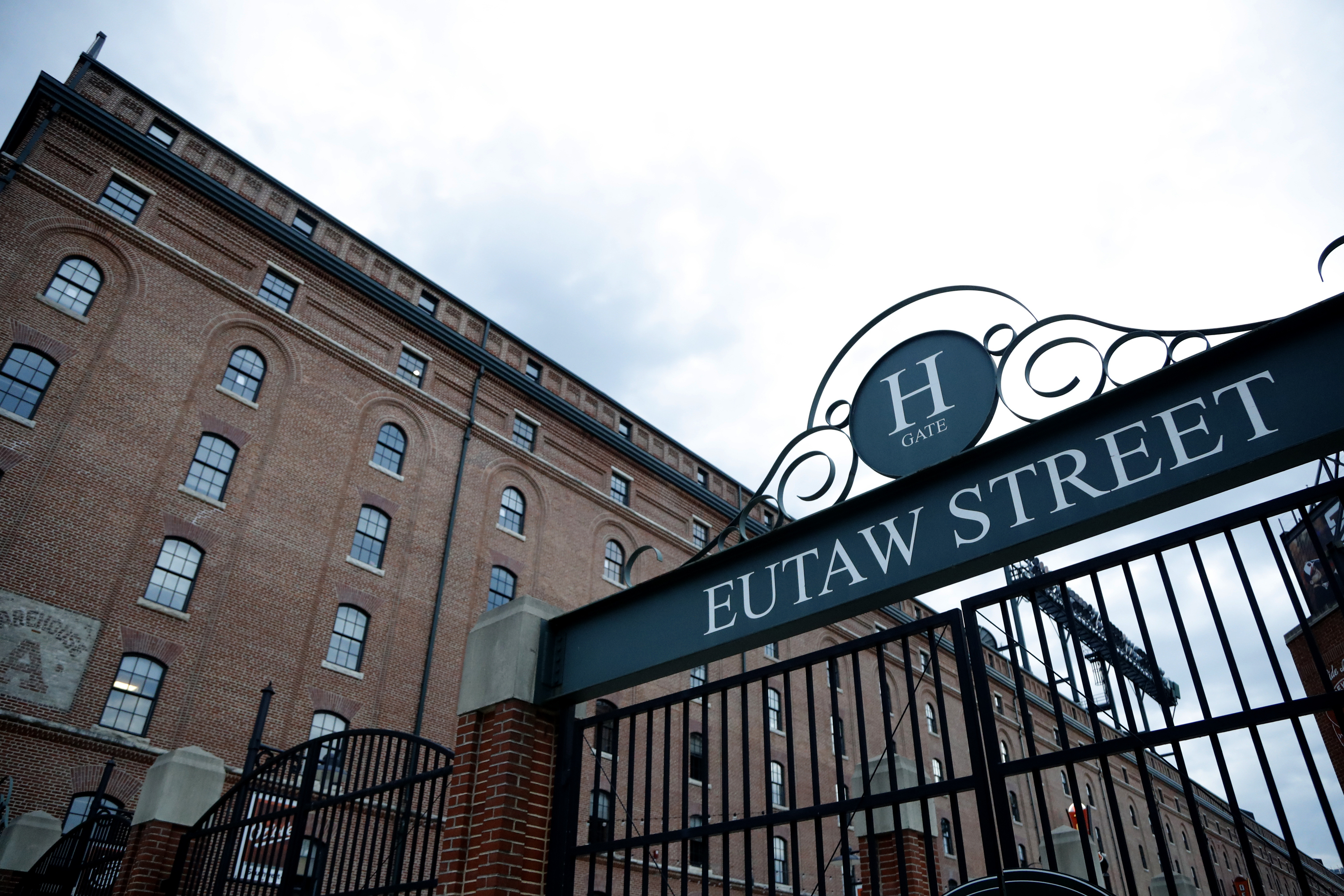
BALTIMORE -- Eutaw Street is 2.4 miles long and runs north-south through Downtown Baltimore. On a map, it looks like any other street in Charm City.
Baseball fans -- especially those who love the Orioles -- know it’s not just any other street.
The south end of Eutaw Street is a pedestrian walkway located inside of Camden Yards since the ballpark opened in 1992. It serves as a primary entrance/exit, with Gates A and H on the ends. It’s a gathering spot for fans to socialize and to dine on ballpark fare, most notably at Boog’s BBQ -- the famous barbeque stand named after longtime O’s slugger Boog Powell.
But watch where you step. Much of the southern half of the walkway is littered with bronzed plaques designed like baseballs, and at any time of day -- before, during or after games -- there may be somebody squatting down or hunching over to read one.
And there are a lot of them -- 134 on the ground for every in-game home run that landed there from 1992-2025, as well as two temporary markings for the pair hit so far in ‘26. There’s also an honorary plaque on the B&O Warehouse that runs parallel to Eutaw Street, marking the only ball to hit the historic brick building, which came off the bat of Ken Griffey Jr. in the 1993 Home Run Derby.
To fully appreciate Eutaw Street, its history and all it has to offer, it’s best to go back to the beginning.
Eutaw Street gets its moniker from the Battle of Eutaw Springs, which occurred in South Carolina during the Revolutionary War on Sept. 8, 1781. The reason there’s a street in Baltimore named after it is because Maryland regiments assisted in that battle.
As time passed, Eutaw Street became an important area of Downtown Baltimore. The B&O Warehouse was constructed from 1899-1905, then stored products that were being shipped west until the early 1970s. Train tracks were located on both sides of the building.
When the Orioles decided they were going to leave Memorial Stadium (their home ballpark since their inaugural season in 1954), they identified the location below the southern end of Eutaw Street as an ideal spot.
But there was one important question -- what should be done with the warehouse?
“Initially, when the ballpark was being planned, there was debate about keeping the warehouse,” said Bill Stetka, the Orioles Alumni director and team historian. “Some people thought, ‘Well, it’s going to block the views of downtown and the Inner Harbor and overwhelm the row houses in the nearby neighborhood and all that.’
“In the end, it was determined that not only was the warehouse salvageable, but it would become, really, the key element to the entire ballpark concept. By keeping the warehouse, using it as offices, it really created an authentic, old-feel look.”
Ground was broken for Camden Yards on June 28, 1989, and the ballpark hosted its first game less than three years later.
The pedestrian walkway built inside the ballpark on Eutaw Street alongside the warehouse was always meant to exist the way it does today. But it wasn’t yet clear how many home run balls might make it that far or would potentially even hit the warehouse (which is why the lower windows feature shatter-proof glass).
“A lot of people wondered who would be the first to hit the warehouse. But I think most knew it would take a tremendous shot,” Stetka said. “And even hitting a home run onto Eutaw Street would be special.”
Janet Marie Smith, the Orioles’ vice president of planning and development at the time at which Camden Yards was built, and a team of architects came up with an idea -- one that would also incorporate a historic feat achieved at Memorial Stadium.
On May 8, 1966, Frank Robinson became the first (and only) player to hit a home run completely out of Memorial Stadium. The O’s marked the spot where that ball landed with a flag that read “HERE,” which remained until the ballpark closed.
So, what if the Orioles marked every Eutaw Street home run in a similar fashion? Thus, the idea for the bronzed ball plaques was born.
Here’s how the process works.
After a home run lands on Eutaw Street, one of the ushers inside the ballpark will identify where the ball hit. That process can include asking nearby fans to help locate the exact spot. And once that happens, it gets marked with chalk.
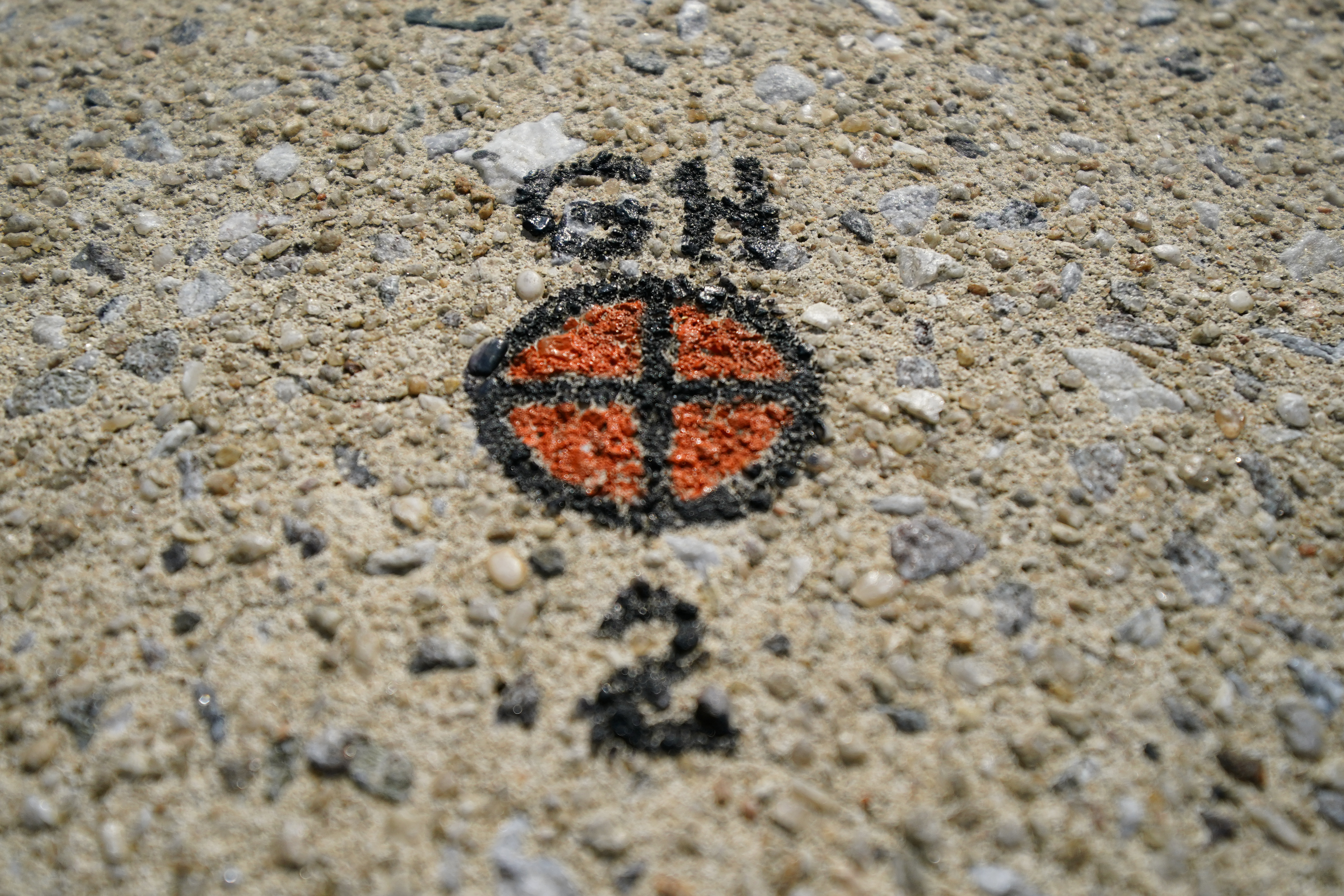
The spot then gets a temporary painted designation featuring the initials and uniform number of the player who hit the home run.
During the offseason, the Orioles order the permanent plaques, which will feature the player’s name, his team, the date of his Eutaw homer and the distance. Then, before the next season -- and once the weather starts to warm up a bit -- they get installed into the concrete.
Some fun facts:
• Of the 136 Eutaw Street home runs, 64 were hit by Orioles players and 72 were hit by opponents. Unlike some ballparks -- such as Oracle Park in San Francisco, where only Giants homers hit into McCovey Cove count as “Splash Hits” -- all Eutaw homers get a plaque, even if they are hit by a visiting player.
That has resulted in some cool moments when a player may return to Camden Yards after the plaque is installed. Carlos Santana hit a Eutaw Street home run on July 17, 2011, while playing for Cleveland. He had never seen the plaque -- until he made a trip out there during the 2025 season to see it for the first time.
“I think it’s special not just for the fans, but the players who hit one out there get a kick out of it,” Stetka said.
• Former Orioles sluggers Chris Davis and Anthony Santander share the record for most Eutaw Street home runs with 11 apiece.
• Two players have hit their first MLB home run to Eutaw Street -- the Astros’ Robbie Grossman (July 31, 2013) and the Orioles’ Jackson Holliday (July 31, 2024), who hit a grand slam there.
• All 136 Eutaw Street home runs were clubbed by left-handed hitters. Pete Alonso has expressed his desire to try to become the first righty slugger to hit one out there, and the Polar Bear may just have the type of opposite-field power necessary to make it happen.
“You’ve really got to touch it,” Alonso recently said. “But with the right conditions, I feel like it could get out.”
As more games are played at Camden Yards, more plaques will fill Eutaw Street, which continues to be among the most unique ballpark experiences around MLB. It’s highly suggested for out-of-town visitors to explore the area, but it’s also a fun time for repeat customers.
“If you’re out there before a game or whenever the street is open, people are staring, looking at the plaques. ... You’ll see fans of different teams looking for their player, players from their team, that type of thing,” Stetka said. “I think it’s great.”