

This story was excerpted from Tim Stebbins' Guardians Beat newsletter, with MLB.com's Jared Greenspan filling in for this edition. To read the full newsletter, click here. And subscribe to get it regularly in your inbox.
Patrick Bailey has never seen anything like Cade Smith’s fastball.
“It was not a fun at-bat,” recalled Bailey, who is 0-for-3 against Smith, his new batterymate with the Guardians. “I remember facing him for the first time in 2024. The fastball, with the extension and the shape of it, is by far the best right-handed fastball I’ve ever seen.”
Smith’s heater is fast, sitting at 96.8 mph, but it’s not blow-your-doors-off fast. The pitch plays up thanks to elite extension: Smith releases his fastball 7.4 feet in front of the rubber, giving hitters even less time to react. For context, the average right-handed pitcher releases the ball 6.5 feet from the rubber -- nearly a full foot farther from the plate.
The fastball is largely responsible for Smith’s quiet emergence as one of baseball’s elite relievers. In a two-year span from 2024 to 2025 -- beginning with Smith’s rookie season -- Smith’s four-seamer was tied for the second-most valuable pitch in all of baseball, according to Statcast’s run value metric. It had a run value of +40, trailing only the +47 that Chris Sale recorded with his slider. It was the most valuable fastball in the game, tied with Cincinnati flamethrower Hunter Greene.
This season, though, Smith's fastball hasn't been as dominant as usual.
Comparing Smith’s four-seamer, 2025 vs. 2026
- 2025: .170 BA / .302 SLG / 37.6% hard-hit rate
- 2026: .290 BA / .430 SLG / 50.0% hard-hit rate
Another pitch, though, has taken a big step forward -- the splitter. And it's allowed him to maintain the same level of success.
“Like all of his pitches, he’s matured in his ability to pitch,” catcher Austin Hedges said. “He’s got a good feel for it. At first, it wasn’t moving a whole lot, but it was a good, tumbling split. As he kept working on it, he’s gotten better action. It’s just a testament to his hard work.”
The league is hitting .148 with a 48.5% whiff rate against Smith’s splitter. The expected batting average -- which takes into account the quality of contact allowed -- is just .113. That’s the second-lowest xBA against any splitter this season, among the 35 pitchers to throw at least 100 splitters.
The splitter is a large reason why Smith -- who owns a 2.48 ERA with an MLB-best 23 saves and a 99th-percentile strikeout rate (38.0%) -- is plenty deserving of a trip to Philadelphia next month for the All-Star Game.
But what makes it so good? For one, it's a unicorn pitch. While splitters are a low-spin pitch type, Smith’s is especially low-spin. This season, his splitter is averaging 583 rpm, which is the second-lowest spin rate on any pitch by a non-position player this season, behind only Matt Waldron’s knuckleball (and knuckleballs are known for having essentially no spin).
In fact, it’s one of the elite spin-killing splitters of the Statcast era, which goes back to 2015.
Lowest splitter spin rates in a single season, Statcast era
Min. 100 splitters thrown in a season
- Emmanuel Ramirez, 2024 – 550 rpm
- Cade Smith, 2026 – 583 rpm
- Logan Gilbert, 2024 – 641 rpm
- Mark Leiter Jr., 2025 – 675 rpm
Over the past three seasons, Smith’s splitter has tumbled from 863 rpm in 2024 to 711 rpm in 2025 to 583 rpm in 2026.
That’s not the only evolution happening here. It’s taken on a different shape, too.
Smith’s splitter is dropping more than ever -- and more than nearly every splitter in the Majors. It drops 42.2 inches, second to only Logan Gilbert’s splitter, and Gilbert throws his 81.1 mph -- the slow speed gives the pitch more time to drop on its way to the plate, so we’d expect that sort of movement. Smith, by contrast, throws his splitter at 86.4 mph. It drops a whopping 7.4 inches more than comparable pitches, based on splitters thrown at a similar velocity and release height.
He’s added more than eight inches of drop across the last two seasons.
“There was definitely a thought process where, at least anecdotally, and some of the numbers back it up, slightly slower, more depth, there’s more separation from my fastball than something with less depth,” Smith said. “So that’s part of it. Just awareness and tinkering.”
Smith first toyed with a splitter at the end of the 2021 season when Tony Arnold, his pitching coach at Single-A Lynchburg, introduced the idea. Arnold told Smith that if the first few splitters had a tumbling action, then it had the potential to become a legitimate pitch. Smith threw a few. They tumbled.
Modifying the pitch is a constant process. Smith uses his large fingers to maximize the split-finger grip, widening the split between his index finger and middle finger.
“Over the course of learning the pitch, there’s been periods of time where I started more narrow and threw harder with less depth,” Smith said. “Then chasing a little wider with more depth and making that trade-off. That’s where it is now. There’s a sliding scale of what’s going to help separate it from my fastball and make it controllable and executable, ultimately.”
Those are two words that Smith references a few times during our conversation – controllable and executable. Let’s look a bit deeper into what each actually means.
Controllable
Smith calls the splitter a finicky pitch, and it is one. It doesn’t dance like a knuckleball, but it has taken a lot of tinkering to find a movement profile that’s comfortable and repeatable.
Over time, Smith has gotten better at throwing the splitter where he wants to -- which isn’t the same thing as throwing it for a strike.
“The intention is controlling the height,” Smith said. “That’s the most important part.”
Smith is landing his splitter in the zone just 24.6% of the time (down from 38.2% a year ago). That’s the third-lowest zone rate of any splitter in the Majors (min. 100 pitches).
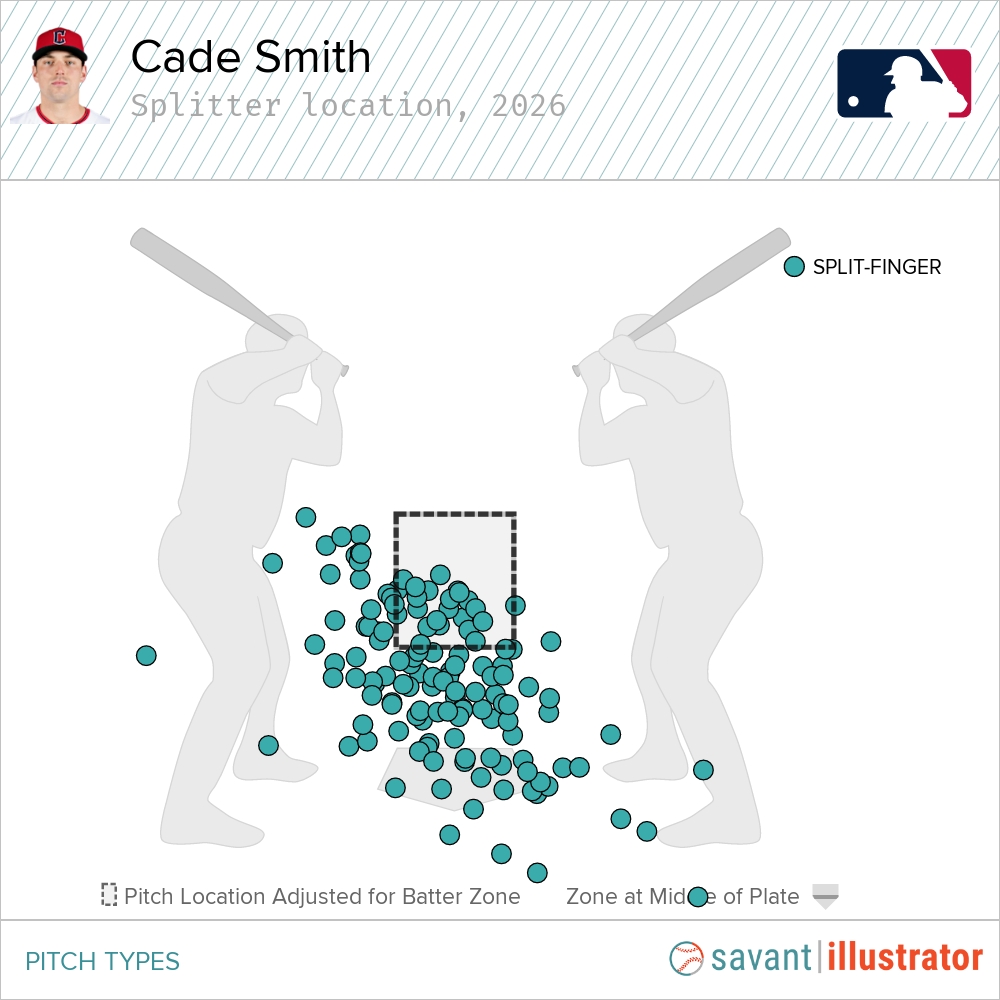
“You go through stretches where I have really good feel of where I need to release it, where I need to pick it up visually, and where I need to move through my motion down the mound to be able to get it where I want it,” Smith said. “That’s at the bottom of the zone and below the zone.”
Executable
Smith’s splitter is at its best when it plays off his fastball.
The movement profile on Smith’s splitter is more up and down, as opposed to some other splitters, which will have more arm-side fade. Smith’s version is a high-velocity pitch that drops straight down, playing off the true-carry four-seamer.
You can see that relationship in the pitch movement profile below, where Smith’s splitter lies almost directly below the fastball. They look similar, but the splitter drops two and a half feet more.
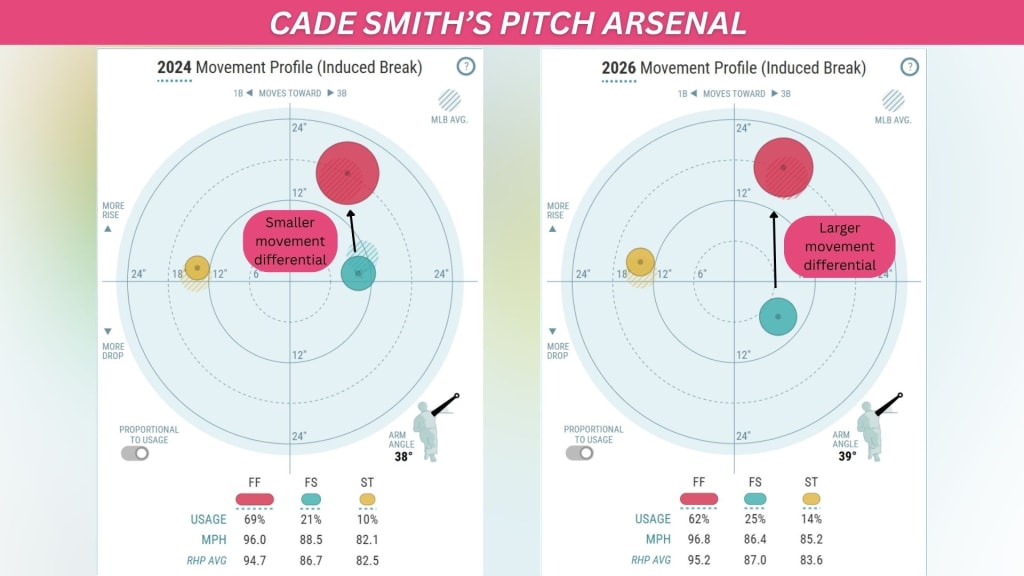
“Part of it is that tunneling, that overlap, of where does my fastball need to come out to be most effective?” Smith said. “Where can I start my splitter to follow and get late swing decisions and really make that a toss-up? Both are strong pitches on their own. But if you learn how to use them well, they’ll make each other better.”
Among other areas, that’s where Smith has taken a step forward.
Said Hedges: “The discrepancy off his fastball, because his fastball is so firm with so much ride, and then the split does the opposite action, that makes it tough for the hitter.”
That’s certainly been the case this year. Even if his four-seamer is seeing diminished results, the splitter/fastball combination is helping him have just as much success.