

The Blue Jays, coming off a sweep in Tampa Bay, their long-time house of horrors, may be having trouble getting going. But there is one pretty large silver lining, and it's their biggest offseason acquisition, third baseman Kazuma Okamoto.
Okamoto's first three weeks in the Majors were mostly what you’d expect from a player adjusting not only to new pitchers and a new league, but a new continent entirely: bumpy. After going 0-for-4 on April 17 in Arizona, his third consecutive oh-fer (and sixth in his previous seven games), Okamoto’s line sat at .188/.263/.290 over his first 18 games.
The next day, Okamoto made a pretty large change in the batter's box, and he collected two hits. The next day, he got two more, including a homer. He’s barely stopped hitting since, and in the 18 games since that day in Arizona, his line is .308/.400/.708, which is to say: better. So much better, in fact, that Okamoto has been one of the top 10 hitters in baseball over that span. When he doubled on Wednesday afternoon against Tampa Bay ace Shane McClanahan, it was, at 112 mph, the second-hardest-hit ball of his career to date.
To some extent, this seems like just the normal peaks and valleys that every hitter goes through over the course of the year, even the best ones. But when a struggling hitter makes a big change in his approach and then immediately finds success, it’s worth looking into a little closer. What changed? Let’s find out.
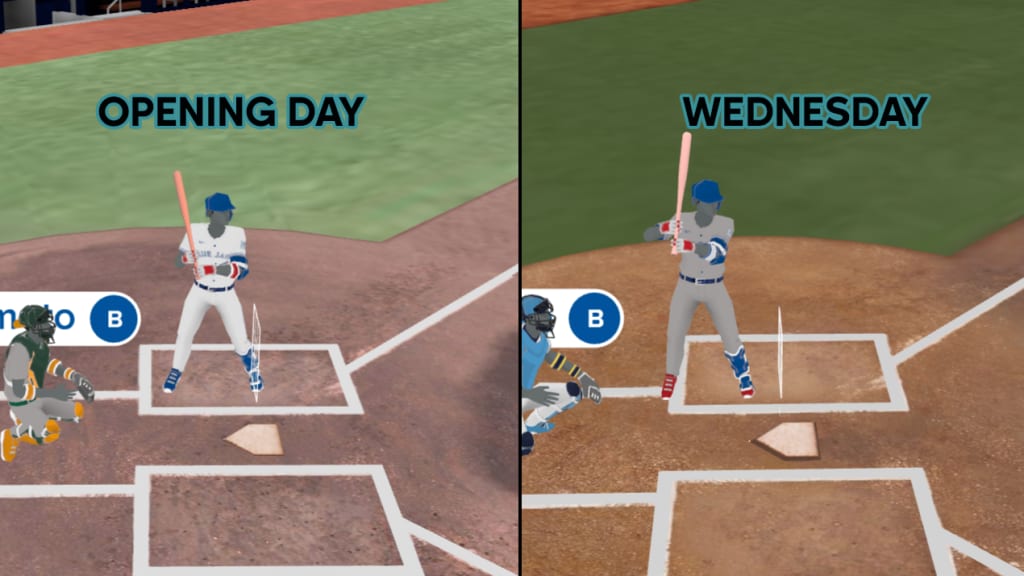
The big change: Quesadillas, obviously. OK, the other big change: He moved back in the batter's box by a lot. A lot, a lot. More than half-a-foot, to be exact.
The average Major League hitter stands approximately 26 inches deep in the box, which is defined as “behind the front, flat edge of home plate.” There’s a pretty big spread around that, though; Houston’s Jose Altuve moves up nearly as much as he can, just 10 inches deep, while Seattle’s J.P. Crawford is 35 inches deep, with his foot often on or beyond the back line of the box.
That kind of gap – two feet – shows you there’s not really one right way to do this, just the way that feels comfortable. Batters who move up in the box like Altuve (9.9 inches), Zach Neto (16.4), and Geraldo Perdomo (17.9) are good hitters. Batters who stand way back like Ben Rice (33.9 inches) and Cody Bellinger (33.4) are good hitters, too. This isn’t really a straight line to success in the same way as “throw hard, get outs” can be for pitchers.
But it’s still noticeable when it changes, as we got into when Pete Crow-Armstrong moved back into the box late in the 2024 season. In Okamoto’s case, the move was from 20.9 inches deep, or further up in the box than most hitters, all the way back to 27.7 inches deep, or slightly deeper than average. It’s not so much that either number is an outlier as it is that this is a big change to make in the middle of a road trip, as you can see by the foot positioning graphic on Baseball Savant’s batting stance tracker.
He moved slightly closer to the plate, too – about an inch-and-a-half – but it’s really the move back that’s the headline here. So what did it do? The secret might be in what he’s doing (or not doing) against the kind of pitch that was always going to be his kryptonite: breaking balls.
This was in every scouting report, as Okamoto pondered a move to North America. The thought was that he would likely do well against velocity but perhaps struggle with spin. “Okamoto does particular damage against fastballs,” wrote Baseball America, while FanGraphs said, “he’s been more often on time to pull fastballs with power.”
Quite right. Ten of Okamoto’s first 11 hits were off fastballs, and the one that wasn’t, an Opening Day single off a Scott Barlow sweeper, was a softly hit flare off the end of the bat. Opponents had noticed, surely. During Toronto’s three-city, nine-day trip through Milwaukee, Arizona, and Anaheim in the middle of April, only four regular hitters in the sport, over the same time span, were seeing a higher rate of breaking balls than Okamoto was: nearly half of all pitches after having been at 35% entering the trip.
Improvement was going to happen, and it has, in a big way. Before he made his big move, Okamoto was hitting .167 (with a .167 SLG) against breaking balls; ever since, he’s hitting .333 (with an .833 SLG) against them. The whiff rate has dropped, from 44% to 28%; the hard-hit rate has jumped, from 27% to 38%. It’s all good.
Again: this could just be comfort level, since we’re still barely more than a month into Okamoto’s first year in the Western Hemisphere. But we keep thinking back to something Crow-Armstrong said when he moved back, too: “I'm definitely trying to give myself a chance to be able to see the baseball for as long as possible.” When he did, his chase rate on breaking balls dropped commensurately.
For Okamoto, the result has been a little different. Yes, he’s chasing a little less on breakers, though going from 29% to 21% chase is hardly earth-shattering. Instead, it’s much more about swinging more when they’re in the zone, which strongly suggests that seeing the ball longer is helping him identify those pitches better.
You can see that in swing rate at in-zone breakers, which went from 48% before the move to 65% after; you can see it in fewer called strikes, which dropped from 50% of breakers in the zone to 31%; you can really see it in the heatmap of where he’s swinging at breaking balls.
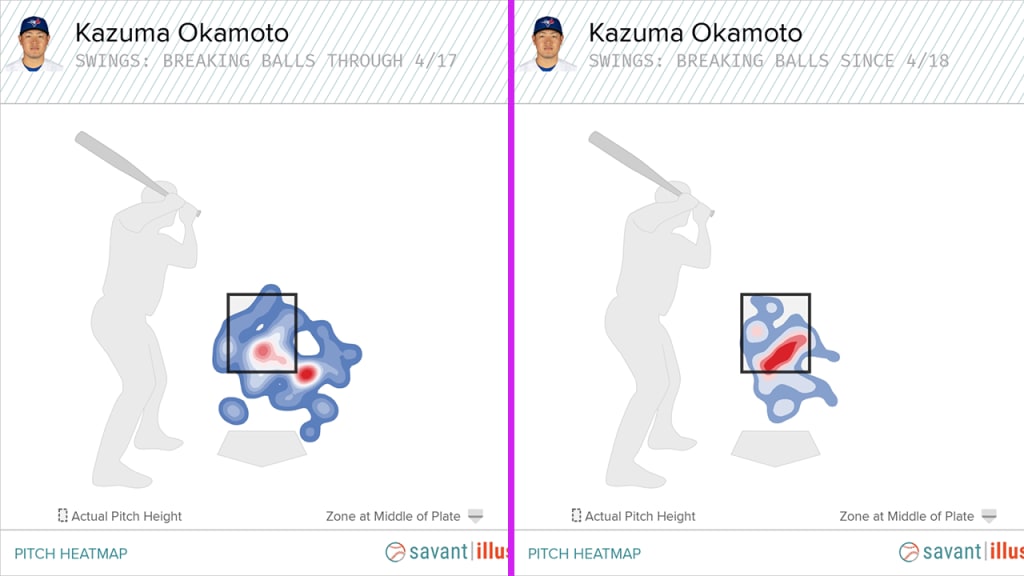
Everything, really, flows from better swing decisions. Okamoto’s bat speed on breaking balls is up from 72.5 mph to 73.7 mph, which isn’t so much about gaining physical strength as it is having the confidence here to make stronger, better swings, rather than weaker, more defensive ones.
On a completely related note, he's catching the ball further out front, too, going from 28 inches in front of his body to just over 31 -- and if you're wondering why that matters, well, power is out front. As we looked into last year, the sweet spot for hitting homers is more in the 36 inches out front range, and while he's not quite there yet, he's at least gotten it out of the "letting it get way too deep" range.
There are, for every player, ups and downs over the course of a season. A .300 hitter doesn't get three hits in every 10 times up, obviously. Maybe this is just an 'up' range for Okamoto, with lots of season left. But ever since he moved back, the results have been there. Moving back might just have moved his season forward.