

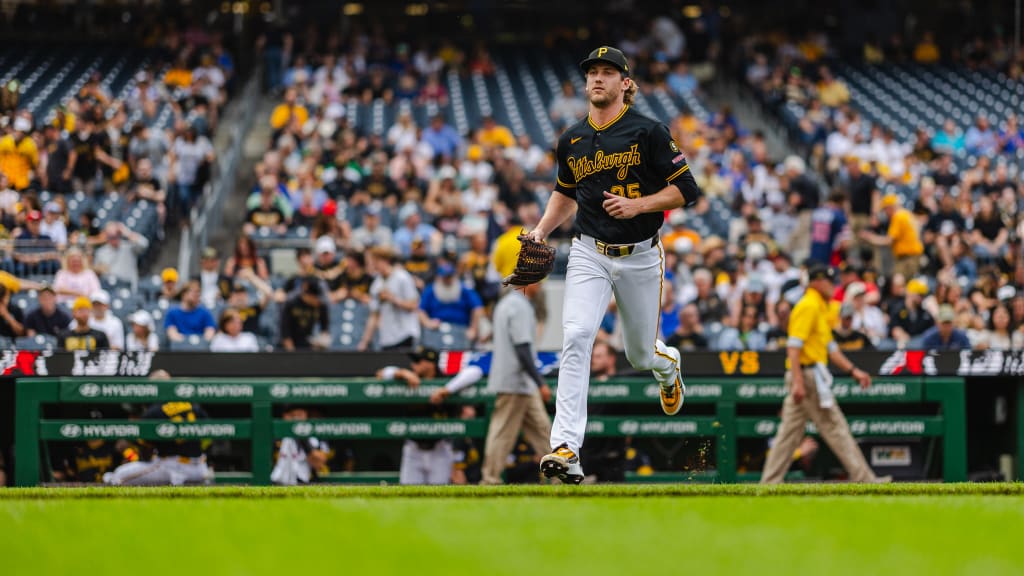
PHILADELPHIA -- As the Pirates kept hitting, erupting for five runs in the fourth inning last Wednesday against the Mariners, Braxton Ashcraft stood at the far end of the home dugout at PNC Park, inching up the steps like a bull ready to charge out of the gate.
It’s a common occurrence whenever Ashcraft pitches, an idiosyncrasy teammates needle him for, though like a lot of what the proud Texan does, there’s intent behind it.
“I like getting out there early so I can have a breather before the inning starts,” Ashcraft said. “I do work fast. So it’s nice to get the warmup pitches in and be able to take a breath, to let everyone else get to their positions and get ready.”
Ashcraft has made an impressive charge over the first half for the Pirates, enough to enter his name into the conversation surrounding the MLB All-Star Game next month here at Citizens Bank Park.
When looking at National League pitchers, only Milwaukee’s Jacob Misiorowski and Philadelphia’s Cristopher Sánchez have been worth more wins above replacement (per FanGraphs) than Ashcraft (2.9).
Paul Skenes (2.8) and Cincinnati’s Chase Burns (2.8) are close.
As far as traditional numbers, Ashcraft has gone 7-3 with a 3.07 ERA in 16 starts, walking 22 and striking out 107 over 96 2/3 innings. Ashcraft, Skenes, Sánchez and another former Cy Young Award winner, Chris Sale, are the only NL pitchers in the top 10 of both categories.
“He’s been great,” Ryan O’Hearn said. “I can’t say enough good things about him. He’s throwing a lot of strikes. He’s got great stuff. Feels like he gives us a great chance to win every time he pitches.”
Ashcraft has been nothing short of dominant in his first full MLB season. But it’s also worth examining how he arrived at this point. He's piled up strikeouts without pitching for them. He’s understated but whip smart, an old soul who cares a great deal about what he does and who he represents.
“I enjoy being around people and learning,” Ashcraft said, discussing his approach to becoming one of the best pitchers in the National League. “A lot of times I have to tell myself to shut up and listen. I think there’s a lot of value in that, especially when it comes to how I want to live my life … when my daughter is born, to be a father and role model to her, to be a good husband, brother and son.
“I feel like I’ve learned a lot in this game, but the biggest thing is probably to not take anything for granted."
‘Keeps everybody engaged’
The charging-bull analogy drew a wry smile from Henry Davis.
“Oh, yeah. We definitely tease him about that,” Davis said. “Sometimes it feels like there’s a ground ball, and he’s already running back out there. He wants to be on the mound.”
Ashcraft said teammates will joke with him that it feels like he’s rooting for them to make an out so he can pitch again. But again, there are multiple reasons why he operates like this.
Number one, Ashcraft grew up playing a position -- usually third base -- and only gave it up after the Pirates drafted him. When he played behind someone who worked slow or didn’t throw strikes, he hated it.
“It didn’t feel right to do that to somebody else,” Ashcraft said. “I’ve always found with working fast, it keeps everybody engaged and keeps the pace of play up. The goal of a pitcher should be to get your hitters back in the dugout.”
And to make the opposing ones uncomfortable, which Ashcraft’s suffocating pace definitely does, Davis said.
It’s not uncommon for Davis to sense agitation with Ashcraft’s unrelenting pace. As soon as Ashcraft can legally deliver a pitch (at the 8-second mark of the pitch timer), he’s ready to fire.
While it might be unnerving for opposing hitters, Davis brought up an interesting point: Ashcraft’s pace can also reduce rest for the opposing pitcher.
The get-it-and-go mentality will sometimes force Endy Rodríguez, who has been catching Ashcraft more, to work faster. But that’s a problem he welcomes.
“I love that [stuff],” Rodríguez said. “It makes hitters uncomfortable. He has to keep doing it until somebody says something.”
Then there’s the strike throwing, the pounding of the zone, which draws from another source of inspiration.
‘Fearlessly attacking’
Ashcraft has heard the questions. After dealing with shoulder, forearm and elbow issues during his time in the Minor Leagues, including Tommy John surgery in 2021, Ashcraft knows the Pirates want to be careful with his innings.
Similar to the caged-bull comparison, he always wants to keep pitching, hence why Ashcraft has been most proud of his efficiency, how he's filled up the strike zone better than anyone throughout his splendid first half.
Ashcraft this season has thrown 1,412 pitches, 974 of those for strikes. His strike rate of 69.0% leads all MLB pitchers.
“When this guy is in the strike zone, with his stuff, it’s a problem for the hitter,” Rodríguez said.
Added Davis: “Fearlessly attacking the zone. Never really shakes. Whatever pitch you call, he’ll throw it in any count.”
In Ashcraft’s mind, it’s all part of a bigger plan. He doesn’t want to stop pitching. The best way to do that involves being efficient.
“Coming into this season, there were question marks about my longevity and health. And rightfully so,” Ashcraft said. “I’ve had a lot of hardships in my career. But when you’re efficient, your pitches per inning are down, you’re not taxing yourself within an inning, and it makes those innings a little less stressful. Less stressful innings are less stressful on the body and help with longevity.
“I’ve really put a priority on getting guys out of the box early, letting strikeouts come when they come. I’m not trying to throw the nastiest stuff in the world. Just trying to miss a barrel, not necessarily a bat.”
All-Star time?
Don’t worry, Ashcraft has missed plenty of bats, too.
Only five National League pitchers have more strikeouts than the 26-year-old, and two have started more games. Ashcraft's chase rate (36.6%) puts him in the 95th percentile. The whiff percentage he's achieved primarily with a four-seam fastball and two dynamic breaking balls sits at 27.4%, in the 65th percentile.
Looking specifically at Ashcraft’s curveball -- only one other bender throughout baseball has performed better, per Baseball Savant’s Run Value metrics -- opponents are hitting just .124 against it with a 41.3% whiff rate.
Ashcraft has a barrel rate of 5.1% that puts him in the 81st percentile -- close to his walk (89th) and strikeout (82nd) rates -- of that stat while his expected ERA (2.87) is also better than his actual one, an indication of defensive plays not executed.
Examine the numbers, compare them to Ashcraft’s peers, and it’s easy to see he has a legitimate case for the MLB All-Star Game. But while Ashcraft admitted he has thought about potentially making the trip, he’s also not willing to let it define or consume him.
“It’s hard not to think about it,” Ashcraft said. “The opportunity to showcase who you are as a player and a person, to get recognized by your peers, guys would be remiss to say they don’t think about it at all.
“But it’s outside of my control. I’m at peace with the idea that there’s nothing else I can do other than put a good brand of baseball on the field.”
Right about there is where Ashcraft’s mentality -- his ability to process the game and understand what his body is doing -- slows down and shifts a little into that Texas wrangler gear.
‘A different mentality’
Growing up in Robinson, Texas, Ashcraft was one of four. The Ashcrafts lived on a large plot of land in a tiny town midway between Austin and Dallas, where activities and social lives revolved around sports: football in the fall, baseball in the spring and basketball and soccer in between.
Braxton’s mom, Karen, works in pharmaceutical sales. His dad, Tony, stayed at home, coaching Braxton, his siblings and a bunch of their friends. What Tony Ashcraft emphasized was simple, too.
“His big things were attitude and effort,” Braxton said. “They’re direct drivers of performance. If you have a good attitude and put forth good effort, the results are generally going to be acceptable. If one of those things lacks, your performance is probably going to fall.”
Such a simple idea yet so true, the same for throwing strikes and challenging hitters. It’s why Ashcraft races to the mound to solve pitching problems, and it’s how he lives his life off the field, too.
Back home in Texas, Ashcraft and his brother enjoy doing things outdoors: hunting and fishing, as well as working on trucks and tractors. The entire repair process fascinates Ashcraft: identifying a problem and trying to find the most direct route to a solution.
“I love the challenge of being presented with something that takes time and diligence,” Ashcraft said. “I don’t mind messing something up a few times if I can be proud of what I’ve learned.
“Plus, I have a hard time paying someone for something I could probably do myself.”
It’s sort of how Ashcraft has developed as a pitcher. His curveball came from mimicking Mike Burrows’ grip and obsessing over it during the pandemic, throwing the pitch from shorter distances to perfect how it felt coming out of his hand, sometimes snapping off as many as 100 per day.
The slider, meanwhile, came after Tommy John, when Ashcraft felt he lacked dexterity in his wrist. While trying to cut the ball more, Ashcraft randomly started to feel the side-to-side snap required to master the pitch.
Accidentally on purpose. Figuring out a way. Charging to solve the problem.
It has all fueled an incredible first half for Ashcraft, an old soul and simple person … but also endlessly curious and motivated to be great.
“He has a different mentality on the mound," Pirates pitching coach Bill Murphy said. “He has that bulldog, ace mentality. You can see that with attacking the zone and making good pitches. You have everything you want for a front-line starter at the Major League level. He’s pitched like that this year."
Jason Mackey: Jason.Mackey@pirates.com and @JMackey_PGH on X.